

A Cross-Field Reflection: Environment as Instruction
ABC-IQ Field Research Review Test Climates
Across climates, cultures, and biological kingdoms, life responds to stress with a sophisticated level of adaptation. Whether observed in a controlled Dutch greenhouse or within the shifting emotional climate of a human life, organisms adapt to environmental signals in ways that reveal profound truths about resilience, identity, and survival. Research indicates that stress testing is a foundational method in both plant sciences and human behavioral research; in plants, stressors such as heat, light fluctuation, or physical damage activate biochemical pathways that alter growth and chemical expression (Zandalinas et al., 2020), while in humans, stress triggers neuroendocrine responses that shape emotional regulation and social behavior (McEwen, 2007). Both systems demonstrate a core truth: environment is not passive, but instructive.
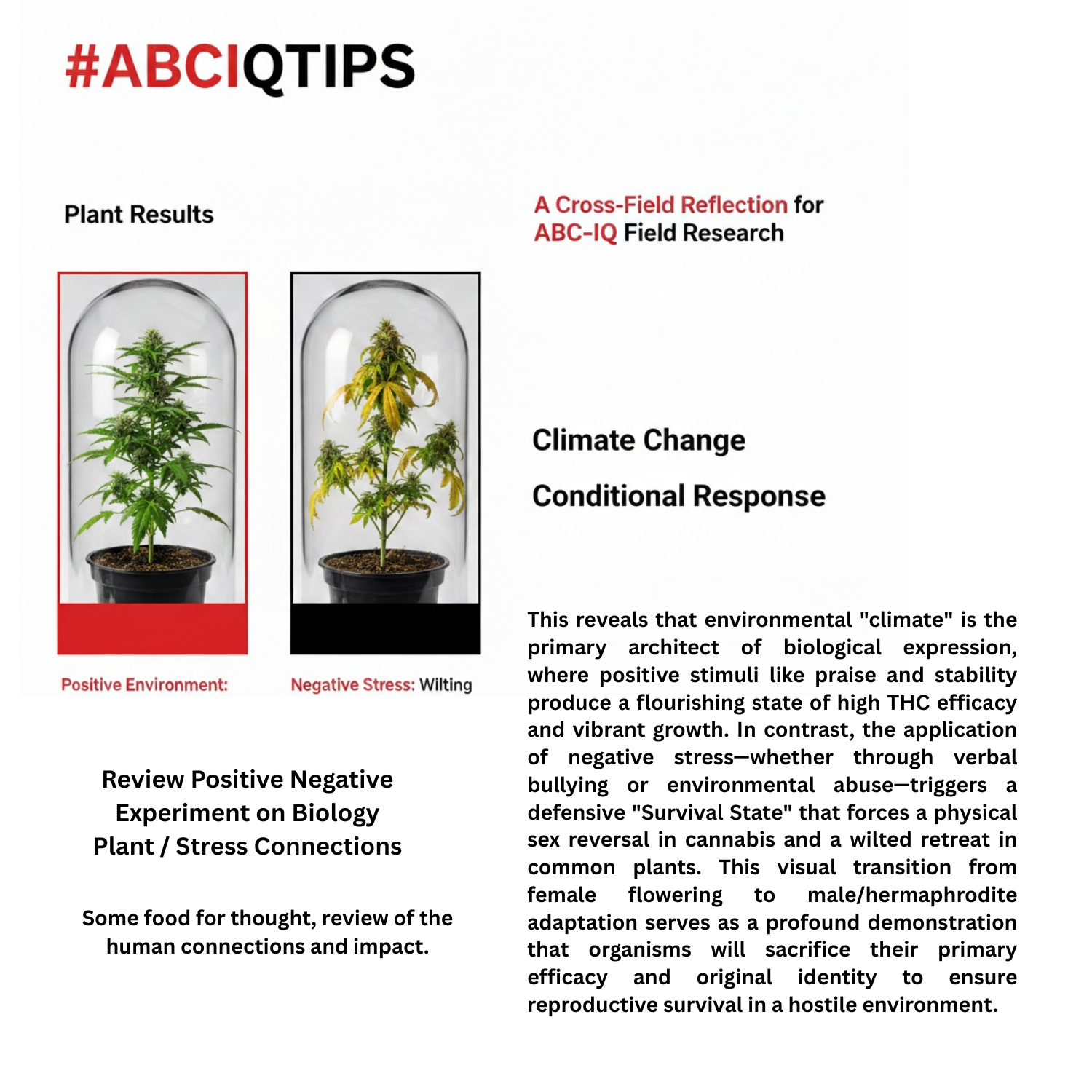
The IKEA "Bully a Plant" experiment (2018) serves as a vivid metaphor for this emotional ecology. By exposing two identical plants to different verbal climates—one receiving praise and the other aggression—the study demonstrated that the "bullied" plant wilted while the "praised" plant thrived. This echoes decades of research regarding plant sensitivity to vibration and environmental cues (Gagliano, 2013). This principle is most starkly visible in cannabis, a species that undergoes a survival-driven biological pivot known as hermaphroditism when exposed to excessive stress. Hermaphroditism is an adaptive response where a genetically female plant develops male reproductive organs to self-pollinate, intelligently sacrificing its primary efficacy—THC potency and flower quality—to ensure reproductive survival in a hostile climate (Pate, 1994).
The ABC-IQ Cross-Field Reflection synthesizes these findings to show that identity is fluid and responsive. In a "Positive Stimulus" phase, characterized by praise or environmental stability, organisms enter a "Flourishing State" where they prioritize the production of luxury outputs, such as high THC concentrations or vibrant foliage. Conversely, a "Negative Stimulus" phase, such as verbal bullying or nutrient shock, triggers a "Survival State." In this state, the IKEA plants exhibited physical decline to preserve moisture, while the cannabis plants underwent a physical sex reversal from female to male traits. This mirrors how human bodies under chronic stress shift hormonal balance and emotional expression (McEwen & Gianaros, 2011).
Ultimately, the transition from flourishing to survival demonstrates that the body expresses exactly what the environment demands. Masculine energetic patterns—associated with structural rigidity and reproductive urgency—emerge under stress to prioritize survival, whereas feminine patterns—associated with receptivity and creativity—require a climate of safety to flourish. As field research across various climates shows, as environments become more unstable, these defensive adaptations become more common (Rodriguez-Morrison et al., 2021). This insight suggests that if we desire healthier biological and social outcomes, we must design physical, emotional, and political environments that support nourishment and stability rather than forcing adaptation through chronic stress.
This challenges us to take radical responsibility for the "emotional climates" we broadcast as individuals and strangers. Our research confirms that we are never neutral actors; we are either donors of stability or donors of stress. When we carry ourselves with aggression or neglect, we act as a "Negative Stimulus" that forces the receiver into a defensive survival state. For the victim, this isn't just a bad mood—it is a physiological hijacking where their "interior" must reconfigure to survive the "exterior" hostility. Just as the cannabis plant sacrifices its flowering efficacy to become a hermaphrodite under stress, a human being on the receiving end of a toxic climate sacrifices their creativity, openness, and "feminine" receptivity to build a "masculine" armor of hypervigilance and rigidity.
To choose a positive carriage—or even the dignified absence of harm—is to act as a stabilizer for the collective ecology. Enlightenment begins when we recognize that our words and vibrations are literal environmental stressors that can trigger a "Biological Pivot" in others. When we "bully" a stranger or a plant, we are responsible for the resulting "Sex Reversal" or "Personality Shift" that occurs in them as a survival mechanism. We must decide: are we contributing to a world that allows others to flower in their true identity, or are we forcing them into a deformed survival mode where they must sacrifice their highest potential just to endure our presence? The results of our research are clear: we are the architects of each other’s biology.
The results of our research serve as a definitive review of the "Donor-Receiver" dynamic: "Ugly" behavior is a toxic climate that produces "ugly" biological results. The IKEA and Cannabis experiments prove that when we act as donors of verbal or environmental abuse, we are planting seeds of deformity. The victim on the receiving end has no choice but to adapt; they sacrifice their efficacy—their beauty, their potency, and their peace—to build the armor necessary to survive our presence. This experiment has demonstrated that the "hermaphroditic" shift in plants and the personality "wilting" in humans are direct evidence of a donor's failure to take responsibility for the energy they carry.
Taking responsibility means acknowledging that we are the primary architects of the world's "success" or "survival" mode. If we plant seeds of praise and stability, we harvest a flourishing state of high vitality. If we choose the "Negative Stimulus" of bullying, we must take ownership of the resulting wreckage: the seeded buds, the brown leaves, and the rigid, defensive personalities of those we have stressed. Enlightenment is the choice to be a stabilizing donor—to either provide a positive growth climate or to maintain a respectful absence of harm—allowing the biology of those around us to remain in its highest, most potent form.
As we continue our research on the therapeutic efficacy of THC CBD cannabis as medicine, we invite participants to provide feedback on use, establishing breed, strain and impact effectiveness for medical efficiency for data base manual collection.
Survey: New Frontiers of Cannabinol Pathic Medicine in Mind Science
Manual Data Base: Level 5 Data Collection
Pocket Doctor: Dose Guide TBA
Lessons learned: ABC-IQ Field Tests #abciqtips Magazine
Contact Us ABC-IQ Programs
Dr. Shelley D. Chuchmuch B,ED, MAED, Ph.D.
Faculty ABC-IQ University College Professor
Extension School Research Manual Residency
References
Gagliano, M. (2013). Seeing green: The revelation of plant communication. Trends in Plant Science, 18(7), 353–355.
IKEA. (2018). Bully a Plant [Public awareness campaign].
McEwen, B. S. (2007). Physiology and neurobiology of stress and adaptation: Central role of the brain. Physiological Reviews, 87(3), 873–904.
McEwen, B. S., & Gianaros, P. J. (2011). Stress- and allostasis-induced brain plasticity. Annual Review of Medicine, 62, 431–445.
Pate, D. W. (1994). Chemical ecology of Cannabis. Journal of the International Hemp Association, 1(2), 29–32.
Rodriguez-Morrison, V., Llewellyn, D., & Zheng, Y. (2021). Cannabis yield, potency, and cannabinoid profile are influenced by environmental stressors. Frontiers in Plant Science, 12, 646020.
Zandalinas, S. I., Mittler, R., Balfagón, D., Arbona, V., & Gómez-Cadenas, A. (2020). Plant adaptations to the combination of drought and high temperatures. Physiologia Plantarum, 165(1), 2–12.