
Water is one of the most important resources in agriculture and gardening. Whether you are managing a small backyard vegetable garden, maintaining a landscaped property, or operating a commercial farm, providing plants with the right amount of water is essential for healthy growth and productivity.
However, watering plants is not simply about turning on a tap or using a hose whenever the soil looks dry. Different plants, soil types, climates, and growing environments have different water requirements.
Choosing the wrong irrigation system can result in water wastage, uneven watering, poor plant development, increased maintenance costs, and unnecessary expenses.
On the other hand, selecting the right irrigation system can help you manage water more efficiently, reduce manual labour, support healthier plant growth, and improve agricultural productivity.
With increasing pressure on water resources, particularly in areas that experience seasonal droughts and irregular rainfall, efficient irrigation has become an important consideration for farmers, gardeners, and property owners.
But with several irrigation methods available, how do you know which one is right for your needs?
In this guide, we explore different irrigation systems, their advantages and disadvantages, the factors to consider before purchasing one, and practical tips for making the right investment.
Understand Your Watering Requirements First
Before purchasing an irrigation system, understand what you want to irrigate.
A system suitable for a small flower garden may not be appropriate for a large agricultural field.
Similarly, a vegetable farm growing leafy vegetables may require a different irrigation approach from an orchard containing mature fruit trees.
Start by considering the following:
- What type of plants or crops are you growing?
- How large is the area?
- How frequently do the plants require watering?
- What type of soil do you have?
- How much water is available?
- Is the area flat or sloping?
- What is your available budget?
- Do you need manual or automated irrigation?
Example
Imagine you have a small vegetable garden containing tomatoes, spinach, lettuce, and herbs.
Watering every plant individually with a hose may become time-consuming as the garden expands.
A drip irrigation system could be a more practical option because it delivers water directly to the root zones of plants.
However, if you are maintaining a large lawn, sprinklers may provide more convenient coverage.
The best irrigation system is the one that matches your plants, available resources, growing environment, and budget.
Understand the Different Types of Irrigation Systems
There are several irrigation methods used in agriculture and gardening.
Each has its own advantages, limitations, and ideal applications.
Let's examine some of the most common options.
Drip Irrigation System
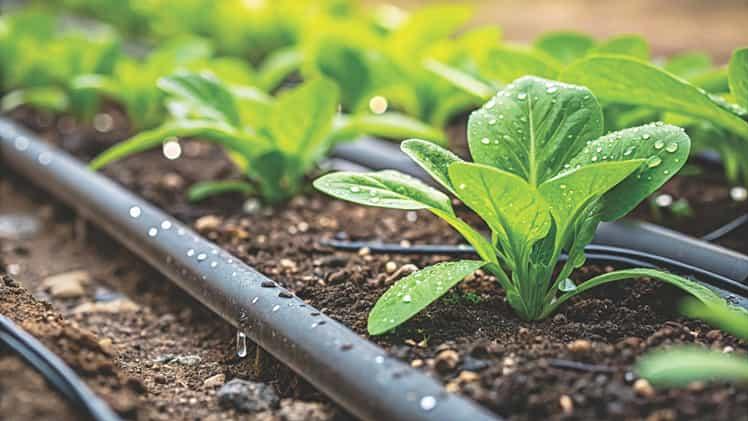
Drip irrigation is one of the most useful irrigation methods for vegetable gardens, orchards, greenhouses, and many agricultural applications.
It works by delivering water slowly and directly to the soil around plant roots through pipes, tubing, and small emitters.
Instead of spraying water over an entire area, the system targets individual plants or rows.
Advantages of drip irrigation:
- Delivers water close to plant roots.
- Can reduce evaporation and unnecessary water loss.
- Helps maintain more consistent soil moisture.
- Suitable for many vegetable crops.
- Can reduce weed growth between planted rows.
- Can be automated using timers and controllers.
- Useful in areas with limited water supplies.
Disadvantages:
- Emitters can become blocked.
- Filters require regular cleaning.
- Installation requires careful planning.
- Tubing and connections may need occasional replacement.
- Pressure must be managed correctly.
Best suited for:
- Vegetable gardens.
- Fruit trees.
- Greenhouses.
- Orchards.
- Raised garden beds.
- Agricultural crop production.
For many small-scale growers, drip irrigation is worth considering because it offers targeted watering and flexibility.
Sprinkler Irrigation System
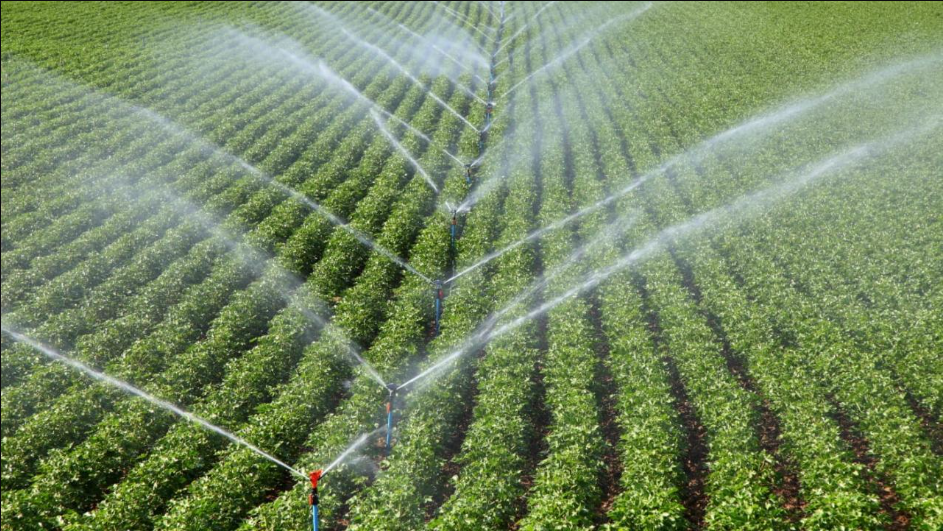
Sprinkler irrigation distributes water through pipes and sprays it into the air, allowing it to fall over plants and soil in a pattern similar to rainfall.
It is commonly used for lawns, agricultural fields, sports grounds, and larger garden areas.
Sprinkler systems come in different forms, including fixed sprinklers, rotating sprinklers, oscillating sprinklers, and travelling irrigation equipment.
Advantages:
- Can cover relatively large areas.
- Suitable for lawns and many crops.
- Can be automated.
- Provides relatively even coverage when properly designed.
- Useful for areas where individual plant watering would be difficult.
Disadvantages:
- Wind can affect water distribution.
- Some water may evaporate before reaching the soil.
- Poorly positioned sprinklers may waste water on pathways and buildings.
- Requires appropriate water pressure.
- Wet foliage may increase disease risks for certain crops under some conditions.
Best suited for:
- Lawns.
- Parks.
- Sports fields.
- Certain agricultural crops.
- Large garden areas.
If you manage a large lawn or open agricultural field, sprinkler irrigation may be a practical option.
Surface Irrigation
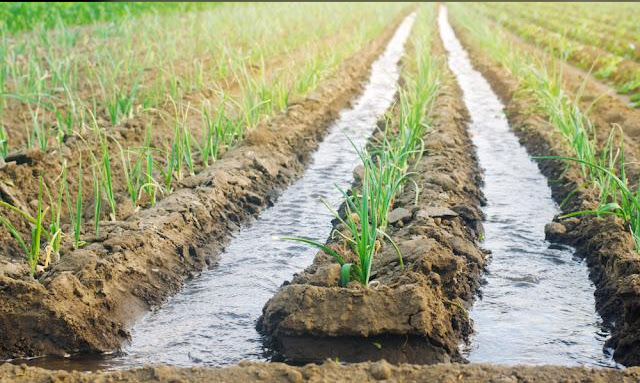
Surface irrigation is one of the oldest irrigation methods.
It involves allowing water to flow across the soil surface using gravity.
Water may be distributed through channels, furrows, or basins.
This method is commonly used in certain agricultural settings where the land, soil, and water supply are suitable.
Advantages:
- Relatively simple technology.
- Can have lower equipment requirements.
- Does not always require electricity.
- Suitable for certain field crops.
- Can be practical where land and water infrastructure already support it.
Disadvantages:
- Can result in uneven water distribution.
- May cause waterlogging.
- Requires appropriate land preparation.
- Can contribute to soil erosion.
- May involve considerable water losses if poorly managed.
Best suited for:
- Suitable agricultural fields.
- Certain row crops.
- Orchards using basin irrigation.
- Farms with appropriate land slopes and water availability.
Surface irrigation is not suitable for every farm. Soil infiltration, field slope, drainage, and water availability must be evaluated.
Micro-Sprinkler Irrigation
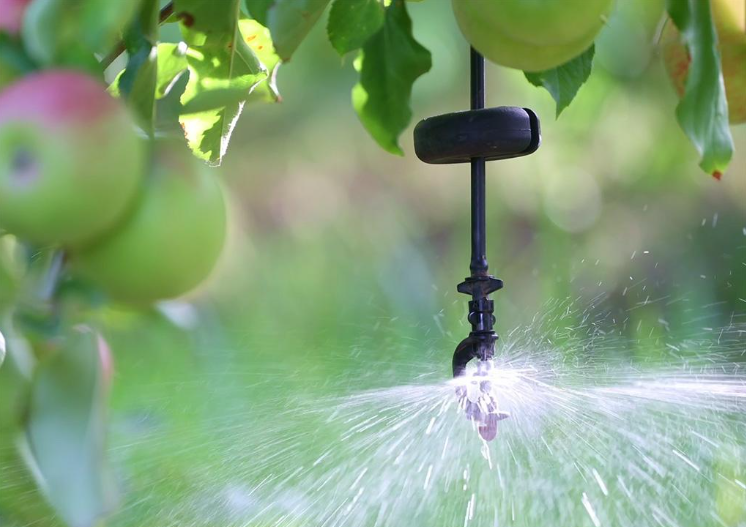
Micro-sprinklers distribute water over a relatively small area using low-flow sprinkler devices.
They are often installed around trees, shrubs, and certain agricultural crops.
Unlike conventional sprinklers that cover large areas, micro-sprinklers provide more localised watering.
Advantages:
- Suitable for orchards and tree crops.
- Can provide more controlled water distribution.
- Covers a wider soil area than a single drip emitter.
- Can be useful for nurseries.
- Can be automated.
Disadvantages:
- Wind can affect distribution.
- Nozzles may become blocked.
- Requires suitable pressure management.
- May wet foliage depending on the design.
Best suited for:
- Fruit trees.
- Orchards.
- Nurseries.
- Certain landscaped gardens.
- Selected agricultural applications.
Soaker Hoses
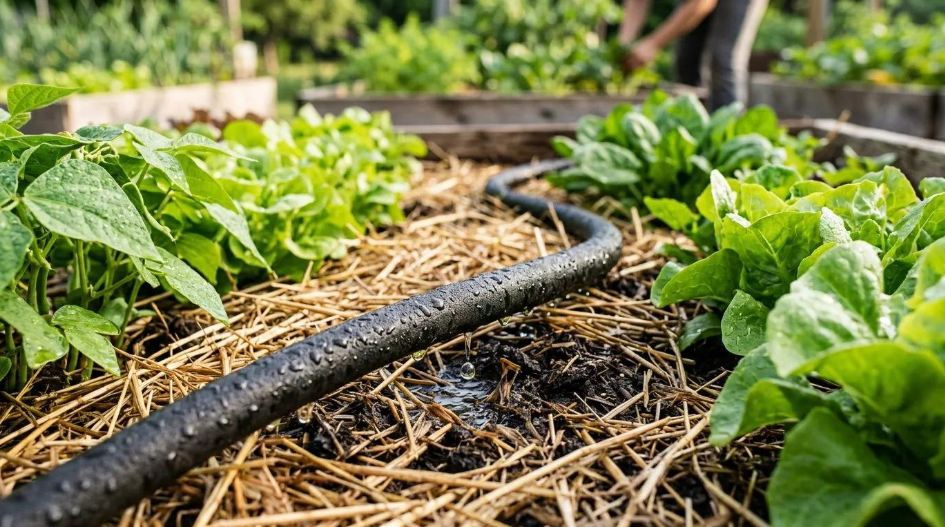
Soaker hoses are porous hoses that release water gradually along their length.
They are often placed around plants or along vegetable garden rows.
Water seeps through the hose into the surrounding soil.
Advantages:
- Relatively simple to install.
- Suitable for small gardens.
- Can reduce water reaching unwanted areas.
- Useful for garden beds and rows.
- Generally requires limited equipment.
Disadvantages:
- Water distribution may be uneven.
- Performance depends on pressure and hose condition.
- Can become blocked.
- Less suitable for very large areas without careful design.
Best suited for:
- Home vegetable gardens.
- Flower beds.
- Raised beds.
- Small growing areas.
Compare Irrigation Systems Before Making a Decision
Understanding the differences between irrigation systems makes it easier to identify the most appropriate option.
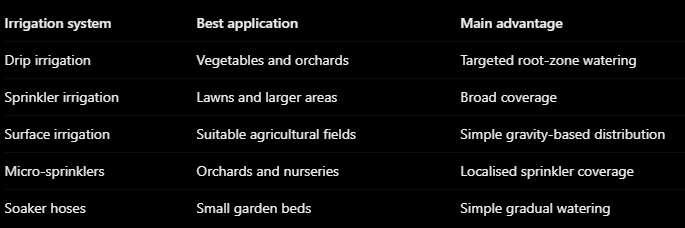
There is no single irrigation system that is best for every situation.
The final decision should consider water availability, soil conditions, crop requirements, installation costs, and maintenance.
Consider Your Soil Type
Soil type plays an important role in determining how water moves through the ground.
Different soils absorb and retain water differently.
Understanding your soil can help you choose an irrigation system that delivers water effectively.
Sandy Soil
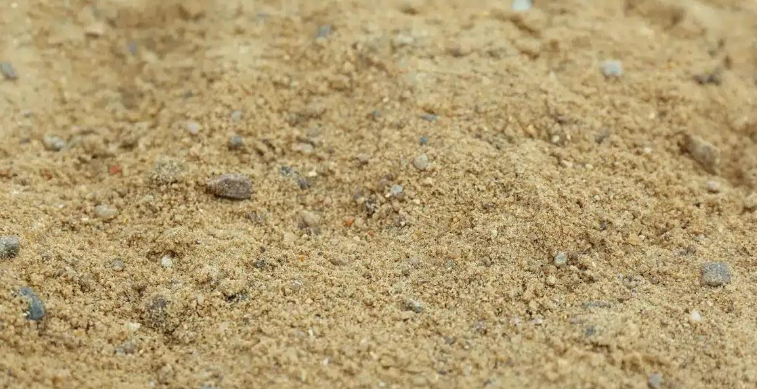
Sandy soil has relatively large particles and drains quickly.
Water may move through it faster than through clay soil.
This means plants growing in sandy soil may require more frequent irrigation, depending on their needs and the weather.
Drip irrigation can be useful because it allows water to be delivered gradually around the root zone.
Clay Soil
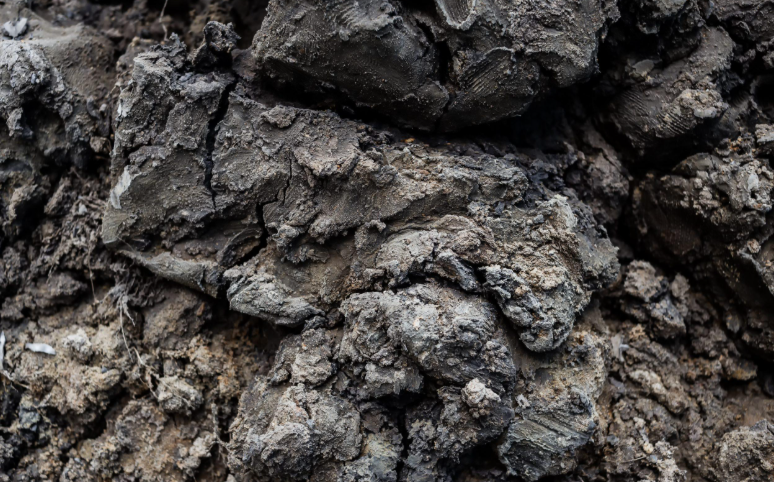
Clay soil contains fine particles and generally retains water for longer.
However, water may infiltrate slowly.
Applying too much water too quickly can result in waterlogging and runoff.
Lower application rates and carefully managed irrigation intervals may be more appropriate.
Loamy Soil
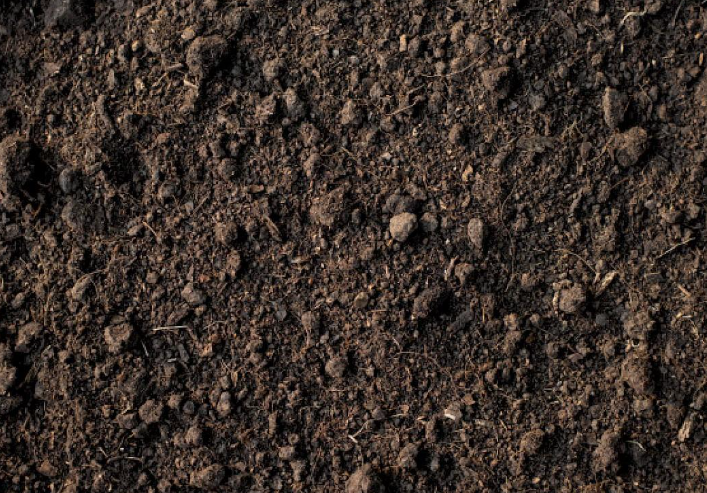
Loamy soil generally contains a mixture of sand, silt, and clay.
It often provides a good balance between drainage and moisture retention.
Many irrigation systems can work well in loamy soil when properly designed.
Practical tip: Don't assume that every section of your property has the same soil characteristics. Conduct soil checks before planning irrigation across a large area.
Consider the Size of Your Farm or Garden
The size of your growing area can influence the type of irrigation system you need.
Small Home Gardens
For a small garden, consider:
- Drip irrigation kits.
- Soaker hoses.
- Small sprinklers.
- Manual watering systems.
These options are generally easier to install and manage.
Medium-Sized Gardens
For larger residential gardens or small farming projects, consider:
- Drip irrigation networks.
- Micro-sprinklers.
- Automated sprinkler systems.
- Multiple irrigation zones.
Dividing the garden into zones can help you manage different plant watering requirements.
Large Agricultural Farms
Larger agricultural operations may require:
- Drip irrigation networks.
- Centre pivot systems.
- Large sprinkler systems.
- Furrow irrigation.
- Automated irrigation controllers.
For large installations, professional irrigation planning is advisable.
The system must account for water demand, pump capacity, pipe sizing, pressure, crop requirements, and the size of the area.
Check Your Water Source and Availability
Before installing an irrigation system, understand where your water will come from.
Possible sources include:
- Municipal water.
- Boreholes.
- Dams.
- Rivers, where lawful abstraction is permitted.
- Rainwater harvesting.
- Stored water tanks.
Each source has different considerations.
For example, borehole water may require testing to determine its suitability for irrigation.
Water from certain sources may contain sediment, salts, or other materials that affect crops and irrigation equipment.
If you use a tank, consider whether it can supply sufficient water at the required flow rate.
You should also investigate any applicable water-use permissions and restrictions.
Important: A suitable irrigation system cannot compensate for an unreliable or inadequate water supply. Assess the available water before investing in equipment.
Understand Water Pressure and Flow Rate
Water pressure and flow rate are two important factors when selecting an irrigation system.
They are related, but they are not the same.
Water pressure describes the force that pushes water through pipes and irrigation equipment.
Flow rate describes the volume of water delivered over a specific period.
For example, an irrigation system may require a particular pressure to operate sprinklers effectively.
If the available pressure is too low, the sprinklers may not distribute water properly.
If the pressure is too high, it can damage pipes, fittings, or emitters.
Before purchasing irrigation equipment, check the manufacturer's pressure and flow requirements.
For larger systems, a qualified irrigation professional can help determine the appropriate pump, pipe sizes, and pressure regulation.
Think About Automation and Smart Irrigation
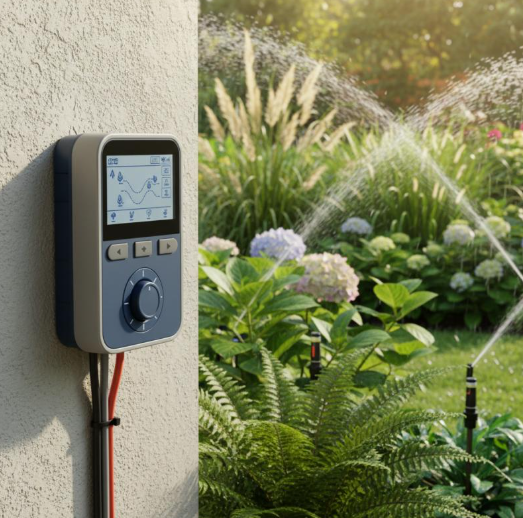
Technology has made irrigation management more convenient.
Automated irrigation systems use controllers, timers, sensors, and sometimes weather information to manage watering schedules.
Instead of manually switching the system on and off, users can programme irrigation to operate at selected times.
Common automation options
Irrigation timers
Allow you to schedule when watering starts and stops.
Soil moisture sensors
Measure soil moisture and can help determine when irrigation is needed.
Rain sensors
Can prevent certain irrigation systems from operating when rainfall is detected.
Smart irrigation controllers
Some systems use weather information, schedules, and sensor data to adjust watering.
Benefits of automated irrigation
- Reduces manual labour.
- Makes watering schedules easier to manage.
- Can help avoid unnecessary watering.
- Supports consistent irrigation.
- Useful for larger gardens and farms.
However, automation does not mean you can forget about your irrigation system.
Sensors need checking, filters require cleaning, and watering schedules must be adjusted when conditions change.
Consider Installation and Maintenance Costs
The purchase price is only one part of the total irrigation investment.
A system that appears affordable initially may become expensive if it requires frequent repairs, high electricity consumption, or specialised maintenance.
Before purchasing, calculate:
- Equipment costs.
- Pipes and fittings.
- Filters.
- Pumps.
- Controllers and sensors.
- Installation labour.
- Electricity.
- Water costs.
- Maintenance.
- Replacement components.
Example
Imagine you want to install irrigation for a small vegetable farm.
You could purchase a basic drip irrigation kit, but you may also need filters, connectors, a suitable water source, and a pressure regulator.
Failing to budget for these additional components could result in an incomplete or poorly functioning system.
A proper budget should consider the entire installation rather than only the advertised equipment price.
Choose an Irrigation System That Matches Your Crops
Different crops have different watering requirements.
Some plants have shallow root systems, while others develop deeper roots.
Some crops need relatively consistent moisture, while others are more sensitive to excessive watering.
Consider these examples:
Crop or plant
Irrigation option to consider
Tomatoes
Drip irrigation
Lettuce
Drip or suitable sprinkler irrigation
Spinach
Drip or sprinkler irrigation
Fruit trees
Drip or micro-sprinklers
Lawns
Sprinkler irrigation
Herbs
Drip irrigation or soaker hoses
Certain field crops
Drip, sprinkler, or suitable surface irrigation
These are starting points rather than fixed rules. The best method depends on climate, soil, crop variety, planting arrangement, and production practices.
Plan for Water Conservation
Water conservation should be part of your irrigation strategy from the beginning.
You don't need to wait until water becomes scarce to start managing it responsibly.
Here are practical ways to reduce unnecessary water consumption.
Water at suitable times.
Early morning is often a good time for irrigation because evaporation may be lower than during the hottest part of the day.
Use mulch.
Mulching helps reduce evaporation and can improve soil moisture retention.
Repair leaks immediately.
A leaking connection can waste water continuously.
Avoid overwatering.
More water does not necessarily mean healthier plants.
Monitor soil moisture.
Use observation or suitable moisture-measuring tools to guide watering.
Group plants with similar water requirements.
This makes irrigation scheduling easier.
Maintain filters and emitters.
Blocked equipment can cause uneven water distribution.
Consider rainwater harvesting.
Where practical, collected rainwater can supplement other irrigation sources.
These practices can improve water management while supporting healthy plant growth.
Common Irrigation Mistakes to Avoid
Even a good irrigation system can perform poorly when it is incorrectly installed or managed.
Avoid these common mistakes:
- Purchasing equipment without measuring the growing area.
- Ignoring soil type and drainage.
- Installing sprinklers without checking coverage.
- Using insufficient pipe sizes.
- Ignoring water pressure requirements.
- Failing to install appropriate filtration.
- Overwatering plants.
- Using one watering schedule for every crop.
- Neglecting regular maintenance.
- Failing to check for leaks.
- Installing equipment without considering future expansion.
- Ignoring local water restrictions and requirements.
A properly designed system should be practical, efficient, and suitable for the environment in which it will operate.
Which Irrigation System Should You Choose?
Let's simplify the decision.
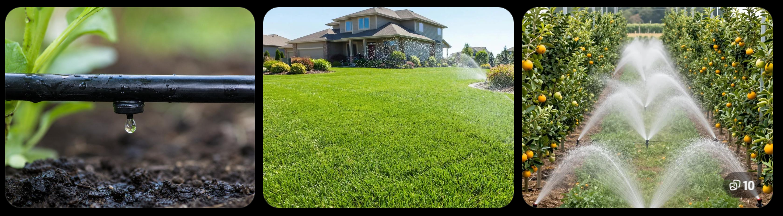
- For a small vegetable garden: Consider drip irrigation or soaker hoses.
- For a large lawn: Consider a properly designed sprinkler system.
- For fruit trees: Consider drip irrigation or micro-sprinklers.
- For a greenhouse: Drip irrigation is often a suitable option.
- For a large agricultural field: Evaluate drip, sprinkler, surface, or mechanised irrigation according to the crop and field conditions.
- For water-conscious gardening: Consider targeted irrigation, soil moisture monitoring, and mulching.
The right choice is not necessarily the most expensive or technologically advanced system. It is the one that meets your requirements without creating unnecessary costs.
How Agric Garden Buddy Can Help
Choosing an irrigation system is an important step towards managing your garden or agricultural project more effectively. However, selecting equipment is only part of the process. Understanding how to use it, maintain it, and integrate it into your growing environment is equally important.
Agric Garden Buddy focuses on providing practical solutions across agriculture, gardening, landscaping, training, and agricultural and garden products.
Whether you're a homeowner, gardening enthusiast, small-scale farmer, or someone developing a larger agricultural project, Agric Garden Buddy offers several areas of support.
1. Agricultural and Garden Products
The right equipment and tools can make irrigation and garden management easier.
Explore Agric Garden Buddy's agricultural and garden products to find solutions that support your growing, maintenance, and landscaping activities.
2. Training and Skills Development
Understanding irrigation, plant requirements, soil management, and agricultural practices can help you make better decisions.
Agric Garden Buddy focuses on training opportunities that help people develop relevant agricultural, gardening, and landscaping knowledge.
3. Landscaping Services
Irrigation is also an important consideration in landscaping projects.
Whether you're improving an existing garden or planning a new outdoor environment, appropriate landscaping can help create a functional and attractive space.
4. Garden Maintenance
An irrigation system needs regular inspection to remain effective.
Agric Garden Buddy also offers garden maintenance services to help customers care for their outdoor spaces and maintain attractive, healthy gardens.
5. Agricultural Solutions
Beyond residential gardening, Agric Garden Buddy has a broader agricultural focus, supporting people interested in farming, growing, and developing practical agricultural projects.
Ready to improve your garden or agricultural project?
Visit the official Agric Garden Buddy website to explore agricultural and garden products, training, landscaping services, garden maintenance, and other available solutions.
Final Thoughts
Choosing the best irrigation system for your farm or garden is an investment in efficient water management, plant health, and long-term productivity.
Whether you choose drip irrigation, sprinklers, micro-sprinklers, soaker hoses, or surface irrigation, the important thing is to understand your specific requirements before making a purchase.
Consider your soil, crop type, available water, property size, budget, and maintenance requirements.
Most importantly, remember that installing an irrigation system is only the beginning. Regular monitoring, proper maintenance, and adjustments according to weather and plant requirements are essential for achieving good results.
You don't need to start with an expensive or complicated system. Begin with what your garden or farm requires, learn how to manage it properly, and expand as your needs grow.
Good irrigation is not about using more water. It is about making every drop count.
Comments ()