

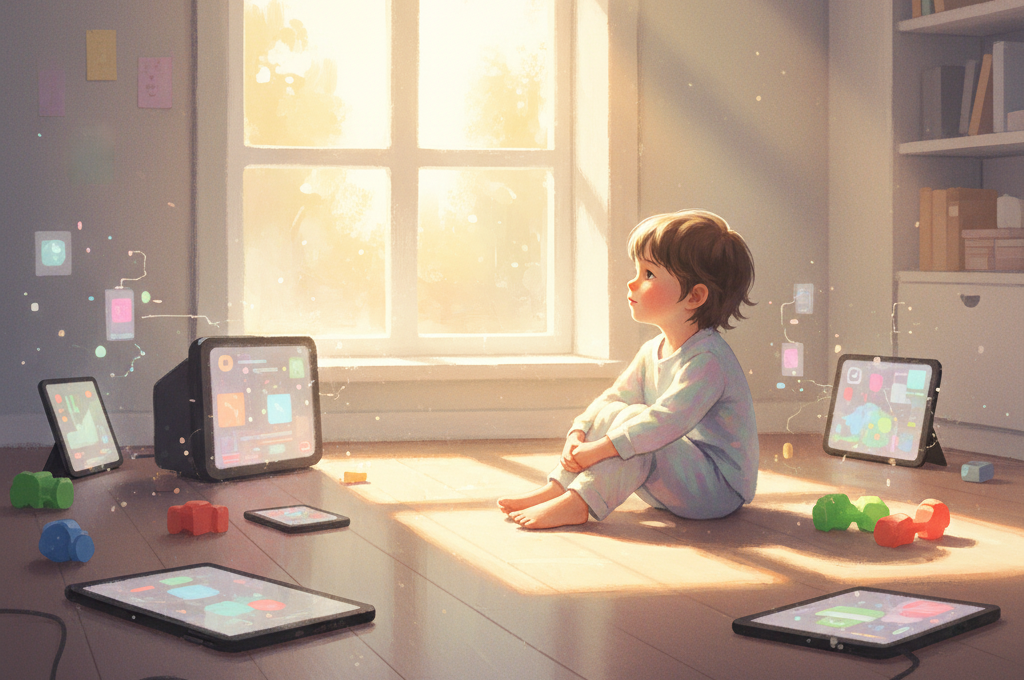
The room is quiet, yet the faint hum of screens fills the air. A child scrolls through a cascade of colors and sounds, their eyes wide but distant. What looks like curiosity is often exhaustion in disguise. Many parents mistake this constant engagement for learning, unaware that the very stimulation meant to enrich childhood may, in excess, quietly drain it.
Overstimulation happens when a child’s senses or emotions are flooded with more input than they can process. Too many activities, too much noise, or an overload of digital content can send their young nervous systems into overdrive. Neuroscientists explain that while stimulation builds brain connections, recovery time — quiet moments, boredom, rest — is what allows those connections to settle and grow. Without that balance, the mind stays restless, and emotions lose their steady ground.
Research from the American Academy of Pediatrics suggests that children today experience sensory and cognitive input at levels far beyond what earlier generations faced. Rapid editing in videos, flashing lights, and the instant rewards of digital play can train the brain to expect constant novelty. Over time, this can make real-world experiences — reading, nature walks, or simply waiting — feel dull. The result isn’t laziness but neurological fatigue, a state where calm feels impossible.
Parents often recognize the symptoms without naming the cause: a child who melts down after school, refuses bedtime, or seems both wired and tired. These are not just behavioral issues but signs of an overwhelmed nervous system. The brain’s stress response, meant for short bursts of excitement, gets stuck in the “on” position. What follows is irritability, anxiety, or sudden withdrawal — a quiet cry for stillness.
Ironically, our best intentions can fuel the problem. We enroll children in endless activities, thinking more exposure means more opportunity. We fill quiet hours with devices to “keep them learning.” Yet children do not thrive on constant stimulation — they thrive on meaningful stimulation. A slower rhythm allows curiosity to deepen and attention to mature.
Creating that rhythm doesn’t require abandoning modern life. It simply means making space for calm. Families can start small: setting screen-free evenings, embracing boredom, or taking unhurried walks together. As psychologist Dr. Dan Siegel reminds us, “Boredom is not the absence of stimulation — it’s the presence of possibility.” In that space, imagination awakens again.
The hidden cost of overstimulation isn’t visible in test scores or routines — it’s seen in the subtle loss of wonder, patience, and peace. When we protect moments of quiet, we give children back the gift of awareness. They learn to listen, to focus, to be comfortable with stillness — skills that form the foundation of emotional intelligence.
Pause with your child today. Step away from the noise, even for five minutes. Watch how calm returns like sunlight through clouds — gentle, steady, and exactly what their growing hearts need. [[Cognify Kids]]
Comments ()