

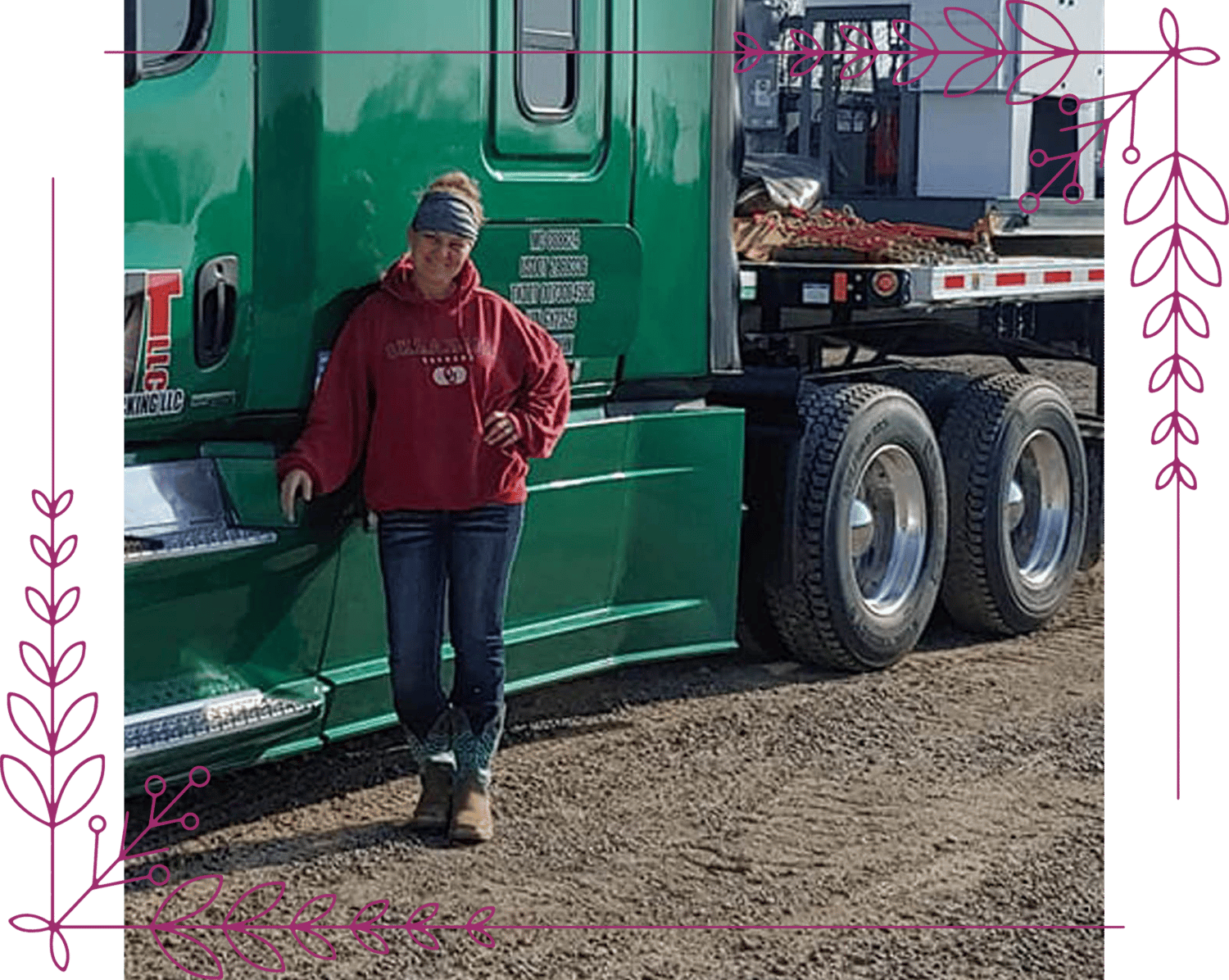
A STORY OF A DEAF COMMERICAL TRUCK DRIVER
Kerri Wright is a true pioneer in the deaf community in the state of Oklahoma. She is the first deaf female truck driver to obtain a CDL license in the state which enables her to be a truck driver, an ideal career for a person who loves freedom and independence in daily life activities. This is a viable career where her strengths and talents could be used. Indeed, Kerri has always had the desire to function normally in a world that is comprised mainly of hearing people. Hence, the path to obtaining a CDL license was not an easy one. It would require all the dedication, energy, and focus that Kerri would ever had to put forth. In addition to this, it took Kerri nearly 1 ½ years to finally obtain her CDL endorsement.
Kerri was born east of Fort Worth, Texas as a premature baby, weighing at 4 pounds and 3 ounces. Added to the delicate situation of being a premature baby, she yet encountered another life-altering event at 18 months of age. She contracted a form of meningitis (hymophelous influenza) which was detected after a visit to the doctor. It took all but 5 minutes for Kerri to be transported to the emergency room and do a spinal tap procedure. The doctor’s quick action saved her life, but left her deaf. The cilia in the inner ear (cochlea) were stripped and left her with almost no hearing. It would take many years before she would be able to successfully negotiate her path in the world.
Despite her hearing loss, Kerri’s intelligence was evident early in her childhood. Her mother and she would learn sign language together, and engage in many activities that helped develop Kerri’s sense of language (I.e. pieces of paper with the name of an object would be taped to various furniture items in the house). All she needed as a young girl was a nudge, and she took off. Her mother lovingly says “After a while, I couldn’t keep up with her!”
Kerri moved to the great state of Oklahoma at the age of 13. She attended mainstream schooling, and was successful as a student. She became fluent in PSE (Pidgin Sign English-a form of ASL with strong English grammatical structure) and English. Upon graduation, she was accepted to the prestigious National Technical Institute for the Deaf, at Rochester Institute of Technology in Rochester, NY. She discusses how the process of obtaining an education at Rochester Institute of Technology’s National Technical Institute for the Deaf and seeking employment was something of a challenge, due to her deafness and how the world was structured for the mainstream hearing population.
Upon graduation from RIT/NTID, she faced struggles in obtaining a well-salaried career position, commensurate with her education and experience. Kerri was often forced to choose less-paying jobs (data entry, clerical work, customer service representative, etc.). Just because she could not hear as well as others. She saw people without a college degree being promoted left and right. Despite the struggles, she was determined to present herself as an asset to whatever company she worked for.
For years, she had a great deal of difficulty finding employment that would be specifically tailored to her educational background, while accepting low-paying jobs; she struggled with upward mobility in terms of advancement and going into administration/management. Kerri decided she had enough after twenty years of data entry/clerical work/customer service representative and knew that a change was necessary.
Kerri also added that one career she had always found attractive and practical: truck driving/transportation. Already an excellent driver with a regular driving license, she proceeded to do some investigation into the labor requirements, etc. She was dismayed to find out that Deaf/HOH people were absolutely forbidden to possess a CDL license. She shared this with her husband, Tom Wright, who had seen a video online of a deaf trucker who had received their CDL and told her she should check into getting her CDL. She credits him with supporting and encouraging her to join along with him. When she discovered that a law was passed allowing Deaf/HOH to have CDL licenses in 2013, she did not hesitate to proceed.
Indeed, Kerri expresses a sense of deep gratitude for the support of her husband, Tom Wright for the enormous amount of support and encouragement. Tom has been in the Trucking Industry for over twenty-six years and has mostly worked in the oilfield hauling various-sized loads. She also goes on to thank the people that helped train her for the career path. In terms of training, Kerri wants to thank Ricky Davis, the instructor at Central Tech in Drumright, Oklahoma. He took the time, patience, and opportunity to learn basic sign language, in order to effectively train Kerri in all things related to the equipment handling and operations (I.e. practice on 90-degree backing from backing up all around on the eye drop and wagon wheel roads, and various essential knowledge items) and Tyrone Thiede, the another instructor. A sign language interpreter, Margaret Dodd, was dedicated to Kerri’s training schedule, and Sherry Lynn Fisher, another sign language interpreter. There are many others that Kerri wishes to thank. They are as follows: Jimmy Mitchell who is the DRS/Vocational Rehabilitation counselor in Oklahoma City; Doug MacMillan, the State of Oklahoma Director of Disability Services, John Thorpe, the Director of Central Tech, and her fellow truckers from DTU (Deaf Truckers United) who fought for this piece of legislation in the United States of America.
It is in Kerri’s sincerest hopes that this story will inspire other Deaf/HOH people who are considering some careers that may have been inaccessible to Deaf/HOH people in the past. “Work hard and NEVER give up! Don’t ever let someone tell you that you can’t do something you can do whatever you set your mind to! DREAM BIG!” she says.
Kerri now has partnered with her husband, Tom Wright as a team driver at their own company “Get Wright Trucking LLC” and is hard at work learning more about the transportation industry, such as booking loads, billing, safety, and much more. It is a lot of hard work.
By: Joshua William Dowling Cassell