
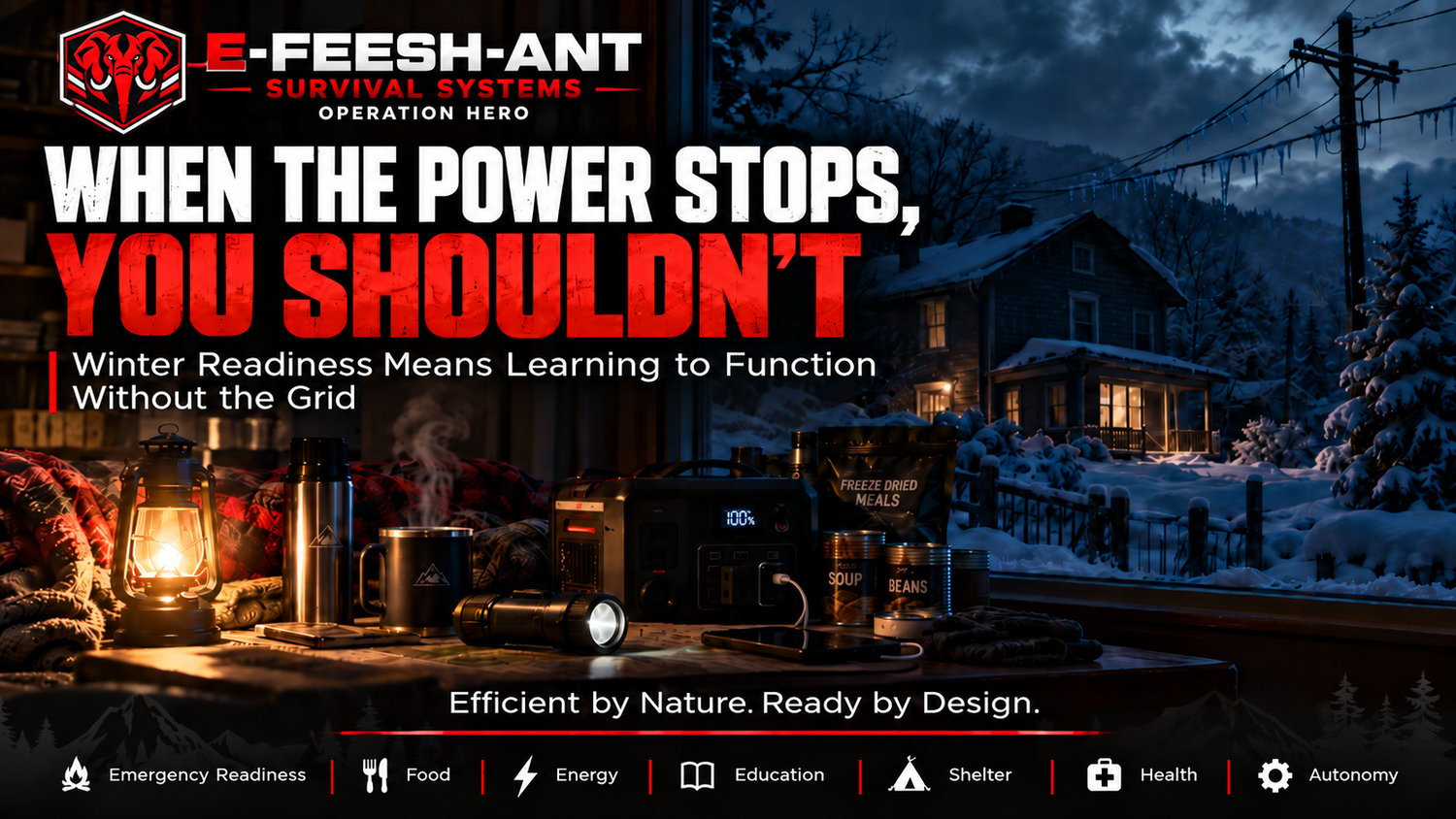
Winter Readiness Means Learning to Function Without the Grid
E-FEESH-ANT Survival Systems
Efficient by Nature. Ready by Design.
Winter has a way of exposing weak systems.
Ice coats power lines. Snow blocks roads. Transformers fail. Wind knocks trees down. Suddenly the lights are gone, the furnace stops, phones start losing battery, and a household that was comfortable an hour ago has to figure out what happens next.
That is exactly why preparedness cannot mean simply owning more things that require electricity.
A generator is useful. A power station is useful. Solar panels are useful. Battery banks are useful.
But none of them should be your only plan.
Real preparedness means building layers.
THE GRID SHOULD BE A CONVENIENCE — NOT YOUR LIFELINE
Most modern homes depend on electricity for nearly everything:
Heating.
Cooking.
Lighting.
Communication.
Entertainment.
Water systems.
Medical equipment.
Security systems.
That convenience becomes vulnerability when there is no backup method.
E-FEESH-ANT preparedness asks a different question:
“If the power disappeared tonight, what could my household still do?”
Could you stay warm?
Could you cook?
Could you safely light your home?
Could you get information?
Could you charge essential equipment?
Could you access drinking water?
Could you function for 24 hours?
Three days?
A week?
Those questions expose the difference between owning emergency equipment and actually having a resilient household.
1. LEARN TO STAY WARM WITHOUT ELECTRIC HEAT
Your first defense against winter is not a generator.
It is insulation.
Blankets. Layered clothing. Sleeping bags. Thermal curtains. Weather stripping. Closing unused rooms. Blocking drafts. Keeping everyone together in a smaller portion of the house.
The less heat you lose, the less energy you need to replace.
That principle is pure E-FEESH-ANT:
Reduce the requirement before increasing the supply.
Never use grills, charcoal burners, outdoor heaters, or generators inside your home or garage. Carbon monoxide can kill without warning. Keep working carbon-monoxide alarms in the home and use combustion-based equipment only as directed by the manufacturer.
2. HAVE LIGHT THAT DOESN’T DEPEND ON AN OUTLET
Keep multiple independent lighting options.
Battery lanterns. Flashlights. Headlamps. Rechargeable lights. Solar-charged lights.
A headlamp deserves special mention because it leaves both hands free while you are cooking, repairing something, assisting someone medically, or moving through a dark house.
Candles may provide emergency light, but they introduce a fire hazard. Battery lighting is generally the safer primary option.
3. YOUR FOOD PLAN SHOULD WORK COLD
An emergency food supply shouldn't require an electric stove before you can eat it.
Keep foods that can be eaten immediately or prepared with minimal heat:
Canned foods. Nut butters. Crackers. Protein bars. Dried fruit. Shelf-stable milk. Tuna or chicken packets. Ready-to-eat meals.
Then build an alternate cooking method appropriate for your situation.
The goal isn't gourmet dining during an outage.
The goal is being able to say:
“We can eat whether that outlet works or not.”
4. WATER COMES BEFORE ALMOST EVERYTHING ELSE
Electricity and water systems are more connected than people realize.
Private wells may stop pumping. Municipal systems can experience disruptions. Frozen pipes create another problem entirely.
Store drinking water before the emergency happens.
Then learn how your home gets water and what happens to that system during a power failure.
Preparedness means understanding the system, not just buying supplies.
5. DON'T BET EVERYTHING ON ONE BATTERY
Phones are incredible survival tools.
Until the battery says 2%.
Have multiple ways to receive information and communicate.
A charged phone. Power banks. Vehicle charging capability. Battery or hand-crank emergency radio. Written emergency numbers. A family communication plan.
And conserve power early.
Don't wait until you're nearly dead to switch into emergency mode.
When an outage begins, lower screen brightness, turn off unnecessary connections, close background apps, and use the phone primarily for necessary communication and information.
6. BUILD ENERGY REDUNDANCY
The answer isn't abandoning technology.
The answer is redundancy.
Grid power.
Battery storage.
Solar charging.
Vehicle charging.
Generator power where appropriate.
Manual alternatives.
None of those systems is perfect.
Together, they create resilience.
Your emergency plan should resemble a ladder. If the first rung breaks, you move to the next one instead of falling to the ground.
7. PRACTICE BEFORE WINTER PRACTICES ON YOU
Here's an E-FEESH-ANT challenge:
Turn the main lights off for one evening.
Don't use your stove, microwave, television, or wall chargers.
Then observe what happens.
What did you immediately reach for?
What couldn't you find?
Which batteries were dead?
What did the kids need?
What became difficult?
What would become dangerous after 12 hours?
That little experiment will teach you more about your household's vulnerabilities than another shopping trip ever will.
Preparedness isn't just equipment.
Preparedness is capability.
THE E-FEESH-ANT PRINCIPLE
Emergency readiness does not mean rejecting modern infrastructure.
It means refusing to become completely dependent upon it.
Use electricity.
Use technology.
Use the grid.
But build the knowledge, supplies, systems, and discipline necessary to function when those conveniences disappear.
Because winter doesn't care how advanced your house is.
When the lights go out, the question becomes very simple:
Can your household continue operating?
That is what readiness looks like.
That is what self-sufficiency begins to look like.
And that is why we prepare before the emergency — not during it.
E-FEESH-ANT Survival Systems
Efficient by Nature. Ready by Design.
Emergency Readiness • Food • Energy • Education • Shelter • Health • Autonomy