

We’ve become exceptionally good at collecting people.
Once it was business cards after conferences and industry events.
Now it’s LinkedIn connections, Instagram follows, email addresses, QR codes, group chats, and contact lists. The technology changed, but the assumption stayed largely the same: the more people you know, the stronger your network must be.
After more than 20 years across publicity, media, publishing, entertainment, events, and entrepreneurship, I’ve learned that the math doesn’t work quite that way. You can know hundreds of people and still have very few meaningful professional relationships.
A contact tells you how to reach someone.
A relationship tells you something about what has been established between you.
That distinction matters.
The Introduction Is Only the Beginning
Meeting someone is easy. Building enough trust for your name to mean something when you aren’t present takes considerably more. It happens through consistency, and follow through.
You remember what people are building.
You share useful information.
You support good work.
You make an introduction when it makes sense.
You stay connected even when you don’t have a launch, request, pitch, or favor attached to the conversation.
Over time, people learn more than your name. They learn how you work.
That’s where professional equity begins.
I’ve seen people become so focused on “networking up” that every new introduction is immediately evaluated by one question: What can this person do for me?
That approach may produce a long contact list, but it rarely produces the kind of trust that moves careers.
People know when they’re being treated like a doorway.
The Room Cannot Work If Everyone Comes to Take
Everybody wants access. We want introductions, information, exposure, referrals, clients, partnerships, resources, and opportunities. and there’s nothing wrong with wanting those things. But imagine a room full of people who all arrive wanting something and nobody brings anything. Nobody shares what they know. Nobody makes an introduction. Nobody offers perspective, points another person toward an opportunity. Nobody contributes expertise. That room eventually becomes useless.
The strongest professional environments work differently because the people inside help create the value they came looking for.
The photographer brings visual expertise. The publicist understands media. The producer knows production. The entrepreneur understands business. The editor understands story. Someone has experience in a market another person is trying to enter. Someone else has already made the mistake another member is about to make and can save them six months of frustration.
Now the room has intelligence.
That is far more valuable than a directory of names.
Reciprocity Is Not Keeping Score
Contribution doesn’t mean turning every interaction into an exchange ledger.
“I shared yours, so you should share mine.”
“I referred somebody to you, so now you owe me a referral.”
That’s still transactional. It just has better manners.
Healthy professional ecosystems allow value to circulate without requiring every exchange to come back immediately, equally, or from the same person.
You may introduce two people today and receive nothing from it. Months later, someone else may remember your expertise when an opportunity surfaces. Another member may share information that saves you money. A conversation may lead to a collaboration nobody anticipated when everyone first met.
That is the beauty of a strong ecosystem.
Everything doesn't have to travel in a straight line.
Make Sure People Know More Than Your Name
Here’s one of the simplest tests of a professional circle:
If someone heard about an opportunity that fit you perfectly, would they know enough about your work to think of you?
That’s a better measure than how many contacts are stored in your phone.
If you’re an artist, can people describe your sound and what you’re currently building?
If you’re an entrepreneur, do they understand the problem you solve?
If you’re a photographer, producer, author, consultant, publicist, or designer, do the people around you understand where your expertise fits?
Opportunities often begin with a very ordinary question:
“Do you know someone who can…?”
You want your work, professionalism, and reputation to have been communicated clearly enough that somebody can connect your name to the need. And when they do, remember what’s happening.
They aren’t simply passing along your phone number. They’re putting some of their own credibility behind the introduction.
Handle it accordingly.
Become Valuable Beyond What You Sell
Some of the most influential people I’ve encountered throughout my career weren’t necessarily the loudest or most visible people in the room. They were connectors.
They listened closely enough to know what people did. They remembered who needed what. They understood where expertise lived. They could hear one person describe a problem and immediately think of someone else who could help.
Their value wasn’t based entirely on what they sold.
It was also based on what moved because they were present.
That’s a different kind of professional influence.
It shifts the question from “Who here can help me?” to “What becomes possible because we know one another?”
Now we’re talking about something much bigger than networking.
We’re talking about community.
From the Publisher’s Table
This is the philosophy behind The INDIE Exchange.
I’m not interested in creating another digital space where people drop links, promote themselves, collect names, and disappear until they need something.
There are already plenty of places for that. I want a room where an artist can meet someone who understands media. Where an entrepreneur can encounter a creative collaborator. Where someone can share an opportunity, ask an intelligent question, make an introduction, learn from another person’s experience, or become the connection somebody else needed.
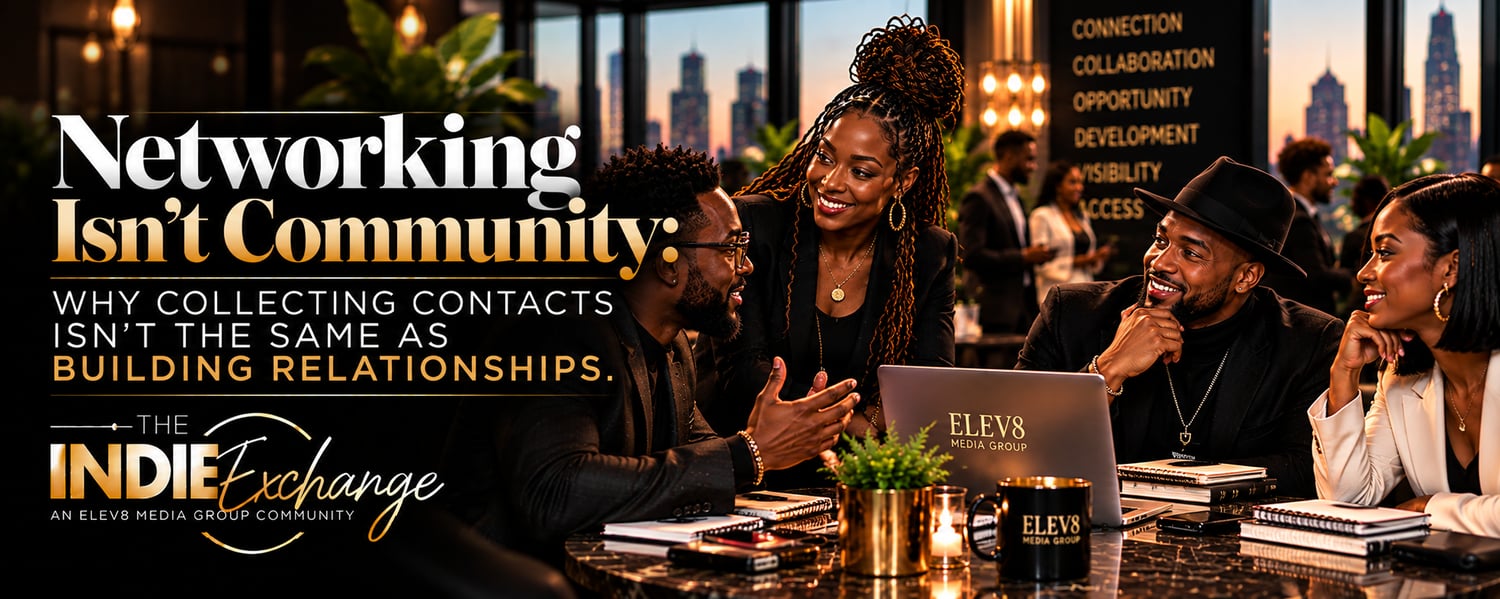
That’s why Connection, Development, Visibility, and Access sit at the center of The INDIE Exchange.
They’re designed to work together. Because the real value of a professional community isn’t simply how many people are inside it.
It’s what becomes possible because those people are connected.
You don’t need another contact list.
You need the right room.
The INDIE Exchange is an ELEV8 Media Group community for independent artists, creatives, entrepreneurs, media professionals, and industry-minded builders ready to build beyond the follow.
Comments ()