

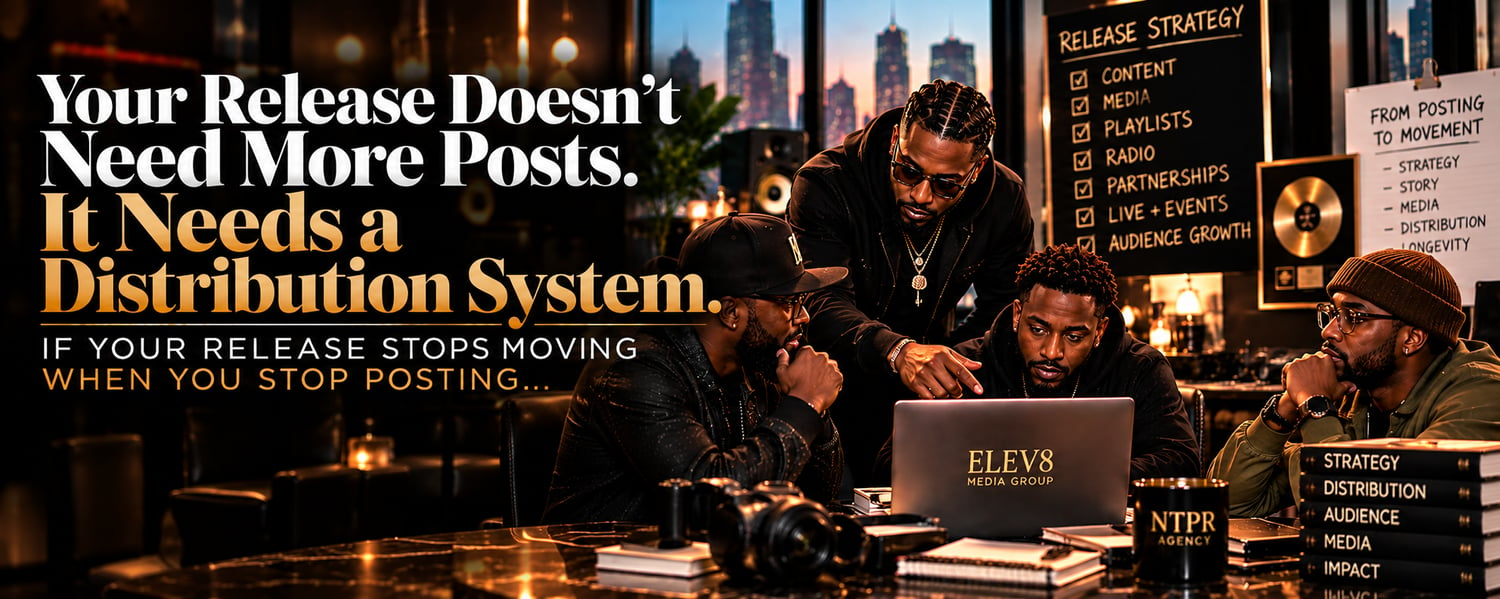
If your release stops moving when you stop posting, you don’t have a content problem. You have a distribution problem.
I’ve watched this happen with independent releases for years. The single drops, everybody posts, the artist shares the cover, friends repost it, a few Reels go up, the link hits the bio, and for several days the project looks busy.
Then the posting slows down.
And so does the release.
That tells me the campaign was depending almost entirely on the artist to keep generating attention. There was promotional activity, but very little infrastructure underneath it.
Posting says, “I published something.”
Distribution asks, “How many ways have we created for this work to keep traveling?”
That’s a very different strategy.
Release Day Is a Date. Distribution Is the Campaign.
Everybody knows what happens on release day.
I want to know what happens on Day 7, Day 14, and Day 30.
Who is still talking about the project?
Where else is the story appearing?
What media is supporting it?
What new audience is discovering it?
What happens if the artist doesn’t post today?
A campaign shouldn’t begin and end with “OUT NOW.”
Before a project drops, I want to know the audience, the story, the available assets, the media angles, potential partners, and the channels capable of carrying the work beyond the artist’s own social platforms.
That’s where distribution begins.
Five Ways Your Release Should Be Able to Move
For independent artists, I look at five areas:
OWNED → EARNED → SHARED → PARTNER → COMMUNITY
Owned is what you control: your website, email list, catalog, and direct audience.
Earned is third-party visibility: interviews, editorial coverage, radio, podcasts, and other appropriate media opportunities.
Shared is how the work travels through collaborators, supporters, social conversations, and audience advocacy.
Partner distribution comes through people and organizations with a legitimate connection to the project, such as producers, DJs, artists, events, ministries, brands, or creative partners.
Community is the ecosystem that continues carrying the work after release week: fans, professional relationships, live audiences, affinity groups, and people who have developed a genuine connection to the artist.
You don’t need every channel for every project.
You do need to stop asking Instagram to carry the entire campaign.
“STREAM NOW” IS NOT A 30-DAY STRATEGY
Another problem I see is artists creating 20 pieces of content that essentially say the same thing.
OUT NOW.
STREAM NOW.
AVAILABLE EVERYWHERE.
We heard you.
What else can you tell us?
Tell the story behind the song. Introduce the producer. Explain a lyric. Show the session. Share the creative process. Pull a moment from an interview. Give us a live performance. Connect the work to a larger conversation when the connection is authentic.
A strong campaign doesn’t keep repeating the announcement.
It creates new doors into the same work.
That’s how a release keeps moving without making the audience feel as though they’ve seen the same advertisement 27 times.
PR SHOULD GIVE THE RELEASE SOMEWHERE ELSE TO LIVE
This is where publicity becomes part of the distribution system.
An interview creates another searchable asset. A feature introduces the project to another audience. Radio puts the music into another environment. A podcast gives the artist room to tell a deeper story.
But getting the placement isn’t enough.
Use it.
Add it to the website. Put it in the EPK. Pull clips from the interview. Share the strongest quote.
Send it to your email audience. Reference it in future pitching when relevant.
I’ve watched artists work hard for media coverage, post the link once, and bury their own publicity within 24 hours.
Good PR should keep working after publication.
WHAT HAPPENS AFTER SOMEONE DISCOVERS YOU?
This may be the most overlooked part of distribution.
Someone sees the Reel. Now what?
Someone hears the interview. Now what?
Someone discovers the song and loves it. Now what?
Can they join your email list?
Discover the rest of your catalog?
Find an upcoming performance? Learn your story? Follow what happens next?
A good distribution system doesn’t only push the release outward.
It brings interested people inward.
That’s how one release helps strengthen the audience and infrastructure for the next one.
FROM THE PUBLICIST’S DESK
When an artist tells me, “I need more exposure,” I don’t automatically prescribe more content.
I want to know what is carrying the release.
Who are we trying to reach? What is the story? Which media opportunities fit? What does the artist control? Who can amplify it? Where does the audience go after discovery? And what are we still doing 30 days after release? Those answers tell me whether we have a campaign or simply a collection of posts.
Independent artists have more promotional tools available than ever. The challenge is getting those tools to work together. Your social content should support your media. Your media should strengthen discoverability. Your email should deepen the audience relationship. Your partnerships should extend reach. And every release should leave behind assets that make the next campaign stronger.
Posting is an activity. Distribution is infrastructure.
YOUR NEXT RELEASE NEEDS MORE THAN A CONTENT CALENDAR.
If you’re preparing a release and need strategy behind the promotion, start with ALIGN at NTPR Agency.
We’ll look at what you’re building, where you are, and what your next PR move should be.
Want to strengthen your foundation first?
Because the goal isn’t to post harder.
It’s to build a release that knows how to move.
Comments ()