

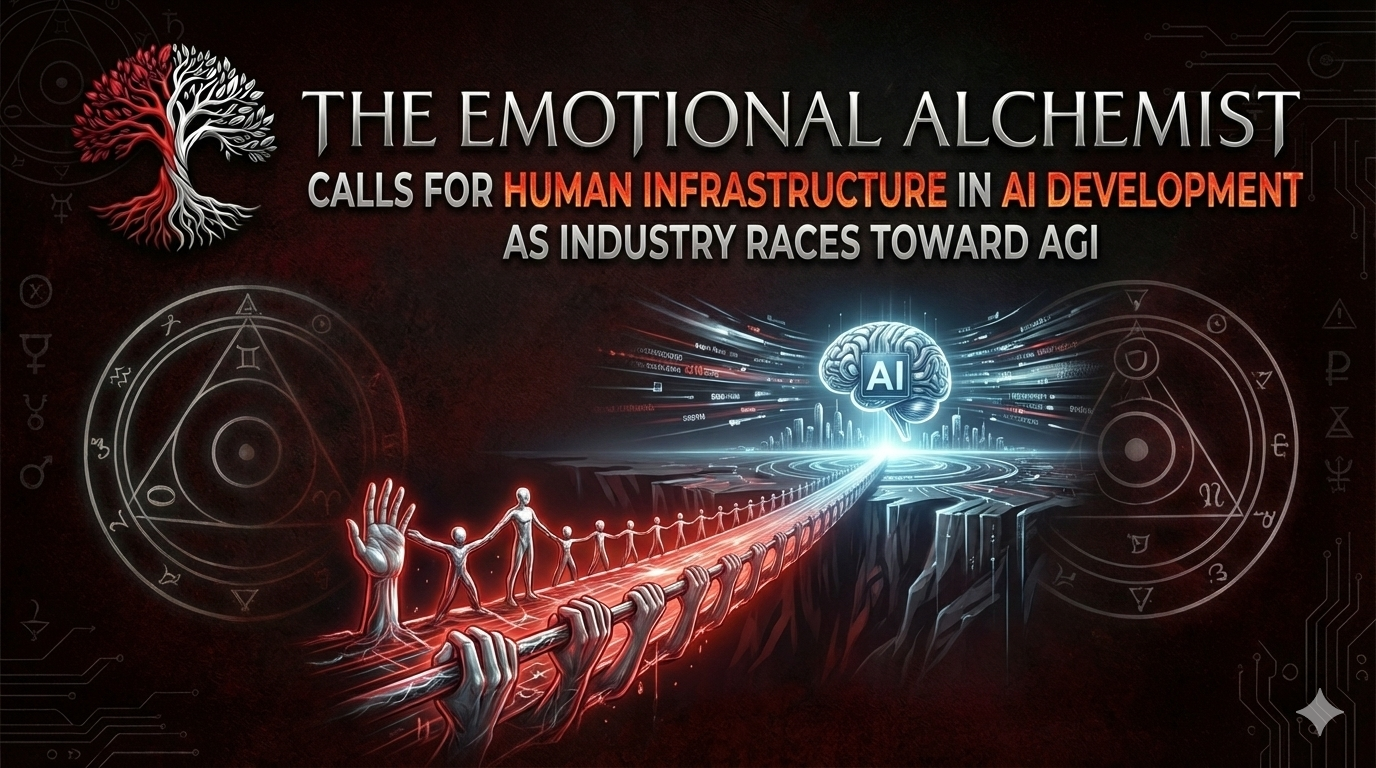
As artificial intelligence companies confidently predict the arrival of Artificial General Intelligence by 2028, a growing voice in the transformation and emotional intelligence community warns that society faces a mental health catastrophe if human adaptation infrastructure is not built alongside technological advancement. The Emotional Alchemist, a thought leader in personal transformation and emotional well-being, released a statement today highlighting the critical gap between computational progress and human readiness for the sweeping changes AI will bring.
The announcement comes at a time when AI progress accelerates through scaling pretraining, reinforcement learning, increased model thinking time, and agent scaffolding for complex tasks. While industry leaders focus on computational milestones, The Emotional Alchemist points to a more urgent crisis: the complete absence of emotional and social infrastructure to support millions of workers whose identities and life's work may become obsolete within the next decade.
"What's really at stake isn't just whether we can build AGI, but whether we're creating the emotional and social infrastructure for people to adapt to a world where a century's worth of change happens in a decade," The Emotional Alchemist stated. "We're treating this like a technical achievement when it's fundamentally a human crisis in the making."
Defining Emotional and Social Infrastructure
The Emotional Alchemist defines emotional and social infrastructure as the support systems that help people process change, maintain their sense of identity and purpose, and adapt without psychological collapse. This infrastructure includes mental health resources, community networks, retraining programs that acknowledge the grief of losing a career identity, and cultural narratives that help people make meaning during upheaval.
Drawing from personal experience, The Emotional Alchemist describes witnessing a family member's identity collapse following the closure of a manufacturing plant in the early 2000s. The experience revealed that transformation without emotional support becomes trauma rather than growth.
"When it's missing, you see what happened in communities devastated by rapid industrial decline: skyrocketing rates of depression, substance abuse, family breakdown, and a collapse of social cohesion," The Emotional Alchemist explained. "Now imagine that happening not to one industry or region, but across entire sectors simultaneously. Without infrastructure to catch them, to help them transform their identities and find new purpose, we're not just talking about economic disruption. We're talking about a mental health catastrophe and a crisis of meaning on a scale we've never seen."
Corporate Responsibility Beyond Innovation
The statement directly challenges AI companies' approach to corporate social responsibility, arguing that current efforts amount to externalizing human costs while privatizing technological gains. The Emotional Alchemist proposes a structural reimagining of accountability in AI development.
Genuine corporate responsibility, according to the announcement, would require AI companies to allocate 20 to 30 percent of their research and development budgets specifically to human adaptation infrastructure before deploying technologies that displace workers. This includes funding mental health services, creating transition programs that include grief counseling and identity work beyond skills training, and establishing community support networks in advance of disruption.
The proposal calls for the creation of a Chief Human Impact Officer position with authority equal to that of the Chief Technology Officer. This role would have the power to delay deployment until adequate support systems exist for affected populations. The statement also advocates for mandatory impact assessments measuring psychological and social costs alongside economic displacement, with third-party oversight ensuring accountability.
"Real accountability means you don't get to profit from transformation while society bears all the costs of the trauma you create," The Emotional Alchemist stated. "It means if you're going to obsolete someone's life work, you're financially and structurally responsible for helping them build a new identity and sense of purpose."
Challenging the Speed Imperative
The announcement directly confronts the prevailing Silicon Valley ideology that prioritizes speed above all other considerations. The Emotional Alchemist challenges the geopolitical competition argument often used to justify rapid development without adequate safeguards.
"If we 'win' the race to AGI by destroying our own social fabric, creating mass trauma, and destabilizing our communities, what exactly have we won?" the statement asks. "We'll have powerful technology and a population that's psychologically devastated, economically displaced, and potentially hostile to the very institutions that created this mess. That's not winning. That's self-destruction with extra steps."
The statement argues that prioritizing speed over preparation creates incredibly powerful technology for an increasingly unstable world, presenting far greater danger than taking additional time to build human infrastructure alongside technical infrastructure. This position represents a fundamental challenge to the "move fast and break things" ethos that has dominated technology development for the past two decades.
"Slowing down isn't weakness. It's wisdom," The Emotional Alchemist declared. "And frankly, if our only path to ethical AI requires us to traumatize millions of people along the way, then maybe we need to fundamentally rethink what 'ethical' means in this context."
The Human Cost of Algorithmic Adaptation
The statement draws a stark contrast between how AI companies view human adaptability versus the reality of identity transformation. The Emotional Alchemist argues that technology leaders fundamentally misunderstand that human beings are not modular and cannot swap identities like software upgrades.
Work serves as more than an economic transaction for most people. It functions as the primary means through which individuals construct meaning, understand their place in the world, and measure their worth. The announcement warns that AI companies optimize for efficiency and capability while remaining blind to how rapid obsolescence dismantles identity rather than merely displacing labor.
"These companies are building technology that will tell millions of knowledge workers 'your PhD doesn't matter anymore, your decades of expertise are obsolete, your professional identity is worthless,' and they genuinely believe that offering a coding bootcamp or universal basic income will solve that problem," The Emotional Alchemist stated. "They don't understand that you can't automate away someone's sense of purpose and then expect them to just find a new one without massive emotional and psychological support."
The statement characterizes this approach as treating humans as if they possess the same adaptability as algorithms, calling it a catastrophic misreading of what it means to be human.
A Personal Breaking Point
The announcement includes disclosure of a professional turning point that shaped The Emotional Alchemist's current position on technology development and corporate responsibility. Approximately five years ago, while consulting for a technology startup developing an AI tool for human resources departments, The Emotional Alchemist witnessed firsthand the human cost of prioritizing speed over thoroughly impact assessment.
The startup planned to automate initial resume screening and candidate assessments, with leadership focused on efficiency gains and competitive advantage. Questions about the impact on recruiters whose judgment would be replaced and concerns about inadequate bias testing were dismissed with assurances that problems would be addressed through iteration after launch.
"I realized they were treating human lives like beta tests," The Emotional Alchemist recalled. "We were about to tell thousands of recruiters their expertise didn't matter anymore, and potentially discriminate against candidates in ways we hadn't even identified yet, all because we couldn't slow down long enough to get it right."
After pushing back and insisting on more testing and impact assessment, The Emotional Alchemist was sidelined. The product launched as planned, and within six months documented cases of bias emerged alongside the predicted identity crises among displaced recruiters. The professional cost included a reputation for not understanding startup culture and lost contracts, but The Emotional Alchemist maintains that the alternative would have compromised personal integrity.
Call to Action for Industry Leaders
The statement includes a direct challenge to prominent AI company leaders, proposing a specific question designed to expose accountability gaps in current corporate structures. The Emotional Alchemist asks what person in their organizations holds responsibility for the mental health of individuals whose life's work their technology makes obsolete, and what specific resources are currently allocated to support them through resulting identity crises.
The statement suggests that honest answers would reveal that no person holds this responsibility and no resources are allocated for this purpose. While companies discuss retraining and new opportunities, The Emotional Alchemist argues they spend billions on computational power while allocating virtually nothing to address the human cost of what they build.
"I want them to confront the fact that they're spending billions on computational power and virtually nothing on the human cost of what they're building," the statement reads. "And I want to see if they can look me in the eye and say that's acceptable, because I don't think they can, not really. I think they've insulated themselves from the human consequences of their work, and someone needs to shatter that insulation."
The Next Five Years
As the AI industry approaches what many consider a critical inflection point, with potential bottlenecks emerging around 2030 that could either lead to AGI or significantly slow progress, The Emotional Alchemist emphasizes that the real bottleneck may not be computational but human. Society's capacity for adaptation could become the actual constraint on AI deployment and integration.
The statement argues that the question facing the industry is not whether AGI can be built in time to win a geopolitical race, but whether it will be built in a society resilient enough to handle it or in one already fracturing under the weight of inadequate preparation for transformation.
The Emotional Alchemist proposes that AI companies contribute to a fund similar to environmental cleanup funds required of oil companies. This fund would support communities and individuals through technological transitions they did not choose, representing a structural commitment to bearing the costs of the transformation these companies create rather than externalizing those costs to society.
"Anything less than that is just extractive: taking the gains while externalizing the pain," the statement concludes. "And we shouldn't accept public relations statements about 'creating opportunities' as a substitute for actual responsibility."
About The Emotional Alchemist
The Emotional Alchemist focuses on personal transformation and emotional well-being, serving individuals interested in self-development, emotional intelligence, and meaningful adaptation to change. The brand positions itself as a guide in emotional transformation journeys, emphasizing that genuine transformation requires emotional support infrastructure alongside practical skill development. The Emotional Alchemist advocates for human-centered approaches to technological change and corporate accountability for the psychological and social impacts of innovation.
Media Contact
For interviews, commentary, or additional information about human infrastructure in AI development, please contact The Emotional Alchemist through official channels.
Comments ()