
Disclaimer: As of 8:30 AM July 25th, 2025, this Studio Note provides our opinion and interpretation of TikTok's policies. Ultimately, you are responsible for reading and interpreting the official rules, applicable laws and regulations. as they apply to your specific content and brand.
Let’s get it straight.
There’s been a lot of chatter and some confusion circulating about TikTok’s upcoming policy changes slated for July 25, 2025. Many creators in the U.S. are wondering how these updates will impact their content and monetization. Here’s the essential clarification you need to navigate these waters with confidence.
The Update: Targeted Changes Outside the U.S.
TikTok is indeed rolling out major revisions to its Branded Content Policy on July 25, 2025.
However, it’s crucial to understand: these specific changes primarily apply to creators and content consumed in the UK, Switzerland, and the European Economic Area (EEA) only. They are not directly aimed at the United States audience or U.S.-based creators.
For a comprehensive overview of what's changing for these regions, you can review TikTok's "Shedding Light on our New Branded Content Policy" page: https://www.tiktok.com/legal/page/global/bc-policy-learn-more/en
So What Does Apply in the U.S. Right Now?
For U.S.-based creators, the focus remains on TikTok’s existing and ongoing policies. Here’s a breakdown of what you need to know and continue to adhere to:
What Is Branded Content?
TikTok defines Branded Content as: Any content that promotes or features a product, service, or brand in exchange for payment, gifting, or any form of affiliate benefit (yes, even free stuff).
Current U.S. Rules for Branded Content (As of July 2025)
You MUST:
- Turn on the Branded Content toggle if you’re posting on behalf of a brand, or if you're promoting your own business, product, or service with a clear commercial objective (e.g., selling a product, driving sign-ups, promoting a paid service).
- For example: If you create a TikTok video directly promoting your new online course, or showcasing a product you sell, you would turn on the Branded Content toggle.
- However, if your TikTok video is simply about this very blog post to share general information, or you are discussing general industry trends without a direct call to action to purchase your services in that specific video, the Branded Content toggle is typically not required. The crucial distinction is whether that particular piece of content has a direct commercial objective for your business or is primarily informational/educational.
- Be clear in the video or caption what you’re promoting – viewers should not have to dig for clarity. Transparency builds trust.
- Not mislead your audience – avoid exaggerated claims or fake reviews.
You CANNOT:
- Promote products or services in categories specifically prohibited by TikTok, which may vary by market and can include, but are not limited to:
- Weight loss or detox supplements
- Gambling and betting services
- Prescription or over-the-counter medications
- Adult content or sexual health products
- Unlicensed financial services or scams
- Confuse Branded Content rules (creator posts) with TikTok Ads rules (ads run through TikTok's ad platform). Content that might be allowed as a paid ad could still be prohibited as Branded Content.
For the most detailed and up-to-date information on Branded Content, including market-specific requirements and prohibited industries, always refer to TikTok’s official Branded Content Policy: https://www.tiktok.com/legal/page/global/bc-policy/en
What About Reusing Other People’s Content?
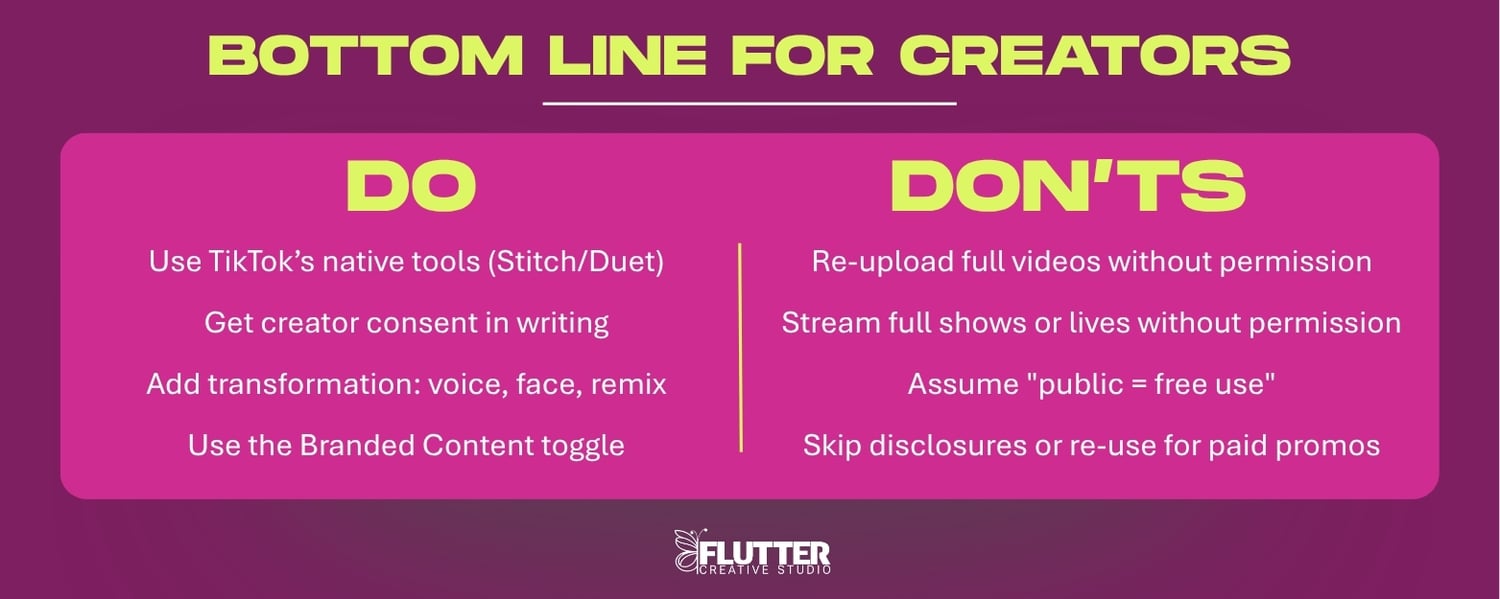
This is another common area of confusion. You can reuse other creators’ content in the U.S. if you follow the existing TikTok terms and general copyright principles.
ALLOWED (with limits):
- Stitch & Duet: These built-in features allow for content reuse within the TikTok app, subject to TikTok's Terms of Service and Community Guidelines.
- Short clips for reaction, parody, or commentary: These may sometimes be permitted under copyright exceptions like fair use, but always proceed with caution and significant transformation. TikTok's internal review and enforcement of its Intellectual Property Policy may differ from a legal fair use defense.
- Clips with explicit, written creator consent: A screenshot of permission is valuable proof.
- Transformative edits: Content where you significantly change the original, adding your face, voice, or unique context.
NOT ALLOWED:
- Reposting full videos with no changes: This is direct copyright infringement.
- Streaming someone’s live broadcast as your own: This is not transformative and lacks proper permission.
- Downloading & re-uploading without express permission or significant, transformative edits.
- Using copyrighted music or soundbeds from others in your own promotional or Branded Content. TikTok has strict rules around commercial music licensing.
TikTok Assumes No Permission Unless:
- You use in-app features (like Stitch/Duet).
- You’re in a verified collaboration via the TikTok Creator Marketplace.
- You can show documented proof of permission if your content is flagged.
- Proof = DM screenshot, email, signed agreement.
For further reading on content reuse, intellectual property, and community standards, please refer to
TikTok’s Terms of Service and Community Guidelines:
- TikTok Terms of Service (U.S.): https://www.tiktok.com/legal/page/us/terms-of-service/en
- TikTok Community Guidelines: https://www.tiktok.com/community-guidelines/en/community-principles/ (Users should ensure they are viewing the version applicable to their region, as guidelines can sometimes vary slightly by locale. This is often accessible via the TikTok app's 'Settings and Privacy' > 'Community Guidelines').
Disclaimer
Please Note: This Studio Note provides general information and our interpretations of TikTok's policies as of July 24, 2025. We are not lawyers, and this content reflects our opinion and understanding. TikTok's policies are complex, subject to change, and their enforcement can be subjective. It is your sole responsibility to do your own fact-checking and to meticulously review TikTok's official policies directly. We strongly recommend consulting with qualified legal counsel for specific advice regarding your content or any legal questions.
Creator Permission Template (suggestion)
If you want to reuse someone’s content for your TikTok, YouTube, livestream, or blog, getting clear consent in writing is always the safest bet. Here’s a simple DM or email template you can use:
Subject: Quick Question about Your Video/Post
Hi [creator name],
I'm a big fan of your content, and I really love your recent video/post [mention specific video if possible, e.g., "about the travel hack" or "your dance"].
I'm creating a reaction/breakdown/commentary video for TikTok (or YouTube/Instagram/my livestream/blog) and would love to include a short clip from your content. I would, of course, credit and tag you prominently in my post.
Would you be okay with me using it? A quick “yes, that’s fine” or similar confirmation is all I need.
Thanks so much either way for considering!
– [Your Name or Handle]
Once approved:
- Screenshot or save the written consent.
- Label the file clearly, e.g., “Creator Consent – [Creator Name] – [Date of Consent]”.
- Save it in a secure, accessible folder in your cloud storage or notes app.
Need TikTok Agency Management?
If you're a creator looking for agency management, please feel free to reach out to me directly, and I'll be more than happy to connect you with my trusted contacts in the industry.
Always remember to consult the official TikTok policies directly for the most definitive information.
Comments ()