
A producer's honest guide to what AI-assisted music actually means in 2026 — legally, ethically, and commercially.
By Zoran Kanti-Paul · Founder & Chairman, Haz2b Pty. Ltd. · June 2026
Let me ask you something directly. You have spent real time — and possibly real money — making an AI-assisted track. You have done the prompting, the production, the mixing, the mastering. The file is sitting on your desktop, sounding exactly like what you imagined it would sound like.
Now what?
If your answer is "upload it to DistroKid and see what happens," we need to talk. Because the landscape between your finished master and a live, legally defensible, royalty-generating release has changed significantly in the past eighteen months. And most producers — even experienced ones — are not across it.
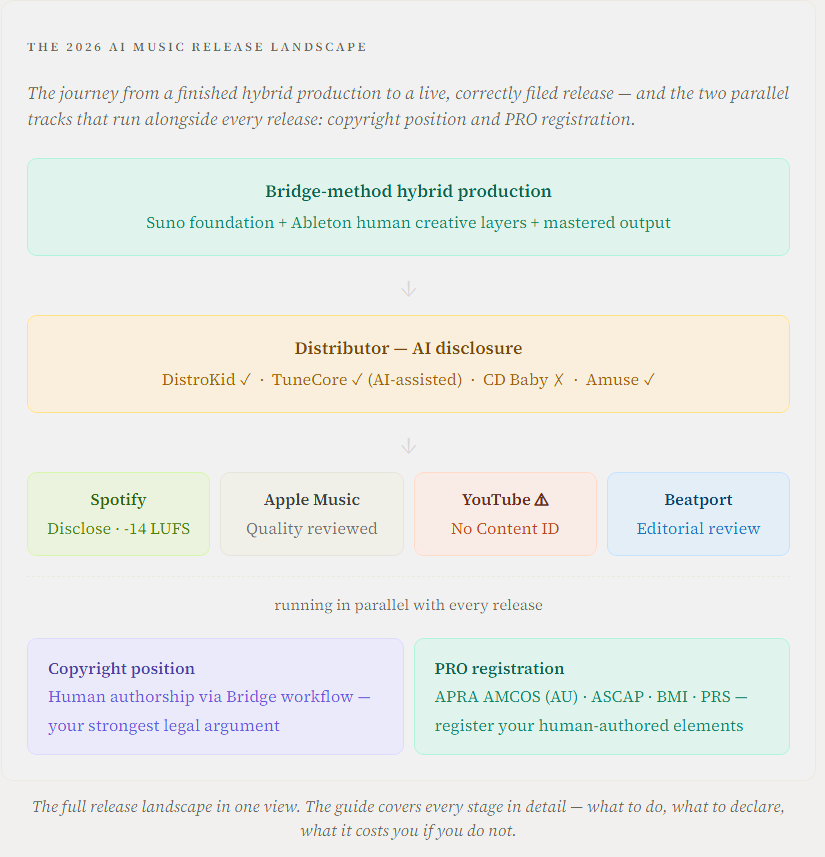
That is why I wrote The AI Producer's Release Guide. Not as a legal textbook. Not as a scare piece. As a producer-to-producer briefing on exactly where things stand right now — the copyright reality, the ethics conversation nobody wants to have honestly, the distributor rules, and the release strategy that protects your work and your account.
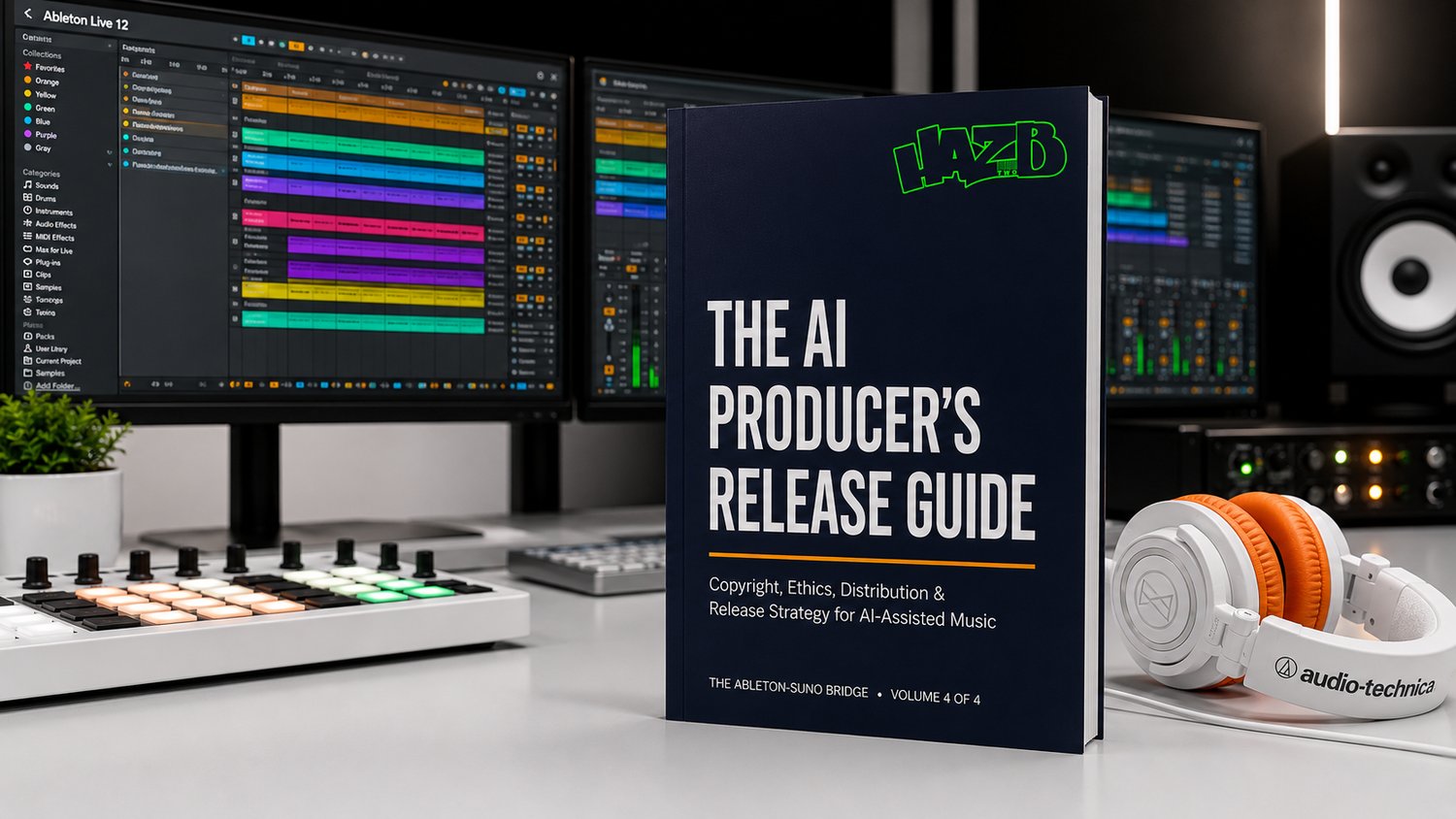
The AI Producer's Release Guide — 18 pages, 28 cited sources, covering every stage of the release process from copyright to PRO registration. Available at haz2b.com.
From Prohibition to Regulation — and Why That Matters
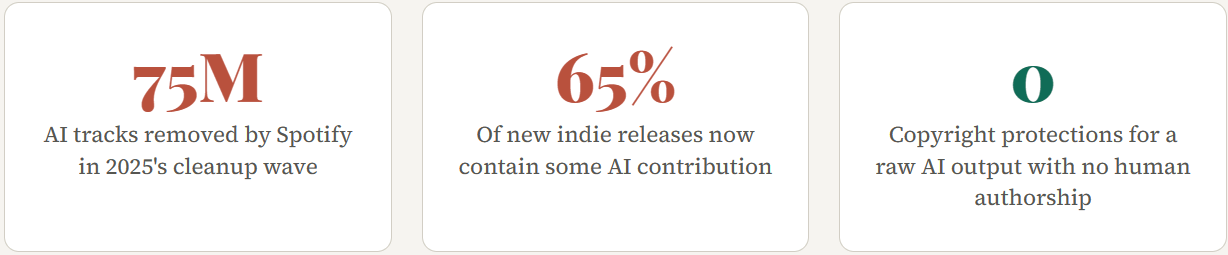
In 2024, the industry's approach to AI music was simple: detect it and delete it. In 2025, Spotify removed over 75 million AI-generated tracks. Apple Music flagged billions of streams as potentially fraudulent. The Universal, Sony and Warner lawsuits against Suno and Udio were filed and — by the end of 2025 — largely settled.
Here is what most people missed in all that noise: the outcome was not prohibition. It was regulation. The major platforms did not ban AI music. They formalised it. Mandatory disclosure. Automated detection. Tiered classification. A clear set of rules about what you can distribute, what you must declare, and what happens if you do not.
That shift changes everything about how a producer should approach a release in 2026. The question is no longer "will this get through?" It is "am I operating correctly within the rules that now exist?" Those are very different questions — and only one of them protects your account, your royalties, and your catalogue long-term.
"The question is no longer 'will this get through?' It's 'am I operating correctly within the rules that now exist?'"
Zoran Kanti-Paul, The AI Producer's Release Guide
The Gap Nobody Talks About
Here is the most important thing I cover in the guide, and the thing most AI producers either do not know or actively avoid thinking about.
Commercial rights and copyright are not the same thing.
Suno's paid subscription — Pro or Premier — grants you commercial rights. That means Suno will not sue you for distributing the track. What it does not grant you, and cannot grant you, is copyright. Copyright requires human authorship under US, UK and Australian law. And without copyright, you cannot register with a performing rights organisation, you cannot claim Content ID on YouTube, and you cannot legally prevent someone else from taking your track and re-uploading it as their own.
That is not a theoretical risk. That is the current legal reality for a raw, unmodified AI output.
The guide spends considerable time on the practical consequence of this — and more importantly, on what changes it. Because the answer is not "give up on AI music." The answer is human creative intervention. The more deeply a human producer is embedded in the final output — stem work, MIDI layering, vocal restoration, arrangement decisions, mastering choices — the stronger the argument for copyright protection becomes. The Bridge workflow covered in the Ableton-Suno Bridge series is, among other things, a copyright strategy.
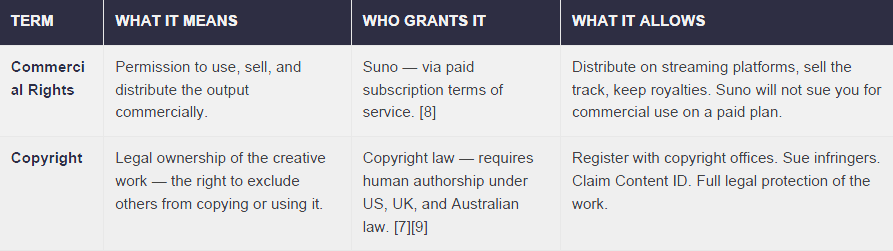
The guide's copyright comparison table — the distinction between commercial rights (what Suno grants) and copyright (what the law protects) is the most consequential thing an AI producer needs to understand before releasing anything.
The Distributor You Choose Is More Important Than You Think
If your distributor bans your account, you lose access to every platform simultaneously. That is not a minor inconvenience. That is your entire streaming catalogue going dark in one move. Which is why the guide dedicates a full section to the current distributor landscape — not to tell you which one to use, but to tell you exactly what each one's policy is right now so you can make an informed decision.
The headline finding is this:
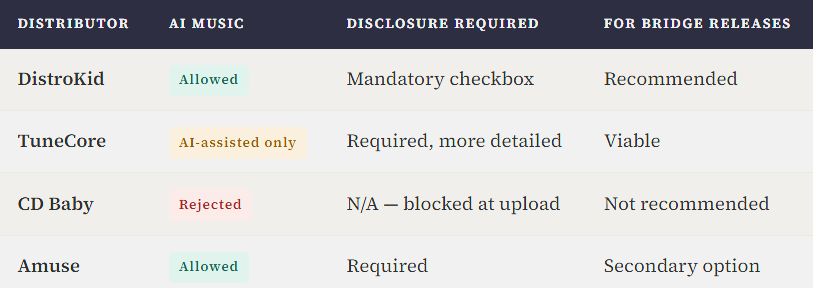
The guide covers detection systems, retroactive enforcement, what non-disclosure actually costs you if you are caught, and how to correctly complete the AI disclosure step for a hybrid production — where the music was AI-generated but the production involved significant human creative work.