
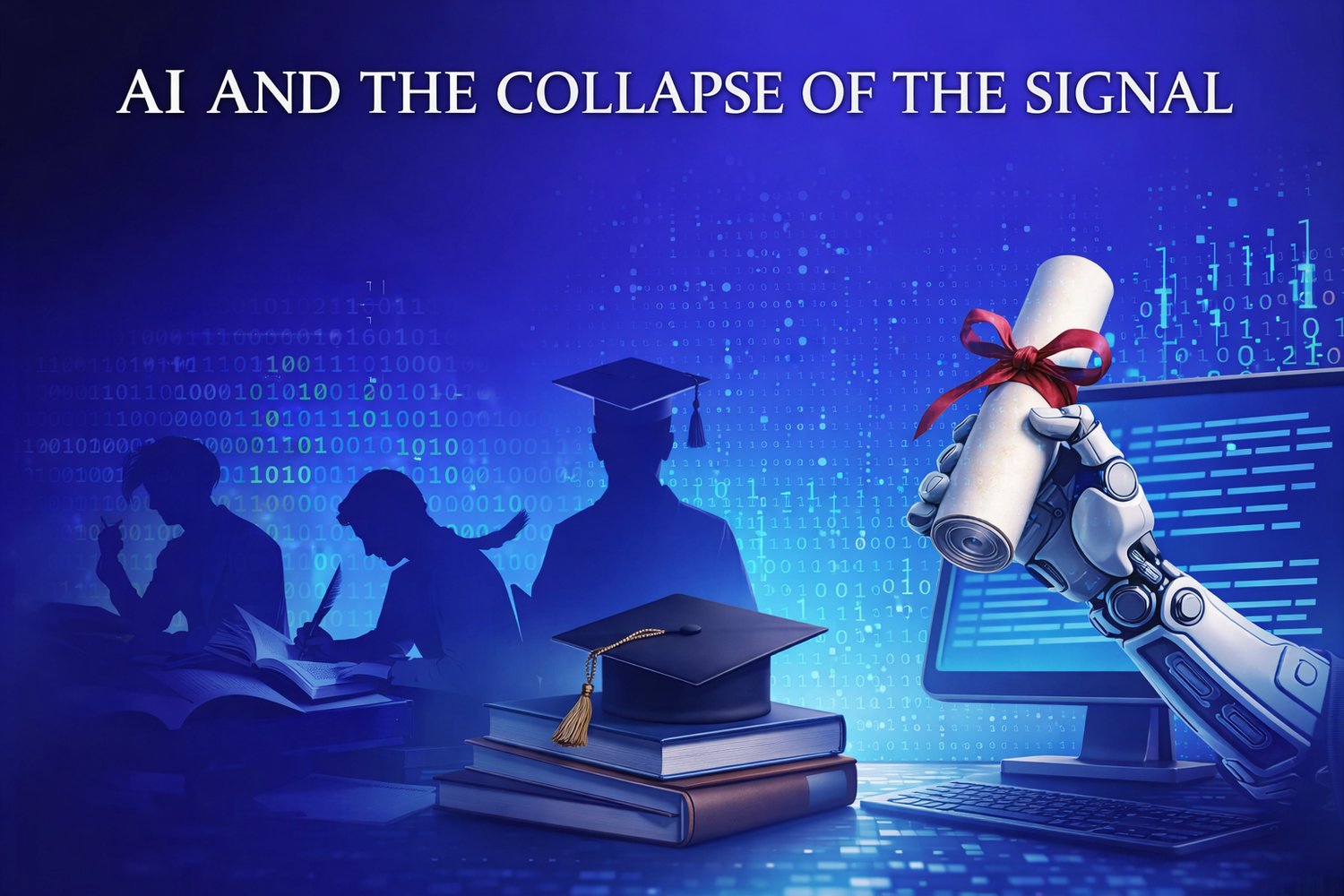
Economists such as Bryan Caplan have long argued that formal education serves not merely to impart knowledge, but to signal desirable traits to employers. Degrees communicate that their holders are intelligent, diligent, compliant, and capable of sustained effort. The well-documented “sheepskin effect”—the disproportionate wage premium for completing a qualification rather than merely studying part of it—illustrates that educational credentials operate as signals of character as much as of competence. Whatever else education achieves, signalling remains a significant component of its social and economic function.
If we grant the above, the arrival of advanced Artificial Intelligence requires a fundamental reassessment—not of learning per se, but of what academic work is supposed to prove.
Tools such as ChatGPT are typically framed as a plagiarism concern, as though the primary issue were intellectual theft. Yet AI-generated work is rarely copied; it is original, coherent, and difficult to detect via plagiarism software. The threat is not that students are stealing others’ work, but that they no longer need to develop—or display—the very abilities that essays were designed to evidence.
Modern AI now functions as a hypercharged research assistant and cognitive proxy. It summarises texts, synthesises arguments, identifies themes, anticipates counterpoints, and constructs fluent analytical prose. It does not merely expedite writing; it can perform the reasoning that writing was once intended to reveal. Educational assessments traditionally measured the journey—reading, thinking, drafting, revising—as much as the destination. AI compresses that journey to a series of prompts.
For students who relish the slow wrestling of ideas into form, this feels like a cheat, not because the product is stolen, but because the process has been bypassed. It echoes a moment from Father Ted, when Mrs Doyle rejects a machine that automates tea-making with the plaintive cry that she likes the misery of making tea. AI provokes a similar disquiet: if the struggle disappears, does the achievement still signify anything?
This intuition reveals something profound. Suppose someone runs a marathon—an extraordinary feat. Now imagine another person completes it after swallowing a tablet that makes running effortless. The distance is the same. The time may be faster. Yet our admiration collapses, because what we valued was not the outcome, but the human effort, endurance, and discipline it represented. If AI makes the intellectual marathon trivial, academic outputs risk suffering the same fate: impressive in form, but hollow as signals.
This is the existential challenge. If essays no longer demonstrate persistence, comprehension, or critical reasoning, then the essay—long the gold standard of academic assessment—ceases to function as a credible indicator of ability. AI does not merely make cheating easier; it dissolves the connection between the work submitted and the worker assessed.
Where does education go from here? One response is defensive: stricter invigilation, closed-book exams, handwriting, and surveillance. The alternative is transformative: redesign curricula around skills and performances that machines cannot easily replicate—live problem-solving, collaborative inquiry, ethical judgment, oral defence, creativity, and applied real-world competence.
Paradoxically, then, AI may accelerate the very reform Caplan anticipated: a shift away from credentialism and towards demonstrable capability. The system must now answer a new and unavoidable question:
What does authentic human achievement look like in a world where machines can do the thinking for us?
Education has not faced a moment like this in generations. Whether it retreats or evolves will determine whether academic work continues to mean anything at all.
Acknowledgements
This post was inspired by reading Bryan Caplan’s work on the signalling model of education and by ongoing reflections on the role of Artificial Intelligence in contemporary schooling—particularly in the context of an IB environment, where critical thinking is prized. In the spirit of the topic, it should be noted that while the core ideas, structure and argument were conceived, refined and directed by the author, many of the sentences were drafted, accelerated, or reshaped with the assistance of ChatGPT.