
How to Start a Small Business with Confidence: A Practical Guide to Planning, Pricing, and Staying Organized
Starting a small business is exciting, but turning an idea into a profitable operation requires more than motivation. You need a clear plan, sensible pricing, and a system that keeps everything organized.
Many aspiring entrepreneurs spend weeks thinking about logos, business names, and social media pages. While branding matters, some of the most important questions are often overlooked:
- Who is my ideal customer?
- How much will it cost to run my business?
- What should I charge for my products or services?
- How will I track expenses and measure profitability?
- What should I focus on during my first 30 days?
The good news? You don't need an expensive business consultant or complicated software to begin answering these questions.
In this guide, we'll walk through five essential steps to building a stronger foundation for your small business.
1. Turn Your Business Idea into a Clear Plan
Every successful business starts by identifying a problem and offering a useful solution.
Before investing money, write down the fundamentals of your business.
Your business plan should answer five questions:
- What are you selling? Describe your product or service clearly.
- Who will buy it? Identify your target audience and their needs.
- Why should customers choose you? Explain what makes your offer valuable or different.
- How will you reach customers? Consider social media, referrals, search engines, marketplaces, or local promotion.
- How will your business earn a profit? Estimate your costs, selling prices, and expected sales.
Example: Starting a Handmade Accessories Business
Imagine you're launching a small online accessories store.
Your initial plan might look like this:
Product: Handmade bracelets and necklaces.
Target audience: Customers looking for affordable, personalized gifts.
Sales channel: Instagram, TikTok, and a simple online store.
Competitive advantage: Customizable designs and attractive gift packaging.
Revenue model: Selling individual accessories and gift bundles.
This simple outline gives you direction before you start spending money.
Practical tip: Keep your initial business plan concise. A clear one-page plan that you regularly update can be more useful than a lengthy document you never revisit.
2. Understand Your Costs Before Setting Prices
One of the biggest mistakes new business owners make is choosing prices based only on what competitors charge.
A competitor's price doesn't tell you how much they pay for supplies, shipping, marketing, or operations.
To price sustainably, start by understanding your costs.
Common Small Business Expenses
Depending on your business, these may include:
- Product materials or inventory
- Packaging and shipping
- Marketplace or payment processing fees
- Website subscriptions
- Advertising and marketing
- Equipment and software
- Rent, utilities, and other overhead expenses
Some expenses change with each sale, while others remain relatively fixed.
Understanding the difference helps you calculate how much revenue you need to cover your costs.
3. Calculate Your Selling Price and Profit
Let's use a practical example.
Suppose you sell a handmade product with these costs:
ExpenseCostMaterials$8.00Packaging$2.00Shipping paid by seller$3.00Payment processing$1.00Total cost per sale$14.00
If you sell the product for $25:
Profit before fixed overhead and taxes = Selling Price − Cost per Sale
$25 − $14 = $11 profit per sale
Your profit margin before fixed overhead and taxes is:
($11 ÷ $25) × 100 = 44%
That means 44% of the selling price remains after the costs included in this example.
However, this is not necessarily your final net profit. You may still need to account for advertising, subscriptions, business overhead, taxes, and the value of your time.
Markup vs. Profit Margin
These two terms are often confused.
Markup measures profit relative to cost.
Profit margin measures profit relative to selling price.
In our example:
- Markup: approximately 78.6%
- Profit margin: 44%
Knowing the difference helps you avoid underpricing.
A Useful Pricing Formula
If you know your unit cost and desired gross margin:
Selling Price = Unit Cost ÷ (1 − Desired Margin)
For example, if your unit cost is $14 and you want a 40% gross margin:
$14 ÷ 0.60 = $23.33
This is a starting point, not a guarantee that customers will pay that price. You should also consider demand, competitors, and your product's perceived value.
Using a pricing calculator can make it easier to compare different scenarios and avoid repeated manual calculations.
4. Organize Your Business with Reusable Templates
Running a small business involves many repetitive tasks.
You may need to track expenses, plan marketing activities, calculate prices, and review progress every week.
Without a system, these tasks can quickly become overwhelming.
Useful business documents include:
Business planning worksheets: Help you define goals, customers, and priorities.
Pricing calculators: Help you compare costs, selling prices, and estimated profit margins.
Task planners: Help you organize important activities and deadlines.
Reusable templates: Reduce the time spent creating business documents from scratch.
You don't necessarily need an expensive management platform when you're starting.
A practical collection of spreadsheets, planners, and templates may be enough to organize your initial operations.
The key is consistency.
A simple system you actually use is more valuable than sophisticated software you rarely open.
5. Create a Realistic 30-Day Business Action Plan
Instead of trying to do everything immediately, divide your launch into manageable stages.
Week 1: Research and Planning
Identify your ideal customers, research competitors, define your offer, and outline your business goals.
Week 2: Costs and Pricing
Calculate startup expenses, estimate your cost per sale, establish preliminary prices, and review your expected profit margins.
Week 3: Branding and Preparation
Prepare product descriptions, promotional content, business documents, and the sales channels you intend to use.
Week 4: Launch and Improve
Start reaching potential customers, collect feedback, track sales and expenses, and adjust your approach based on what you learn.
Remember: Your first month is about testing your assumptions and building useful habits, not achieving perfection.
6. Five Common Mistakes New Entrepreneurs Should Avoid
Mistake 1: Starting without understanding the customer.
Research the people you want to serve before investing heavily in your offer.
Mistake 2: Ignoring hidden costs.
Small fees and recurring expenses can significantly reduce profit.
Mistake 3: Confusing revenue with profit.
Making $1,000 in sales doesn't mean earning $1,000.
Mistake 4: Spending too much on unnecessary tools.
Begin with affordable systems and upgrade when your business genuinely needs them.
Mistake 5: Failing to review business performance.
Check your sales, costs, and goals regularly. Small improvements become easier when you have reliable information.
7. A Practical Resource for Getting Started
If you're building your first business, organizing everything from scratch can take considerable time.
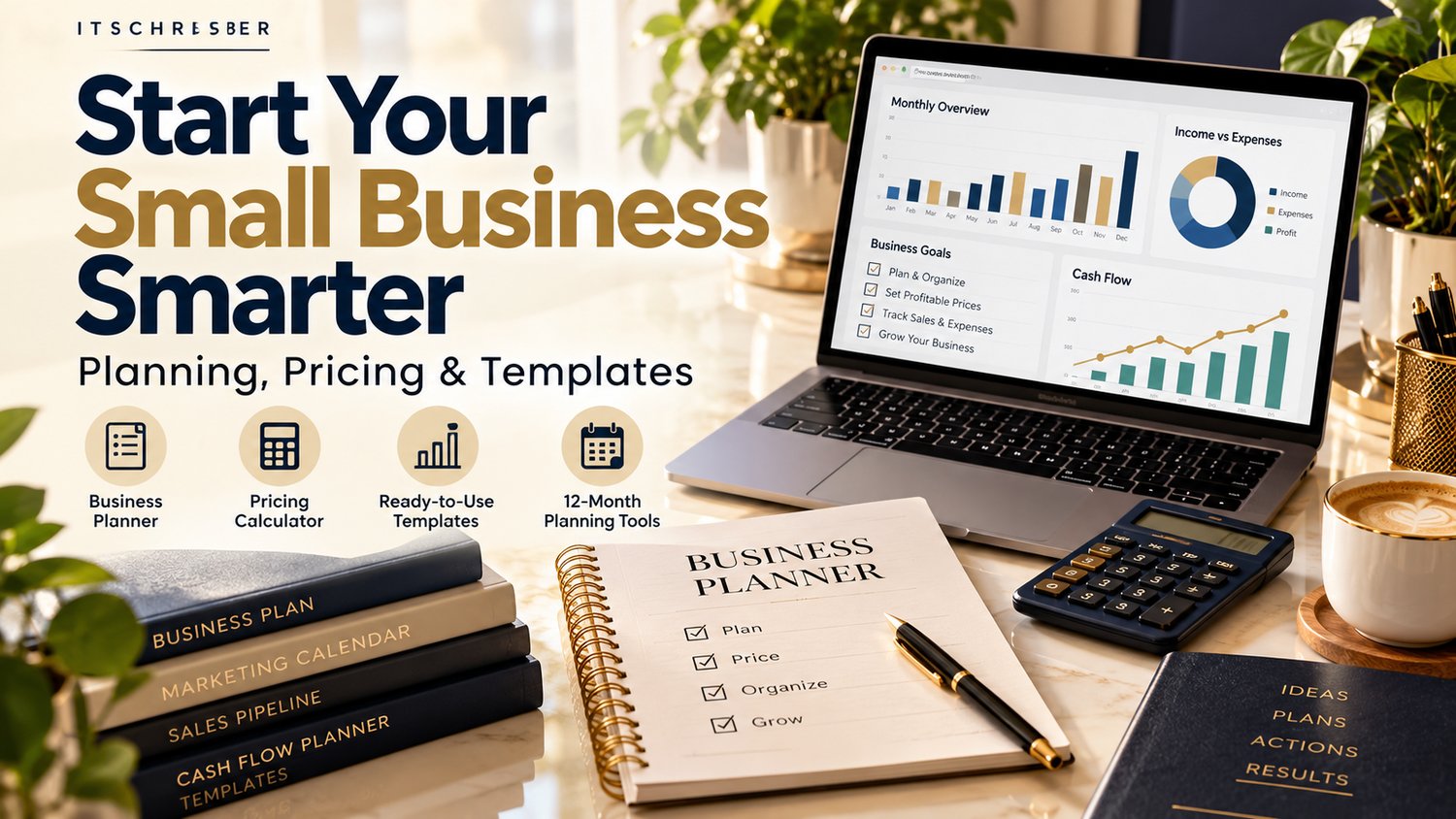
That's why we created the ITSCHRISBER Small Business Starter Toolkit — Business Planner, Pricing Calculator & Templates.
<escape>Designed as a practical digital resource for aspiring entrepreneurs and small business owners, this package brings together business planning, pricing, and reusable templates in one toolkit.</escape>
Rather than starting with blank documents every time, you can use structured resources to support your planning and business decisions.
Small Business Starter Toolkit
Price: $14.99 USD
Get the Small Business Starter Toolkit — $14.99
Browse the store and select the Small Business Starter Toolkit to view its full contents before purchasing.
Final Thoughts: Build a Business with a Plan, Not Just an Idea
Starting a business doesn't require knowing everything on day one.
It requires understanding your customers, keeping your costs under control, choosing sustainable prices, and consistently improving your approach.
Start small, track your numbers, and make decisions based on evidence rather than assumptions.
With the right planning habits and practical tools, you can build a stronger foundation for long-term growth.
Your next step: Write down your business idea, identify three major costs, and calculate one realistic selling-price scenario today.
Small actions like these are how business ideas begin turning into real operations.
Published by ITSCHRISBER — AI Tools, Digital Resources & Practical Guides for Creators and Entrepreneurs.
Disclosure: This article features a digital product sold by ITSCHRISBER. Purchasing it supports our business. The educational information in this guide is free, and results from using any business toolkit will depend on your individual circumstances and decisions.
Comments ()