
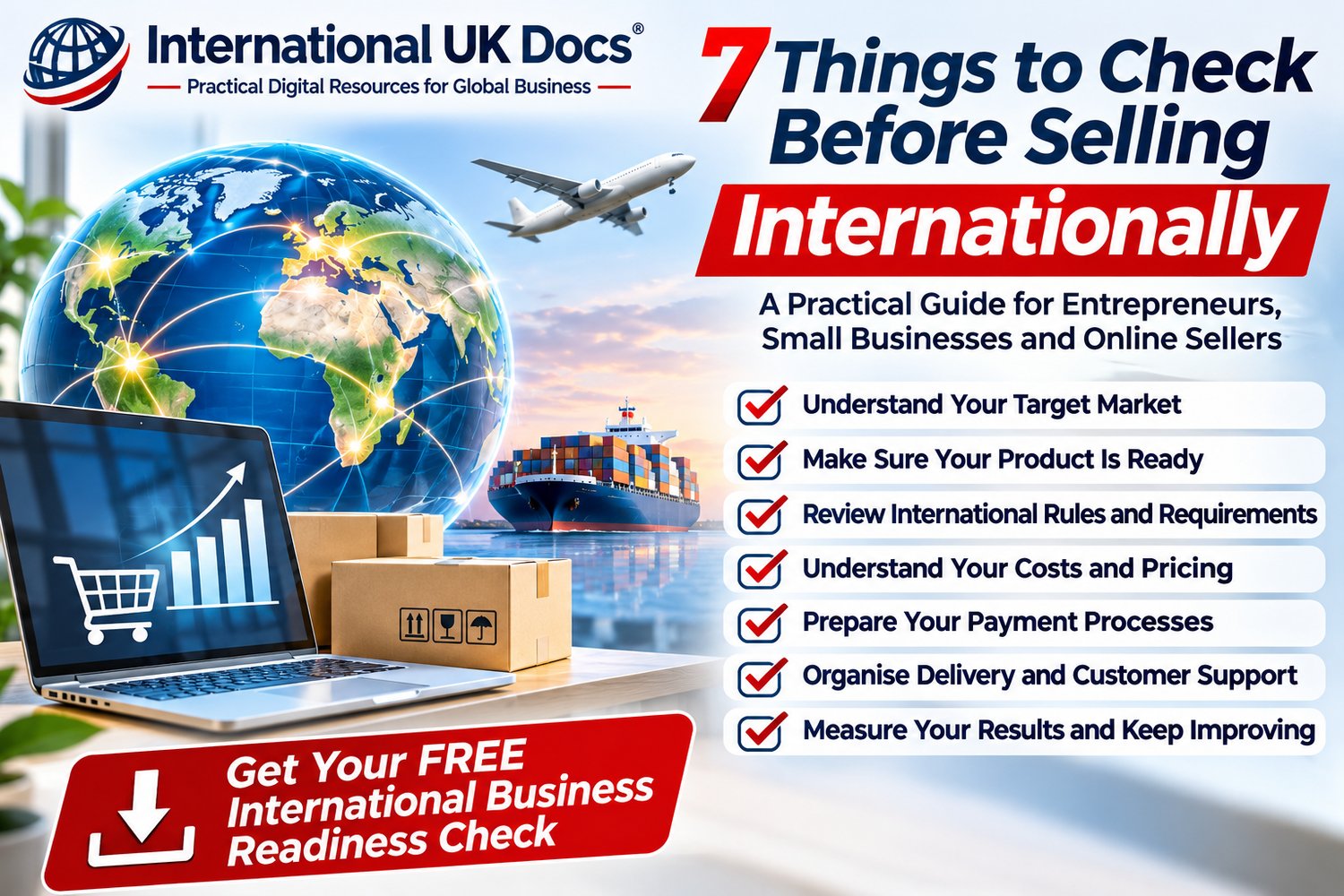
A Practical Guide for Entrepreneurs, Small Businesses and Online Sellers
Expanding into international markets can create exciting opportunities for businesses of all sizes. Whether you're selling physical products, digital downloads or professional services, reaching customers in other countries can help diversify revenue and open new paths for growth.
However, successful international selling requires more than simply making your products available worldwide.
Before entering a new market, it's worth reviewing seven important areas of business preparation.
1. Understand Your Target Market
Every international market is different.
Customer expectations, purchasing habits, local competition and demand can vary significantly between countries.
Before investing in international expansion, consider:
- Who are your target customers?
- What problems does your product or service solve?
- Is there evidence of demand?
- How are competing products positioned?
- Are there language or cultural considerations?
Understanding your target market helps you make more informed decisions about where and how to sell.
2. Make Sure Your Product Is Ready
International customers need to understand exactly what they are purchasing.
Product descriptions should be clear, accurate and relevant to the intended audience.
For digital products, this includes explaining file formats, software requirements, delivery arrangements and product limitations.
For physical goods, consider product specifications, packaging, shipping requirements and after-sales support.
Accurate product previews and straightforward instructions can also help build customer confidence.
3. Review International Rules and Requirements
Selling across borders can introduce legal, tax and regulatory considerations.
Depending on the product and destination, businesses may need to consider:
- Import and export requirements.
- VAT, GST or other applicable taxes.
- Consumer rights and refund obligations.
- Product safety and labelling.
- Data protection and privacy requirements.
- Restrictions affecting particular products or services.
Requirements differ between countries and can change over time.
Always check the relevant official guidance before entering a new market.
4. Understand Your Costs and Pricing
International pricing should account for more than the original cost of your product.
Additional considerations may include payment-processing fees, marketplace charges, shipping expenses, currency conversion and applicable taxes or duties.
Currency fluctuations can also affect the amount your business ultimately receives.
A structured pricing calculation can help you understand your margins and avoid unexpected costs.
5. Prepare Your Payment Processes
Customers need a convenient and trustworthy way to pay.
Before launching internationally, check which payment methods your chosen platform supports and whether customers in your target markets can use them.
You should also consider payment settlement times, refunds, payment disputes and the currencies used for transactions. Clear payment information helps create a more dependable customer experience.
6. Organise Delivery and Customer Support
Reliable delivery is essential to customer satisfaction.
For physical products, establish how orders will be processed, shipped and tracked.
For digital products, ensure downloads work correctly and customers understand how to access and use their purchases.
International customer support may also require consideration of different languages and time zones.
Good preparation can reduce misunderstandings and help customers feel confident purchasing from your business.
7. Measure Your Results and Keep Improving
International expansion is an ongoing learning process.
Rather than relying on assumptions, monitor how customers interact with your business.
Useful measures may include:
- Website and product-page visits.
- Customer enquiries.
- Conversion rates.
- Revenue and transaction costs.
- Refunds and customer feedback.
- Performance across different markets.
Reviewing these results can help identify what is working and where improvements may be needed.
How Prepared Is Your Business?
International expansion does not require every process to be perfect from the beginning.
However, understanding your current strengths, identifying potential gaps and setting clear priorities can make the journey more manageable.
To help businesses take that first step, International UK Docs offers a free International Business Readiness Check.
This practical digital toolkit includes:
- An 18-point business readiness assessment.
- An Excel workbook with automatic scoring.
- Results covering six key business areas.
- A 30-day improvement action planner.
- A printable PDF guide.
The assessment is available in English, Spanish, French, German and Simplified Chinese.
Whether you're planning your first international sale or reviewing established operations, the toolkit provides a structured starting point.
Get Your Free International Business Readiness Check
Ready to assess your business's international potential?
Download the FREE International Business Readiness Check from International UK Docs. Identify your strengths, discover areas for improvement and create a practical 30-day action plan.
Download your free toolkit here:
Explore International UK Docs
Discover our wider range of professional digital business tools for international operations, financial organisation and business administration.
Visit our store:
https://payhip.com/InternationalUKDocs
International UK Docs — Practical Digital Resources for Global Business.
This article provides general business information only and does not constitute legal, tax, financial or regulatory advice. Always verify requirements relevant to your business and target markets.