
How eleven minutes of violence shattered a community and forced a nation to confront its darkest impulses
A Festival of Light
The afternoon of 14 December 2025 unfolded with the languid warmth that December brings to Sydney's eastern suburbs. At Bondi Beach—that crescent of golden sand which has become synonymous with Australian coastal life—families began gathering at Archer Park for what promised to be an evening of joy. "Chanukah by the Sea" had become a beloved fixture of the Jewish calendar, a celebration that merged ancient tradition with the relaxed spirit of Australian summer.
Nearly one thousand people assembled as the sun began its descent toward the Pacific horizon. Mothers spread blankets on the grass. Children darted between adults, their laughter carrying on the salt-tinged breeze. Elderly couples found shade beneath Norfolk pines. The menorah stood ready, its nine branches awaiting the flames that would commemorate the miracle of oil that burned for eight days in the reclaimed Temple of Jerusalem more than two millennia ago.
Among the crowd moved Rabbi Eli Schlanger, greeting congregants with the warmth for which he had become known throughout Sydney's Jewish community. At sixty-three, Schlanger had devoted his life to building bridges—between generations, between faiths, between the old country and the new. He had fled religious persecution in his youth; Australia had offered sanctuary. On this evening, he wore the contentment of a man surrounded by the community he had helped nurture.
Not far away sat Alex Kleytman, eighty-seven years old, his weathered hands folded in his lap. Kleytman's story was etched into the very history of the twentieth century. As a child in Poland, he had been herded into cattle cars bound for Auschwitz. He had survived the selections, the labour, the death marches. When liberation came in 1945, he weighed barely forty kilograms. He had rebuilt his life in Australia, married, raised children, watched grandchildren grow. The tattoo on his forearm had faded with age but never disappeared. Now, eight decades after escaping the machinery of genocide, he had come to celebrate the persistence of his people.
Matilda, aged ten, ran across the grass with the boundless energy of childhood. She knew nothing of pogroms or persecution, of yellow stars or gas chambers. For her, Hanukkah meant latkes and dreidels and the warm glow of candlelight. Her whole life stretched before her, unmarked and full of promise.
None of them knew that two men were approaching Archer Park with murder in their hearts.
The Attackers
Sajid Akram, fifty years old, had lived in Sydney's western suburbs for more than two decades. To neighbours, he appeared unremarkable—a quiet man who kept largely to himself. His son Naveed, twenty-four, had grown up in Australia, educated in its schools, shaped by its culture. Yet somewhere along the way, father and son had turned toward a darkness that would consume them both.
The roots of their radicalisation remain under investigation, but certain facts have emerged. In 2019, the Australian Security Intelligence Organisation had examined Sajid Akram over suspected ties to an Islamic State cell operating in Sydney. The investigation, for reasons not yet fully explained, did not result in prosecution or ongoing surveillance. Akram slipped back into the anonymity of suburban life.
What transformed suspicion into action? Weeks before the attack, both men travelled to the Philippines—a country whose southern islands have long harboured jihadist training camps affiliated with ISIS. Investigators are now probing whether the Akrams received military-style instruction there, learning the tactics of terror far from Australian eyes.
The weapons they carried on 14 December were legally acquired. Sajid Akram held multiple firearms licences, obtained through the proper channels established after the Port Arthur massacre of 1996. Those laws, designed to prevent exactly this kind of carnage, had failed. In the Akrams' vehicle, police would later discover homemade ISIS flags and suspected explosive devices—a arsenal of hatred assembled in plain sight.
Their target was no accident. A Jewish celebration, crowded and joyful, offered maximum symbolic impact. The ideology they had embraced—a bastardised interpretation of faith that has been condemned by Muslim leaders worldwide—demanded the blood of Jews. The ancient virus of antisemitism, dressed in modern jihadist garb, had found willing hosts.
Eleven Minutes
At precisely 18:47 AEDT, the first emergency call reached police dispatch. The words were frantic, nearly incomprehensible: shooting, Bondi, people down.
What followed lasted eleven minutes. In the calculus of mass violence, this is an eternity. The Akrams moved through the crowd methodically, their weapons barking death into the summer air. Screams replaced laughter. Parents threw themselves over children. The elderly, unable to flee, became the easiest targets.
Yet even in those moments of supreme horror, courage blazed forth.
Boris and Sofia Gurman saw the gunmen approaching before the first shots were fired. Something in the men's bearing—the purposeful stride, perhaps, or the shape of what they carried—triggered alarm. The couple moved to intercept them, to challenge them, to buy precious seconds for others to escape. They became the attack's first victims, cut down before they could reach safety. Their bodies were found together.
A civilian whose name has not been publicly released managed to disarm one of the attackers during the chaos. Lifeguards, trained for drownings and not for warfare, dragged wounded strangers toward whatever shelter they could find. Bystanders pressed hands against bleeding wounds, murmuring reassurances they did not believe.
Police arrived to find Sajid Akram still firing. They shot him dead. His son Naveed, critically wounded, collapsed nearby. He would survive to face justice—the only perpetrator to do so.
When the guns finally fell silent, sixteen people lay dead or dying. Forty-three more bore wounds that would mark them forever. The grass of Archer Park, where children had played minutes earlier, was slick with blood.
The Fallen
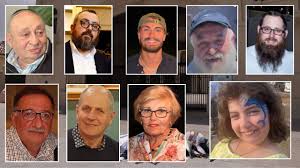
In the aftermath of atrocity, we owe the dead the dignity of being remembered not merely as victims but as the people they were.
Rabbi Eli Schlanger, 63, had built his life around service. Born in Eastern Europe, he had come to Australia as a young man seeking religious freedom. He established himself as a leader of Sydney's Jewish community, known equally for his scholarly depth and his approachability. Congregants recalled a man who remembered names, who visited the sick, who counselled the troubled. He had performed countless weddings and funerals; his own funeral drew thousands.
Alex Kleytman, 87, had survived what no human should be asked to survive. The Nazi concentration camps had taken his parents, his siblings, his childhood. They had not taken his spirit. In Australia, he had rebuilt everything—family, career, faith. He spoke regularly at schools about the Holocaust, determined that memory should outlast him. "Never again," he would tell students. "Never again." That he should die at the hands of hatred, eight decades after Auschwitz, carries a cruelty almost too vast to comprehend.
Matilda, 10, had not yet lived long enough to accumulate the stories that fill obituaries. She liked swimming. She was learning to play the violin. She had recently lost a tooth. Her teachers described her as bright and kind. Whatever she might have become—doctor, artist, mother, leader—was erased in an instant. Her small coffin, carried by weeping relatives, became the attack's most devastating image.
Boris and Sofia Gurman, the couple who died trying to stop the attackers, had been married for thirty-one years. Friends described them as inseparable, the kind of pair who finished each other's sentences. In their final moments, they acted as one—moving toward danger rather than away, choosing courage over self-preservation. Video footage recovered from witnesses' phones shows them approaching the gunmen seconds before the shooting began. They knew. And they went anyway.
Among the other dead were volunteers, athletes, business owners, retirees. Citizens of France, Slovakia, and Israel had come to Bondi that evening, drawn by the celebration or simply by chance. A police officer responding to the emergency was seriously wounded and remains hospitalised. Ages ranged from Matilda's ten years to Kleytman's eighty-seven—a span that encompassed nearly a century of human experience, erased in eleven minutes.
The Reckoning
The days following the massacre brought grief and fury in equal measure.
Prime Minister Anthony Albanese, visibly shaken, addressed the nation within hours. He called the attack "evil"—a word politicians typically avoid—and declared it unambiguously antisemitic. "This was not random violence," he said. "This was targeted hatred. This was terrorism."
The political response came swiftly. National cabinet convened an emergency session and agreed to strengthen firearm controls, acknowledging that existing laws had failed to prevent legally acquired weapons from being turned to mass murder. Officials called for better coordination between intelligence agencies, a tacit admission that the 2019 investigation into Sajid Akram had fallen through bureaucratic cracks. Questions mounted: How had a man flagged for extremist ties obtained multiple gun licences? Who had missed the warning signs?
Yet for Sydney's Jewish community, policy discussions felt distant from the rawness of their loss. Rabbis and community leaders gave voice to a fury that had been building long before the attack. They spoke of years of rising antisemitism—of graffiti on synagogues, of abuse hurled in the streets, of social media accounts spewing hatred with impunity. They accused Australian society of tolerating rhetoric that had now borne its poisoned fruit.
"We warned you," said one community spokesman, his voice breaking. "We told you this was coming. And you called us alarmist."
The charge was not without foundation. Reports compiled before the attack had documented a surge in antisemitic incidents across Australia. Jewish schools had increased security. Synagogues had installed bollards and blast-proof glass. The community had been preparing for violence; they had simply not known when or where it would strike.
Criticism also fell upon the police presence at the event. Subsequent reporting revealed that only two officers had been stationed at Chanukah by the Sea—a gathering of nearly one thousand people at a high-profile location. Whether additional security might have prevented or mitigated the attack remains unknowable, but the question haunted survivors. Why had their safety warranted so little attention?
A Nation Mourns
In the week following the massacre, Australians responded with gestures both intimate and collective.
Thousands queued at blood donation centres, their offerings a literal transfusion of solidarity. Vigils sprouted across Sydney—in Martin Place, in Centennial Park, in suburban community halls. Candles flickered in the darkness, each flame a defiance of the violence that had sought to extinguish light.
At Bondi Beach itself, hundreds gathered for a memorial swim. They waded into the Pacific at dawn, the water cold against their skin, the horizon pink with the promise of another day. It was a peculiarly Australian act of mourning—wordless, physical, communal. Some wept as they swam. Others simply floated, staring up at the endless sky.
International condemnation poured in. Leaders from the United Kingdom, New Zealand, the European Union, and dozens of other nations expressed horror and solidarity. Israel dispatched a support team to assist victims and coordinate with Australian authorities. The Israeli Prime Minister called the attack "an assault on Jews everywhere" and pledged resources for the investigation.
Yet the global response also carried warnings. United Nations human rights experts condemned the massacre but urged against stigmatising Muslim communities for the actions of two radicalised individuals. The fear of backlash—of violence begetting violence—shadowed every statement. In Ireland, Gardaí increased patrols at Jewish community events, a precaution mirrored across Europe.
The Information War
Within hours of the attack, a parallel battle erupted online.
Misinformation spread with the viral efficiency that has become characteristic of modern atrocities. False claims about the perpetrators' identities circulated on social media. Deepfake videos purported to show events that never occurred. Conspiracy theories bloomed in the dark corners of the internet, attributing the attack to shadowy forces ranging from government agents to crisis actors.
Australian authorities scrambled to counter the tide. The Australian Broadcasting Corporation published detailed fact-checks, identifying the most pervasive falsehoods and tracing their origins. But the speed of lies outpaced the speed of truth. By the time corrections reached audiences, the damage was often done.
This phenomenon—the weaponisation of tragedy for ideological purposes—has become a grim feature of twenty-first-century violence. The Bondi Beach massacre was no exception. Within days, the attack had been absorbed into competing narratives, its victims reduced to symbols in arguments they had not chosen to join.
The Weight of History
To understand the depth of trauma inflicted by the Bondi Beach massacre, one must understand what it means to be Jewish in the twenty-first century.
The Holocaust, that industrialised genocide which claimed six million Jewish lives, occurred within living memory. Survivors like Alex Kleytman carried its scars on their bodies and in their minds. Their children and grandchildren inherited a different kind of wound—the knowledge that civilisation itself had nearly succeeded in erasing their people from the earth.
In the decades since 1945, Jews have rebuilt communities across the globe, including in Australia. They have contributed disproportionately to science, medicine, law, the arts. They have integrated into societies while maintaining distinct traditions. And yet the hatred has never fully died. It mutates, finding new hosts and new justifications—sometimes cloaked in religious extremism, sometimes in political ideology, sometimes in nothing more than ancient prejudice dressed in modern clothes.
The attack on Chanukah by the Sea was not an isolated act of madness. It emerged from a global resurgence of antisemitism that has alarmed observers across the political spectrum. From Pittsburgh to Halle to Jersey City to Bondi, Jewish communities have found themselves targets of violence that many had hoped belonged to the past.
That an 87-year-old Holocaust survivor should be murdered at a Hanukkah celebration—a festival commemorating survival against impossible odds—carries a symbolism almost too heavy to bear. Kleytman had outlived the Third Reich by eight decades. He had watched empires rise and fall, had seen humanity land on the moon and invent the internet. He had believed, perhaps, that the worst was behind him.
He was wrong.
What Comes Next
As funerals concluded and the wounded began their long recoveries, Australia confronted uncomfortable questions about what kind of society it wished to be.
The debate over hate speech, long simmering, erupted into public view. Civil libertarians warned against overreach; community advocates demanded stronger protections. Politicians promised action while carefully avoiding specifics. The tension between free expression and communal safety—a tension inherent in every liberal democracy—had found its sharpest expression.
Firearm laws, too, faced renewed scrutiny. Australia had prided itself on the reforms enacted after Port Arthur, which had dramatically reduced gun violence. Yet the Akrams had navigated those laws successfully, acquiring weapons through legal channels. The system designed to prevent mass shootings had permitted one. How this failure occurred, and how it might be prevented in future, became subjects of intense investigation.
For the Jewish community, the path forward remained uncertain. Some spoke of emigration, of seeking safety in Israel or elsewhere. Others vowed to remain, to refuse the terrorists the victory of displacement. Security measures would increase; the days of unguarded celebrations had ended. A community that had sought normalcy would now live, once again, behind barriers and checkpoints.
The Persistence of Light
Hanukkah, the festival interrupted by murder, carries a message that has sustained Jewish communities through millennia of persecution. When the Maccabees reclaimed the Temple in Jerusalem, they found only enough consecrated oil to light the menorah for a single day. Miraculously, it burned for eight.
The lesson is not subtle: light persists against darkness. Hope survives despair. A people determined to endure will endure.
On the eighth night of Hanukkah 2025, services continued across Australia. Menorahs were lit in homes and synagogues, their flames flickering as they had for over two thousand years. The dead were mourned, but the living carried on. It was, perhaps, the only possible response to an attack designed to extinguish not just lives but spirit.
At Bondi Beach, the site of so much horror, someone left flowers beside the temporary memorial. The card attached bore a simple message, handwritten in careful script:
"You are not forgotten. Your light endures."
The Pacific rolled on, indifferent to human tragedy, its waves breaking endlessly against the shore. But those who gathered to grieve understood what the ocean could not: that meaning is made by those who insist upon it, that memory is a choice, that darkness—however deep—is never permanent.
Sixteen flames had been extinguished on 14 December 2025. Millions more burned in their honour.