

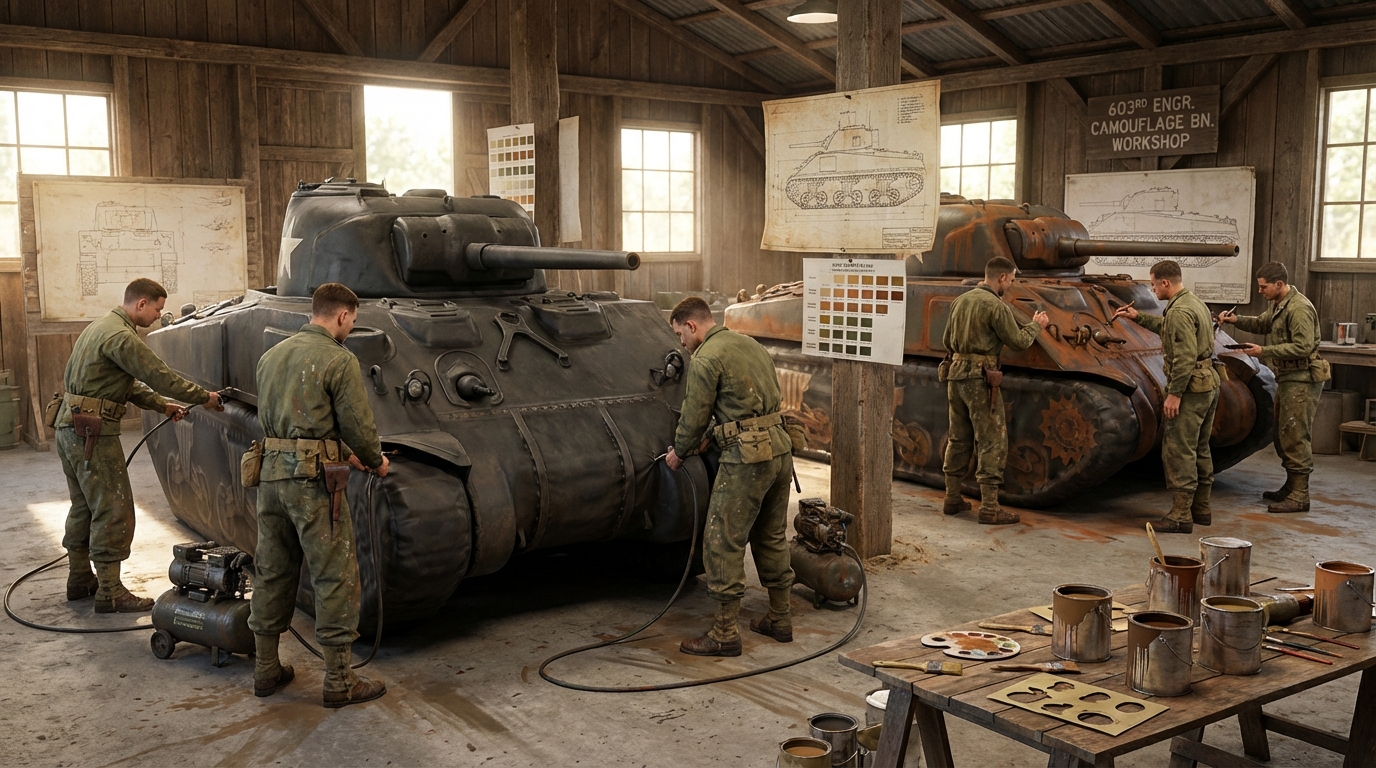
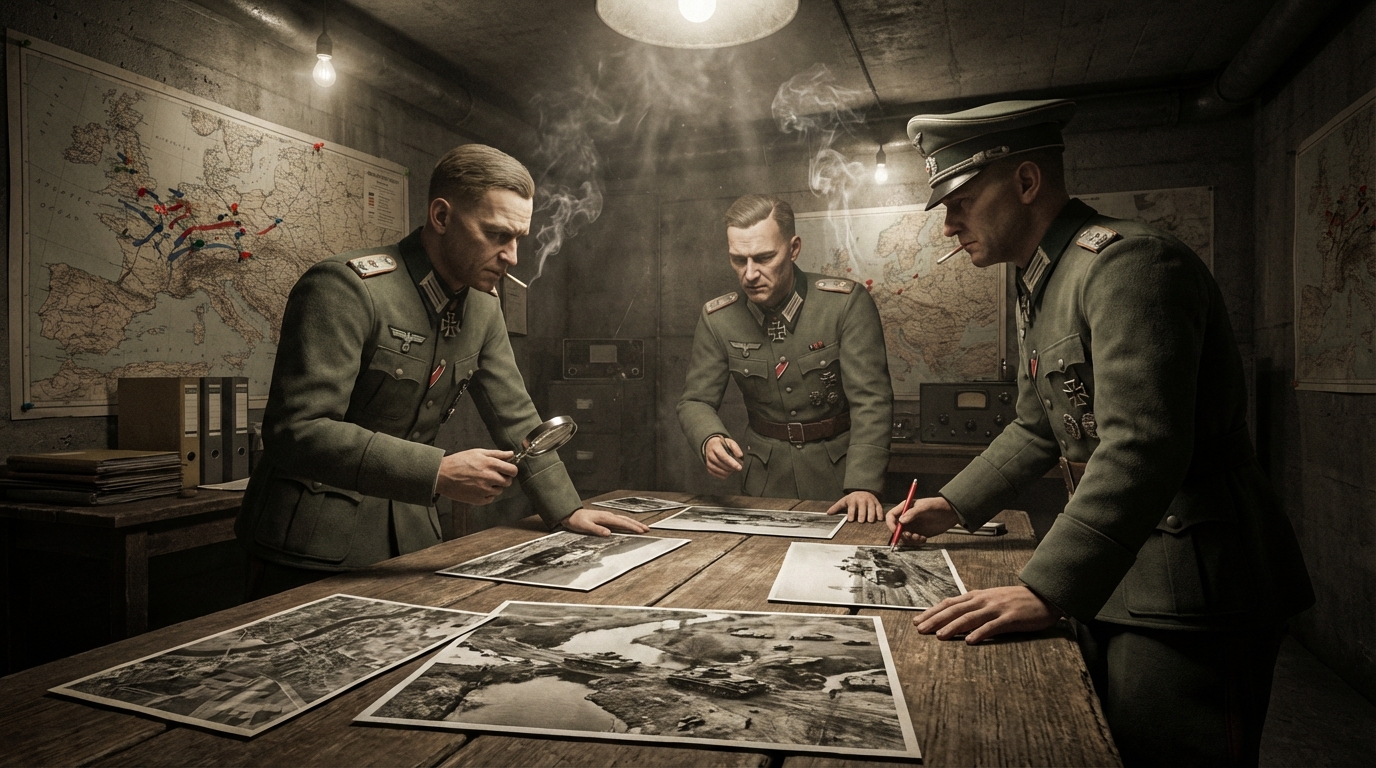
March 1945. German intelligence is staring at reconnaissance photos of the Rhine River, and they're seeing exactly what you'd expect to see before a major American offensive. Tank formations. Artillery positions. Supply dumps. Their radio intercepts are picking up communications from the 30th and 79th Infantry Divisions. Their listening posts are hearing the unmistakable sounds of pontoon bridges being constructed, armour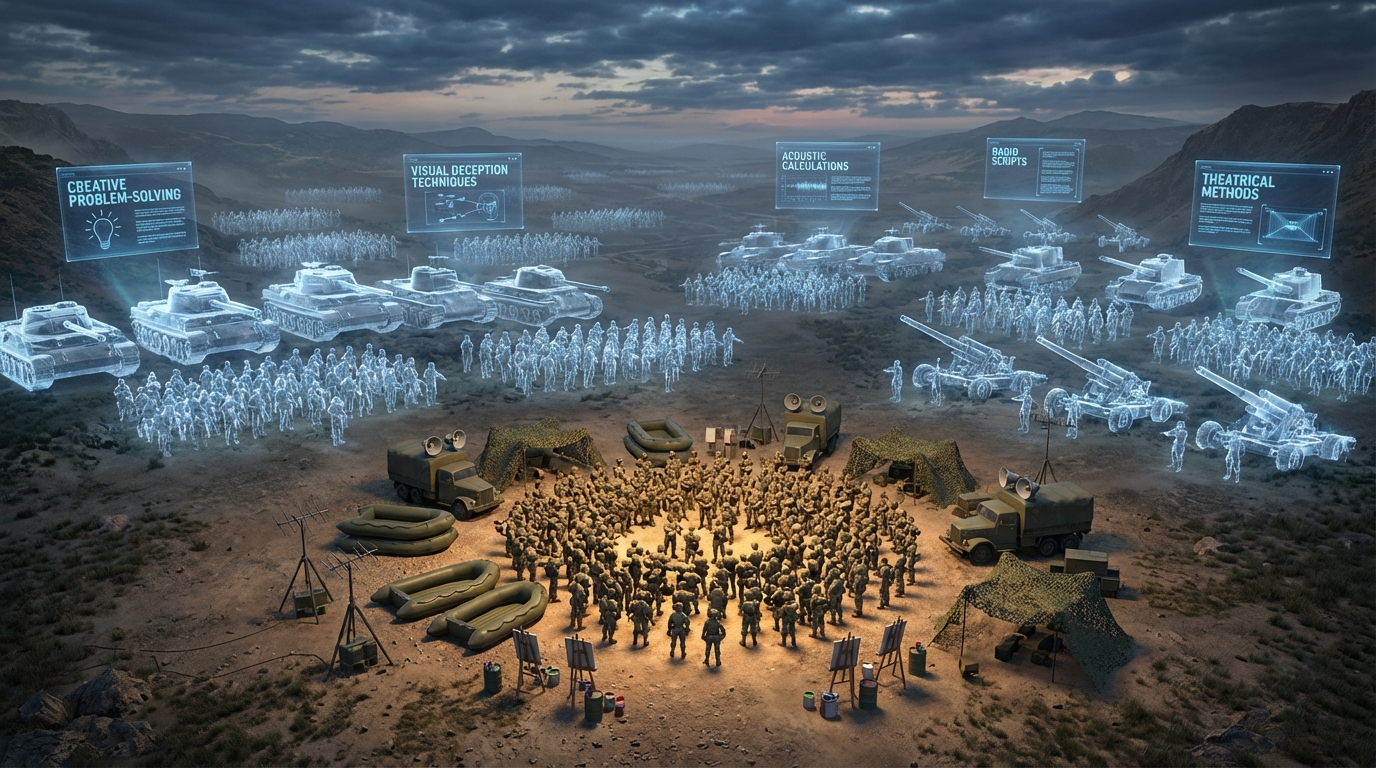 moving into position, thousands of men preparing to cross that river and punch into the German heartland.
And every single bit of it was fake.
I'm not talking about a few dummy positions here and there. I'm talking about an elaborate, coordinated theatrical production involving inflatable tanks, massive speaker systems, fake radio networks, and actors in military uniforms. I'm talking about eleven hundred men whose job was to make the German military believe they were facing tens of thousands of troops that simply didn't exist.
This is the story of the Ghost Army. And the deeper I dug into this, the stranger it got.
Let me set the scene for you. It's early 1944, and the US Army has a problem. They've been watching what the British pulled off in North Africa, where Montgomery managed to completely fool Rommel at El Alamein using dummy tanks and false radio traffic. And American military planners are realizing something crucial about modern warfare. It's not just about who has more guns or more men. It's about who can manipulate the enemy's perception of reality.
Think about it. By 1944, you've got aerial reconnaissance that can photograph individual vehicles from thousands of feet up. You've got signals intelligence operations tracking radio communications across entire theatres of war. You've got experienced intelligence analysts who've been trained specifically to detect deception attempts. The battlefield has become this incredibly complex information environment where what the enemy thinks you're doing matters almost as much as what you're actually doing.
So on January 20, 1944, at Camp Forrest, Tennessee, the Army activates something completely unprecedented. The 23rd Headquarters Special Troops. And here's where it gets interesting. Instead of recruiting soldiers with traditional military backgrounds, they start sending recruiters to art schools. Advertising agencies. Theatre companies. Radio stations.
They're looking for commercial artists. Set designers. Architects. Sound engineers. People who understand visual perspective, acoustic properties, camouflage principles, and dramatic performance. They're assembling what might be the strangest military unit in American history.
And the mission? Simulate the presence of entire divisions. We're talking forces of fifteen to thirty thousand men. Using only eleven hundred guys and a whole lot of creative problem-solving.
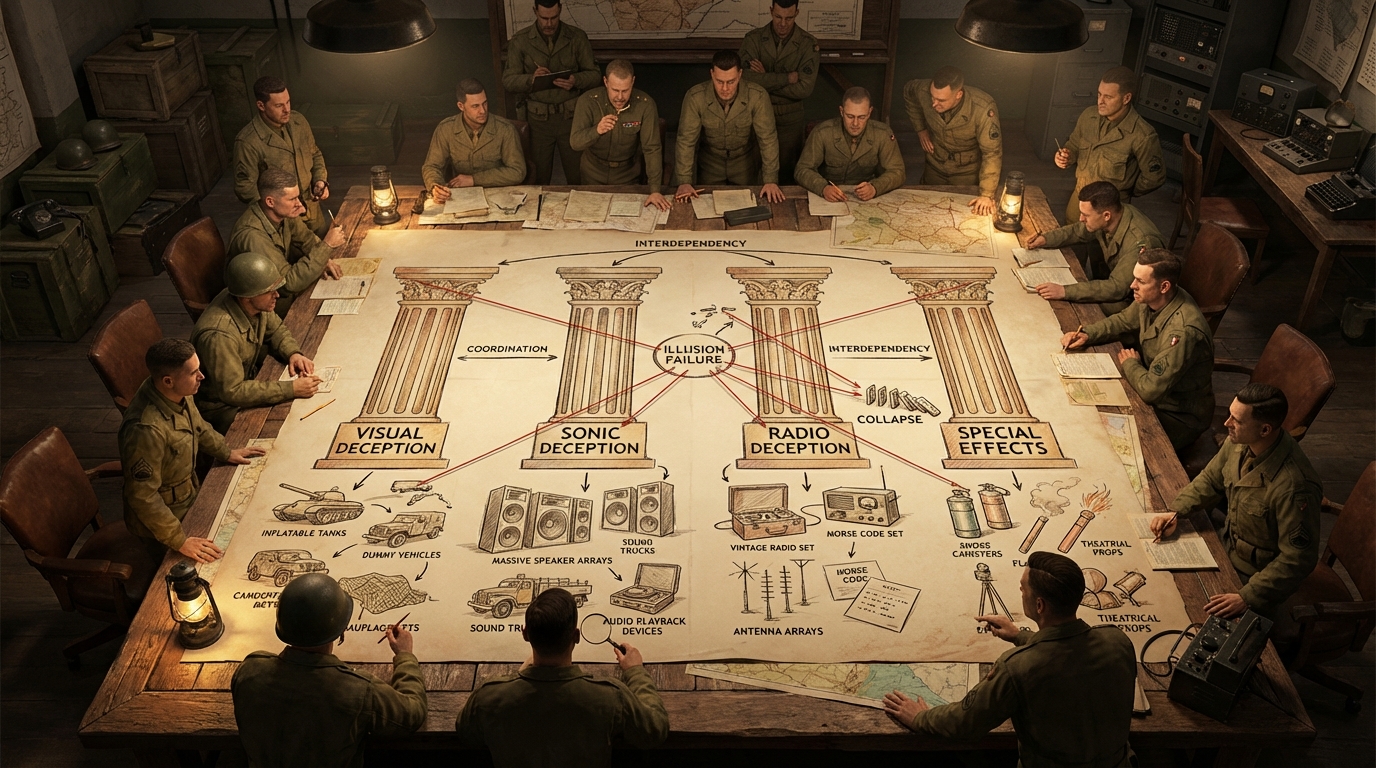
Now, I need to walk you through how this actually worked, because the level of detail is absolutely wild. The Ghost Army operated on what they called four pillars of deception, and each one had to work perfectly with the others or the whole illusion would collapse.
First pillar. Visual deception. The 603rd Engineer Camouflage Battalion was responsible for this, and their primary tools were inflatable decoys. I'm talking meticulously detailed rubber and canvas replicas of M4 Sherman tanks, 155mm howitzers, half-tracks, supply vehicles. These weren't crude balloon animals. They were engineered to withstand photographic analysis.
Each inflatable Sherman weighed about ninety-three pounds. A real Sherman? Thirty tons. But a four-man crew could inflate one of these things in twenty to thirty minutes, and from the air, through a reconnaissance camera, it looked absolutely real. They had realistic gun barrels, authentic track patterns, even weathering effects to simulate battle wear.
But here's the thing I found fascinating. The artists in this unit understood something crucial. It wasn't enough to just put fake tanks in a field. Real armored units leave environmental signatures. Crushed vegetation. Muddy ruts. Oil stains. Supply dumps. Maintenance areas. The debris of military occupation.
So they'd use bulldozers to carve realistic tank tracks through the mud. They'd arrange empty crates to simulate supply operations. They'd hang laundry lines to suggest off-duty personnel. They learned to think like enemy photo interpreters, deliberately creating imperfect camouflage so German analysts would feel like they'd discovered something real. A partially concealed tank was more convincing than one sitting completely exposed.
Second pillar. Sonic deception. This is where the 3132nd Signal Service Company comes in, and honestly, this might be the most technologically impressive part of the whole operation.
Working with engineers from Bell Laboratories, they assembled a comprehensive library of military sounds recorded at actual installations. Tank engines starting and stopping. The grinding of treads on different surfaces. Convoy traffic. Pontoon bridge construction. Every acoustic signature you'd expect from a major military formation.
And they had these massive five-hundred-pound speaker systems mounted on half-tracks. Under optimal atmospheric conditions, these things could project audio up to fifteen miles. Fifteen miles. German listening posts across the Rhine would hear what sounded like a massive engineering operation, armor moving into position, thousands of men preparing for an assault.
The sound engineers had to function like audio directors on a movie set. They'd mix and sequence recordings to create realistic operational scenarios. The approach of an armored column, complete with vehicles stopping for maintenance, idling during tactical pauses, resuming movement. The audio signature of engineers building river crossings at night. Hammering. Machinery. The splash of equipment entering water.
And here's a detail that really stuck with me. The audio was so convincing that it frequently fooled nearby Allied units. American soldiers would start preparing for armor reinforcements that existed only as sound waves. The Ghost Army had to coordinate carefully to prevent their own side from being deceived.
Third pillar. Radio deception. And this might have been the most technically demanding part of the whole operation.
German signals intelligence was sophisticated. They were constantly monitoring Allied communications, tracking unit locations, analyzing message patterns, even identifying individual radio operators by their transmission characteristics. Every real American division had a distinctive electronic fingerprint, specific communication patterns, message volumes, transmission schedules.
The Signal Company Special had to study and replicate these signatures with perfect accuracy. They created entire phantom radio networks. Division headquarters communicating with regiment commanders, who coordinated with battalion leaders. The message volume and timing had to match realistic patterns. Too little traffic suggests a quiet sector. Too much suggests something unusual is happening.
Some accounts describe how operators learned to mimic individual radio operators' distinctive Morse code styles. Intelligence analysts called this an operator's fist. German intelligence tracked these individual signatures to monitor unit movements, so Ghost Army operators had to impersonate specific people, maintaining twenty-four-hour communication schedules that matched the patterns of genuine military units.
They transmitted routine administrative traffic alongside tactical reports. Mundane stuff. Supply requests. Personnel issues. The boring everyday communications that German intelligence would expect from active combat divisions. That attention to mundane detail was what made the deception work.
Fourth pillar. What they called atmosphere. The human element.
Ghost Army personnel would adopt the identities of units they were impersonating. They'd wear the appropriate shoulder patches, visit cafes and shops in liberated towns, engage in seemingly casual conversations about their unit's movements and capabilities. German intelligence maintained civilian informant networks, so these soldiers had to make information appear accidental. Complaining about upcoming operations. Discussing unit strength in ways that seemed natural rather than scripted.
They'd stage convoy deceptions using minimal resources. Two trucks and a jeep would drive through a village, circle back via hidden roads, and pass through the same checkpoint repeatedly. Creating the impression of an endless column of reinforcements.
Even garbage became a tool of deception. They'd scatter appropriate debris around their positions. Empty ration containers. Cigarette butts. Discarded equipment. The waste signature of a large military unit. Every single detail had to be authentic because intelligence analysts examined everything.
Now let me tell you about their biggest operation. Operation Viersen. March 1945. The Allies are preparing for the final assault across the Rhine into Germany, and the Ghost Army is tasked with their most complex deception yet.
The US Ninth Army is assigned to cross the Rhine near Wesel. German commanders know major crossing attempts are coming and they've prepared defensive positions accordingly. The Ghost Army's job is to impersonate the 30th and 79th Infantry Divisions in a sector south of the main crossing area. Create uncertainty. Maybe pull German forces away from where the real crossing will happen.
They deployed everything. Hundreds of inflatable tanks, trucks, artillery pieces positioned across the countryside. Entire phantom installations. Motor pools. Supply dumps built from empty crates. Command posts with appropriate signage. Maintenance areas suggesting the logistical infrastructure for major combat operations.
The sound trucks broadcast hours of recordings. Pontoon bridge construction. Assault boat movement. The acoustic signature of forces preparing for amphibious warfare. All sequenced to match realistic operational timelines.
Radio operators created comprehensive phantom communication networks. Logistical coordination. Tactical planning. Routine administrative traffic. Everything German signals intelligence would expect from divisions preparing for a major river crossing.
And Ghost Army personnel in appropriate division insignia conducted visible reconnaissance. Officers with maps surveying the terrain. Enlisted men in local establishments talking about upcoming operations.
When the actual Ninth Army crossing began on the night of March 23-24, 1945, Operation Viersen had done its job. The deception helped create uncertainty in German intelligence assessments, contributed to confusion about Allied force dispositions, and supported the success of the Rhine crossing.
Now here's something I need to address, because there's a persistent myth about the Ghost Army that really bothers me. The romanticized version of this story suggests these guys were safely behind the lines, pulling clever tricks far from danger.
That's not what happened.
Think about the nature of their mission. To convince German intelligence that weak sectors contained significant forces, they had to place their deceptions where enemy reconnaissance could observe them. That meant working within artillery range of German positions. In forward areas that exposed them to enemy fire.
And they had no real protection. Their tanks were rubber and canvas. They carried standard infantry weapons for self-defense, but they lacked the armor and heavy weapons of the units they were impersonating. If the Germans discovered the deception and attacked, or if artillery targeted positions where they believed American forces were concentrated, Ghost Army personnel would face deadly fire with nothing but their small arms.
The unit suffered real casualties. Three men killed in action. Dozens wounded. Some accounts cite approximately thirty wounded. German artillery, responding to perceived troop concentrations, shelled areas where Ghost Army personnel were operating their deceptions.
The psychological strain was enormous. These men, many of whom had been artists and designers in civilian life, found themselves in situations where errors in their performance could impact major operations involving thousands of other soldiers. They worked primarily at night under blackout conditions, knowing any inappropriate light or sound could draw deadly attention.
They rarely stayed in any position more than a few days. Arrive after dark. Establish elaborate deceptions while maintaining noise discipline. Sustain the illusion under combat conditions. Rapidly dismantle everything and move before dawn.
And who were these guys? That's what really gets me about this story.
Bill Blass. The fashion designer. During the war, he was creating unit insignia, designing camouflage patterns, developing visual elements for phantom divisions. The same skills that would eventually make him a fashion icon were being applied to military deception. He later said his wartime experiences taught him about visual impact and the psychology of appearance.
Ellsworth Kelly. His minimalist paintings eventually hung in the world's greatest museums. But during the war, he was painting camouflage patterns on inflatable tanks. He credited his Ghost Army service with teaching him fundamental lessons about the relationship between art and environment.
Art Kane. The photographer famous for that iconic 1958 photograph of fifty-seven jazz musicians in Harlem. He served in the Ghost Army, and his experience understanding how images could be constructed and interpreted informed his later work.
Many of these guys kept sketchbooks throughout their service. Their drawings and paintings provide this unique perspective on World War II. Inflatable tanks in Norman hedgerows. Exhausted soldiers beside fake artillery at dawn. The surreal juxtaposition of elaborate theatrical productions staged on actual battlefields.
And then the war ended. May 1945. And these eleven hundred men went home bound by strict security classifications that prevented them from discussing any of it.
The Pentagon viewed their techniques as vital for the emerging Cold War. Sonic deception. Radio spoofing. Advanced camouflage. Psychological manipulation. They didn't want the Soviets learning any of this.
So the veterans were instructed to give only vague descriptions of their service. Generic engineering or signal units. They couldn't explain why they'd spent the war creating illusions while their contemporaries fought conventional combat. For artists like Blass and Kelly, this meant concealing formative experiences that had profoundly shaped their development.
Decades passed. Some information emerged gradually. Smithsonian Magazine published an article in April 1985. But comprehensive operational details remained classified until 1996, when major declassification finally allowed researchers full access to the records.
Recognition came slowly. Very slowly. The effort was driven by surviving veterans, their families, and military historians. And it finally culminated in 2022, when Congress enacted legislation awarding the unit the Congressional Gold Medal. The highest civilian honor Congress can bestow.
The medal was formally presented on March 21, 2024, in a ceremony at the Capitol. By that time, only a handful of the original eleven hundred men were still alive to receive it.
So what's the legacy here? What does this story actually mean?
The tactical and strategic principles the Ghost Army pioneered didn't disappear after 1945. During the Cold War, the Army kept developing psychological operations and deception capabilities based on what these guys figured out. Sonic deception evolved into electronic warfare. Visual deception adapted to thermal imaging, radar, satellites.
Today? The Ghost Army's legacy shows up in information operations, cyber warfare, electronic countermeasures. Digital spoofing and information warfare instead of inflatable tanks and sound trucks. But the core principle remains exactly the same. Manipulate the adversary's perception of reality to achieve tactical and strategic advantages.
Modern military planners still study Ghost Army operations. These guys demonstrated that specialized units could achieve strategic impact through understanding enemy intelligence methods and decision-making processes. That unconventional approaches could complement conventional operations in ways traditional combat units simply couldn't match.
The story of the 23rd Headquarters Special Troops is one of the most remarkable chapters in military history. Eleven hundred artists, sound engineers, radio operators, and actors proved that imagination and meticulous planning could achieve significant tactical impact. That elaborate deceptions could support major military operations. That art and war, these seemingly opposite domains, could actually be combined effectively.
These men accepted significant personal risk. They operated close to enemy positions without heavy weapons or armor. They suffered real casualties while creating illusions. And then they came home and stayed silent for decades, unable to talk about experiences that had fundamentally shaped who they were.
Their story reminds us that warfare involves human psychology and perception as much as technology and firepower. That creative solutions can sometimes achieve results conventional approaches simply cannot.
The Ghost Army demonstrated that effective military force sometimes depends less on destruction than on the ability to exist convincingly in the enemy's imagination. Which, when you think about it, might be the most powerful place to be.
Few units in World War II accomplished their mission through such unconventional means. Or demonstrated so convincingly that carefully executed deception could achieve meaningful tactical and strategic results.
Eleven hundred artists. Rubber tanks. Giant speakers. Fake radio networks. And a secret kept for half a century.
That's the Ghost Army. And that's one hell of a story.