
In the early morning hours of April 30, 1943, His Majesty's Submarine Seraph surfaced in darkness approximately 1,600 yards off the southwestern coast of Spain near the port of Huelva. The crew gathered on deck for what their commander, Lieutenant Norman Jewell, described as a burial at sea. The officers removed their caps. Someone read from the 39th Psalm. Then they slid a body into the water and watched it drift toward shore on the incoming tide.
The corpse belonged to Glyndwr Michael, a Welsh vagrant who had died in a London warehouse after consuming rat poison. In life, Michael had been a drifter of no particular consequence, a man with no family willing to claim his body and no achievements to mark his passing. In death, he became Major William Martin of the Royal Marines, a courier carrying documents of supreme importance to the Allied war effort. The transformation of this anonymous corpse into a fictional military officer represented one of the most audacious deception operations of the Second World War.
The concept originated in 1939 from a memorandum circulated by Rear Admiral John Godfrey, Director of Naval Intelligence, though the document bore the creative fingerprints of his personal assistant, Lieutenant Commander Ian Fleming, who would later achieve fame as the creator of James Bond. The memorandum, known as the Trout Memo because it compared deceiving an enemy to fly fishing, contained dozens of proposed schemes. Number 28 on the list was titled "A Suggestion (not a very nice one)" and proposed planting misleading documents on a corpse that would be found by the enemy.
The idea lay dormant until late 1942, when Flight Lieutenant Charles Cholmondeley of MI5 revived it. Cholmondeley, a man described by colleagues as possessing a flair for madcap ideas, had been appointed secretary of the Twenty Committee, the small inter-service intelligence team responsible for managing double agents. His initial proposal, codenamed Trojan Horse, was rejected as unworkable, but the committee recognized potential in the concept. John Masterman, the committee chairman, assigned the naval representative, Lieutenant Commander Ewen Montagu, to work with Cholmondeley on developing the plan further.
The timing proved fortuitous. At the Casablanca Conference in January 1943, Allied planners had agreed to invade Sicily no later than July. The strategic logic was compelling. Control of Sicily would open Mediterranean shipping lanes to Allied vessels and provide a launching point for the invasion of continental Europe through Italy. The problem was that Sicily's strategic value was equally obvious to the Germans. Winston Churchill reportedly remarked that "everyone but a bloody fool would know that it's Sicily."
The Allies needed to convince the Germans that Sicily was a feint and that the real invasion would strike elsewhere. Adolf Hitler was already concerned about a possible Allied assault on Greece and the Balkans, which supplied raw materials essential to the German war machine, including copper, bauxite, chrome, and oil. The deception planners resolved to exploit this anxiety.
Finding a suitable corpse proved more difficult than anticipated. Bentley Purchase, the coroner for the Northern District of London, warned Montagu that "even with bodies all over the place, each one has to be accounted for." On January 28, 1943, Purchase contacted Montagu with news that he had located a body meeting their requirements. Glyndwr Michael had died after ingesting phosphorus from rat poison. The coroner believed the small amount of poison remaining in the system would not be detectable in a body supposedly recovered from the sea after several days. The pathologist Sir Bernard Spilsbury advised that Spanish authorities, as Roman Catholics, were generally averse to conducting autopsies unless absolutely necessary.
Montagu and Cholmondeley set about constructing what intelligence professionals call a "legend," a complete fictional identity for their corpse. They named him Captain William Martin, acting major, of the Royal Marines, assigned to Combined Operations Headquarters. The name Martin was selected because several men of approximately that rank with that name already served in the Royal Marines. The rank of acting major made him senior enough to be entrusted with sensitive documents but not so prominent that anyone would be expected to recognize him.
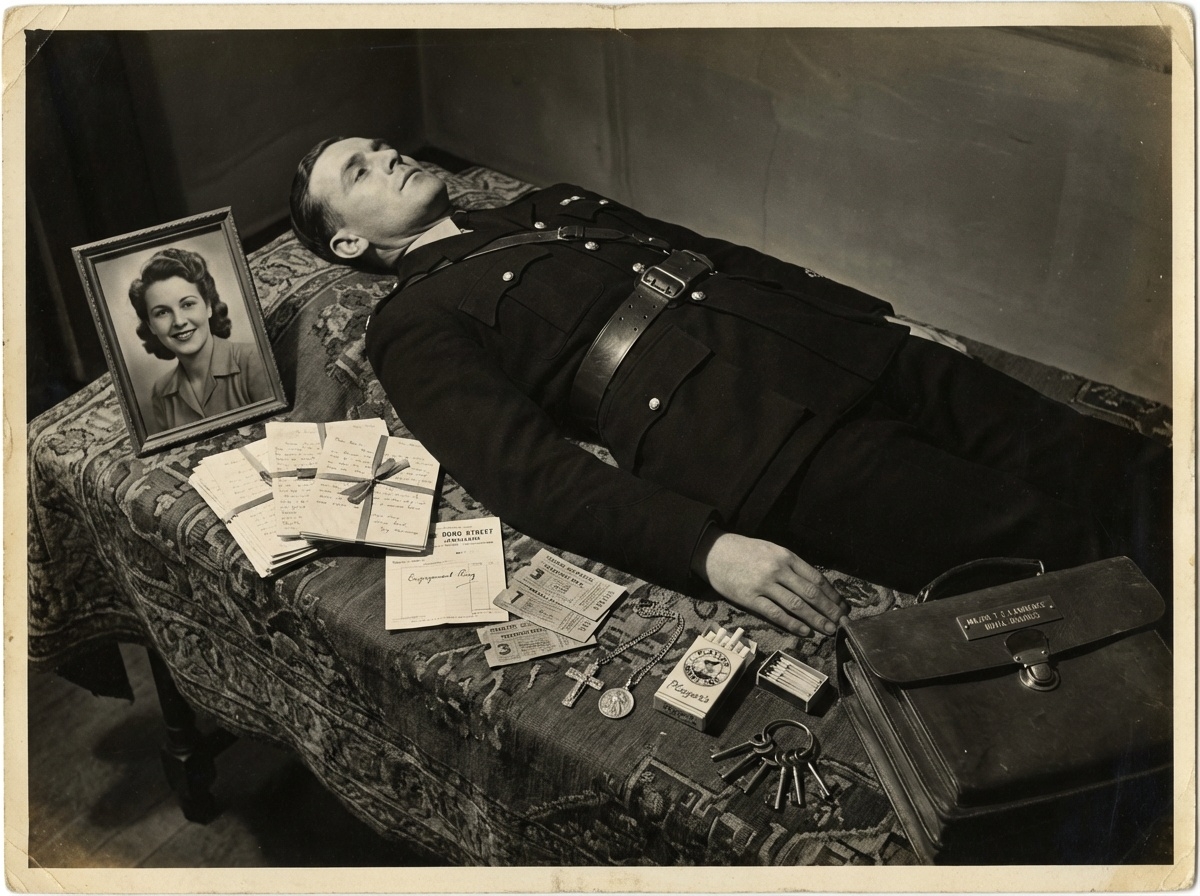
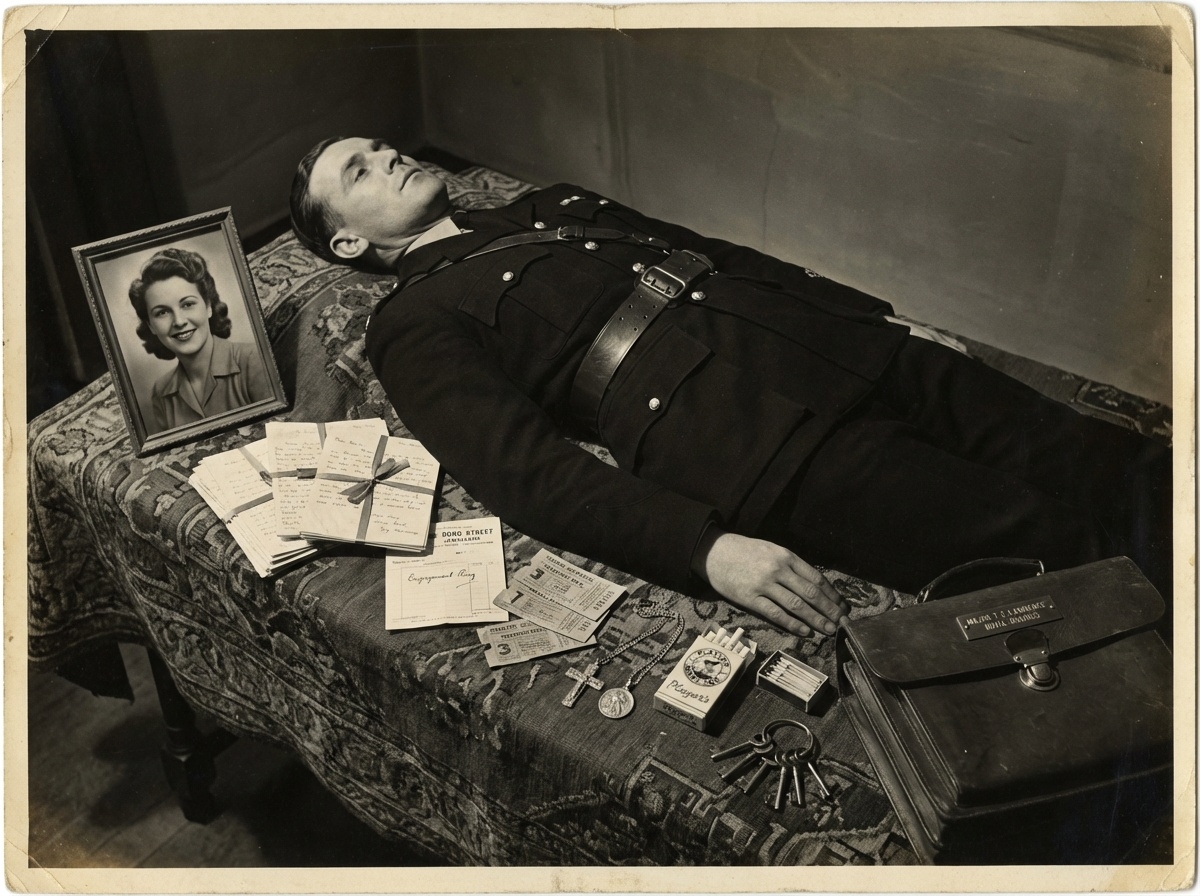
The creation of Major Martin's identity consumed weeks of meticulous work. The planners provided him with a fiancée named Pam, whose photograph was actually an MI5 clerk named Jean Leslie. They composed two love letters in her voice. They obtained a receipt for a diamond engagement ring costing fifty-three pounds ten shillings and sixpence from a Bond Street jeweler. They fabricated correspondence from Martin's father, described as pompous and pedantic in the manner of Edwardian paternal figures, along with a demand from Lloyds Bank for payment of an overdraft. They added theatre ticket stubs, a book of stamps, a silver cross, a St. Christopher medallion, cigarettes, matches, a pencil stub, keys, and a receipt for a new shirt from Gieves. The accumulation of mundane personal effects, known in espionage circles as "pocket litter," would establish Major Martin as a real person living a real life.
Photographing the corpse for the naval identity card proved impossible, as the images were obviously those of a dead man. Montagu and Cholmondeley searched for a living person who resembled the body and found Captain Ronnie Reed of MI5, who agreed to be photographed in a Royal Marine uniform for the identity card.
The critical documents were placed in an official briefcase handcuffed to the corpse. The primary item was a personal letter from Lieutenant General Sir Archibald Nye, vice chief of the Imperial General Staff, to General Sir Harold Alexander, commander of the Anglo-American 18th Army Group in North Africa. After several failed attempts at drafting appropriately natural-sounding text, Nye wrote the letter himself. The document discussed various military matters, including the unwanted tendency of American forces to award Purple Hearts to British servicemen serving alongside them, before arriving at its essential purpose. The letter stated that recent German reinforcement of Greece and Crete had necessitated an increase in the Allied assault force, specifying troop movements to Cape Araxos and Kalamata. It identified Sicily as a "cover target" for the actual assault on Greece.
A second letter from Vice Admiral Lord Louis Mountbatten introduced Major Martin to Admiral of the Fleet Sir Andrew Cunningham as an amphibious warfare expert on loan "until the assault is over." Montagu inserted a clumsy joke about sardines, hoping the Germans would interpret it as a reference to Sardinia.
On April 17, 1943, Montagu and Cholmondeley dressed the corpse and placed it in a steel canister packed with dry ice. They transported the container by van to the Holy Loch in Scotland, where they transferred it to HMS Seraph. The submarine departed on April 19 and reached the Spanish coast on April 29.
Huelva was selected because British intelligence knew that German agents operated actively in the region and that local Spanish authorities were sympathetic to the Axis powers. The plan depended on the Spanish finding the body, examining the documents, sharing copies with German intelligence, and then returning the originals to the British with assurances that they had not been opened.
The operation proceeded precisely as designed. A Spanish fisherman discovered the body on the morning of April 30. Local authorities retrieved the briefcase and its contents. Within days, copies of the documents reached the Abwehr in Madrid and were transmitted to Berlin. When the British formally requested return of Major Martin's effects, the Spanish complied, insisting the briefcase had never been opened. Forensic examination by British experts determined the documents had been removed, photographed, and carefully replaced. A single black eyelash that Montagu had placed inside one letter was missing.
Ultra decrypts of German communications confirmed that the Nazi high command had accepted the documents as genuine. German strategic assessments concluded that the Allies planned major assaults on Greece and Sardinia, with Sicily serving merely as a diversionary target. In response to this intelligence, the Germans reinforced their positions in Greece and Sardinia. Sicily received no additional troops.
On July 9, 1943, Allied forces landed on the beaches of Sicily in Operation Husky. The island fell within a month, faster than planners had anticipated and with fewer casualties than expected. The capture of Sicily opened Mediterranean shipping lanes to Allied vessels and triggered political collapse inside Italy. Within weeks, Benito Mussolini was overthrown. Italy would eventually switch sides and join the Allies.
Glyndwr Michael, the Welsh vagrant who had died alone in a London warehouse, was buried in Huelva with full military honors under the name Major William Martin. His gravestone reads: "Dulce et decorum est pro patria mori," the ancient Latin phrase meaning "It is sweet and fitting to die for one's country." The Commonwealth War Graves Commission later added a second inscription acknowledging that Michael "served as Major William Martin, RM."
The operation remained classified for years after the war. In 1953, Ewen Montagu published an account titled "The Man Who Never Was," which became a bestseller and was adapted into a 1956 British film. The full details of the deception, including the true identity of the corpse, were not officially confirmed until documents were released to the Public Record Office in 1996.
The partnership between Montagu and Cholmondeley demonstrated that in the realm of military intelligence, imagination could prove as valuable as any conventional weapon. They had taken a body nobody wanted, invented a life for it, and used that fiction to alter the disposition of enemy forces across an entire theatre of war. The Germans had trusted their intelligence. They had reinforced the wrong positions. They had protected Greece and Sardinia while leaving Sicily exposed.
Major William Martin never existed. Glyndwr Michael, in life, had accomplished nothing the world would remember. In death, dressed in another man's uniform, carrying another man's letters, he helped change the course of the Second World War.