

There is a building inside Vatican City that does not look like a bank. It sits in the lower floors of a fifteenth-century tower that once served as a dungeon, and for most of the Second World War it operated with a freedom that no commercial bank on earth could match — no taxes, no annual reports, no regulators, no shareholders, and a standing authorization to destroy its own records every decade. Its sole proprietor was the pope. Its location, inside the sovereign territory of a state that the United States had deliberately excluded from its wartime financial blacklist, meant it could move money between enemy nations, across frozen borders, and through channels that every other financial institution in the world was prohibited from using. The bank was established on 27 June 1942. By the time the war ended, it had helped fund escape networks, sustain resistance movements, and channel gold across frontlines — and its architecture would later be exploited by men whose wartime records should have sent them to the gallows rather than to Buenos Aires.
This is one thread. There are dozens.
The story of the Vatican during the Second World War is not the story most people think they know. It is not primarily a story about papal silence, though silence is part of it. It is not primarily a story about hidden Jews, though the hiding of more than four thousand people in Roman convents and monasteries is one of its most remarkable chapters. It is not primarily a story about ratlines, though the escape of Adolf Eichmann, Franz Stangl, and Klaus Barbie through ecclesiastical networks remains one of the most damaging scandals in the modern history of the Catholic Church. It is, before anything else, an intelligence story — the story of how 109 acres of Roman hilltop, defended by a hundred Swiss Guards whom the Pope had quietly ordered to train on submachine guns, became the most important intelligence crossroads in wartime Europe.
The crossroads was not designed. It emerged from the collision of ancient ecclesiastical structures with the pressures of modern total war. The Lateran Treaty of 1929, negotiated between Mussolini and the Holy See, had created something its architects almost certainly did not intend: a dispersed archipelago of sovereign territory scattered across Rome. The extraterritorial properties — the Lateran Palace, the Basilica of Santa Maria Maggiore, the Palazzo di Propaganda Fide, the Cancelleria, dozens of others — enjoyed diplomatic immunity under international law. Italian police could not enter. German soldiers, after September 1943, could not search them without violating the sovereignty of a state that both sides had reasons to respect. These buildings, designed to house ecclesiastical institutions, became safe houses. The legal protections meant to shield the Church’s administrative functions from Italian interference created, as an unintended consequence, a network of spaces across the capital of a belligerent power in which the normal rules of surveillance, search, and seizure did not apply.
Into this network flowed people and information in quantities that no one had anticipated. The Vatican maintained diplomatic relations with thirty-eight nations, including belligerents on every side of the conflict. The British minister, Sir Francis d’Arcy Osborne, was locked inside Vatican City for four years after Italy’s entry into the war, conducting intelligence operations from a guesthouse, managing a cipher he knew had been compromised by his own footman, and funding a rescue network run by an Irish priest who evaded the Gestapo in disguises that ranged from a nun’s habit to a coalman’s soot-blackened overalls. The German ambassador entered freely, because Italy was Germany’s ally, and returned to Rome each evening carrying impressions of Vatican thinking that he cabled to Berlin. The American representative, Myron Taylor, visited intermittently with suitcases of presidential correspondence, leaving his deputy Harold Tittmann to manage the daily intelligence work from the same cramped quarters where Osborne was slowly going stir-crazy. Thirty-five other nations maintained their envoys. Every one of them was also, whether by design or by the logic of the situation, part of the vast intelligence apparatus that the Vatican’s unique position had called into being.
The Pope at the centre of this web was Eugenio Pacelli, Pius XII, elected in the shortest conclave of the twentieth century on the eve of the war he had spent his career trying to prevent. Pacelli spoke ten languages, had served twelve years as nuncio in Germany, had been in Munich on the night of Hitler’s Beer Hall Putsch, and possessed an understanding of German affairs that no other world leader could match. In the winter of 1939–40, he did something that remains one of the most remarkable and least appreciated decisions of the entire war: he agreed to serve as a secret intermediary between German generals plotting to overthrow Hitler and the British government. The channel ran through a Bavarian Catholic lawyer named Josef Müller, who carried messages to the Pope’s private secretary, the Jesuit Robert Leiber, who conveyed them to Pius XII, who relayed them to Osborne, who transmitted them to London. The conspiracy failed — the generals hesitated, France fell, and the strategic premise collapsed — but the Pope had placed the moral authority of the Holy See behind a plot to assassinate a head of state with whom the Vatican maintained formal diplomatic relations. Had the Gestapo discovered the full extent of his involvement, the consequences would have been unforeseeable.
They nearly did. In September 1944, SS investigators searching an Abwehr safe south of Berlin found documentation of the conspiracy’s full extent — records of Müller’s missions to Rome, summaries of conversations with Leiber, elements of the intelligence that had been transmitted to the British through the Pope’s intermediary. The paper trail led directly from the German military opposition through the Vatican to British intelligence. Müller, arrested in April 1943, had endured months of interrogation without breaking. His silence — maintained through Gestapo prisons, through Flossenbürg, through Dachau — preserved the conspiracy’s deepest secret until historians, working from fragments, reconstructed the story decades later.
Leiber, for his part, burned everything. He destroyed his notes, his memoranda, his personal papers, maintaining a deliberate vagueness about dates and details that persisted until his death in 1967. Between Leiber’s ashes and Müller’s silence, the Vatican channel existed for decades as a story told in fragments — a conspiracy reconstructed from the margins of other people’s memoirs and the slow, painstaking work of scholars who understood that the most important document in the archive was sometimes the one that was missing.
The archives that opened on 2 March 2020 changed the terms of the debate, though they did not resolve it. Scholars who had spent careers working from the eleven volumes of carefully curated documents that the Vatican had published in the 1960s and 1970s could now measure their conclusions against millions of pages of raw material — diplomatic cables, internal memoranda, intelligence reports, financial records, and the vast accumulation of supplicant letters from Jews and other persecuted people who had written to the Pope begging for help. What they found was not a single revelation but a confirmation, rendered in granular and sometimes devastating detail, of what the previous generation of scholarship had established on more limited evidence: the Vatican knew. It knew about the systematic extermination of European Jewry from 1942 onward. It knew from multiple independent sources — nuncios, chaplains, bishops, resistance networks, Allied governments, Jewish organizations. And it chose, repeatedly and at the highest level, not to speak publicly in terms commensurate with what it knew.
The silence coexisted with action. The same institution that declined to name the crime sheltered more than four thousand Jews in Roman ecclesiastical properties during the nine months of German occupation. The same pope who would not condemn the deportations authorized — or at minimum tacitly permitted — a rescue operation of extraordinary scope, involving hundreds of religious houses, thousands of individual nuns, priests, and laypeople, and the systematic use of Vatican sovereign territory as sanctuary. The Irish priest Hugh O’Flaherty, operating from the Holy Office building, built a network that saved an estimated 6,500 lives — Allied soldiers, escaped prisoners, Jews, political dissidents, anyone who found their way to the steps of St. Peter’s and was directed, through whispered channels, to a safe house, a convent, or a cellar. O’Flaherty’s methods were improvisational and audacious, his courage was extraordinary, and his postwar relationship with the SS commander who had hunted him — monthly visits to his prison cell, culminating in the man’s baptism — remains one of the most astonishing stories of forgiveness in the twentieth century.
And then came the ratlines. The same networks — the same monasteries, the same parish houses, the same charitable organizations, the same priests — that had hidden the persecuted helped their persecutors escape. Adolf Eichmann obtained false papers through ecclesiastical channels and sailed from Genoa to Argentina. Franz Stangl, commandant of Treblinka, was sheltered by Bishop Alois Hudal and sent to Brazil. Klaus Barbie, the Butcher of Lyon, was put into the ratline by American intelligence and shipped to Bolivia. The architecture of rescue became the architecture of escape, and the transformation was accomplished not through a grand conspiracy but through a convergence of anti-Communist ideology, institutional inertia, individual corruption, and the terrible moral flexibility that comes from operating a system designed to take people at their word and never ask the questions whose answers might be inconvenient.
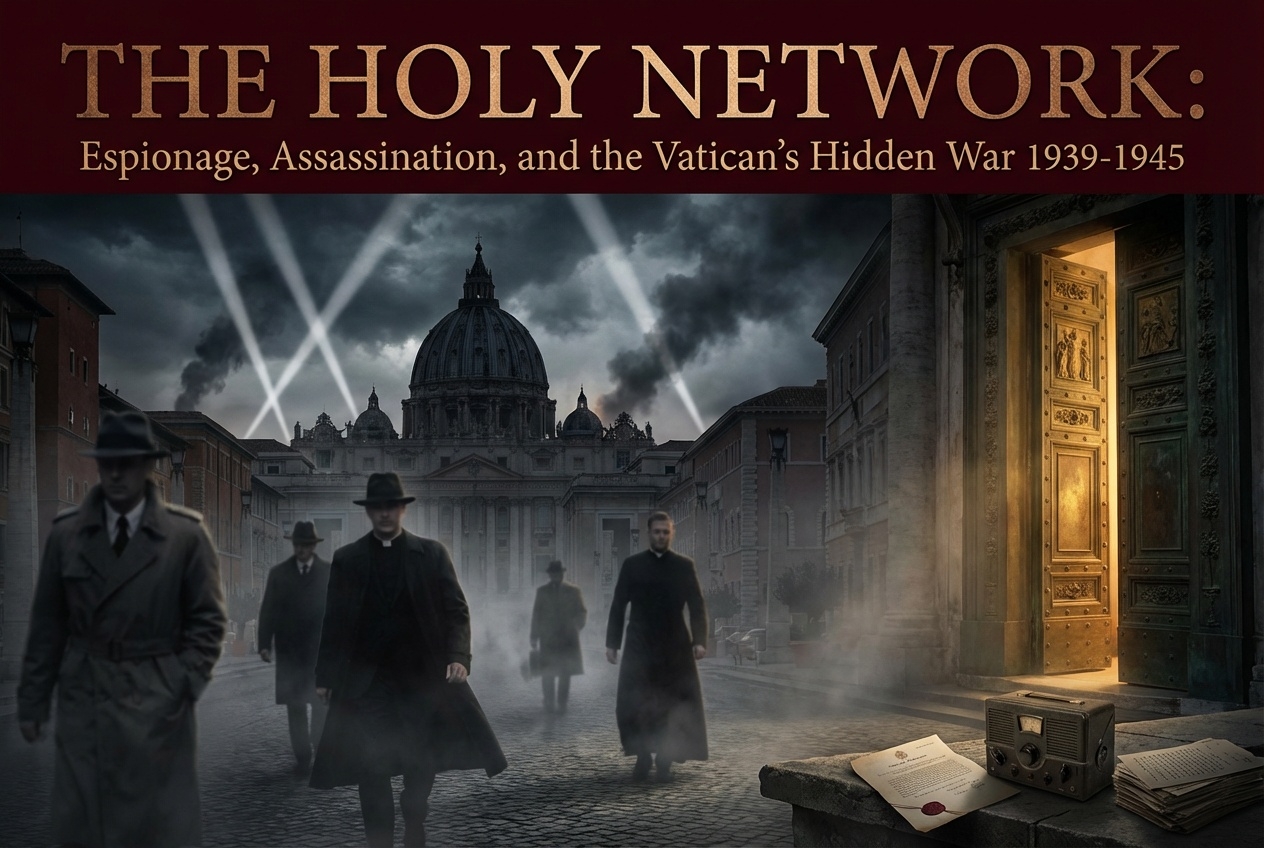
I have spent considerable time with these stories, these archives, these contradictions, and the result is The Holy Network: Espionage, Assassination, and the Vatican’s Hidden War 1939–1945. It is built from the Vatican Apostolic Archives opened in 2020, from declassified American, British, and German intelligence files, and from the private papers and diaries of the diplomats, priests, and spymasters who lived through the events it describes. It is not hagiography. It is not prosecution. It is an attempt to reconstruct, in full, the clandestine machinery through which the world’s oldest institution fought its most dangerous war — and to confront, honestly, the gap between what that institution knew and what it chose to say.
The gap is the hardest part. The intelligence was there. The knowledge was there. The moral authority was there. The will to use them was not — or not sufficiently, or not in the way that the victims needed. The archives have made that wound visible. They have not healed it. History rarely does. But it can, at least, tell the story straight, with the evidence laid out and the judgment left to the reader. That is what this book attempts to do.
Want me to cut a shorter version for a newsletter or social media thread?