
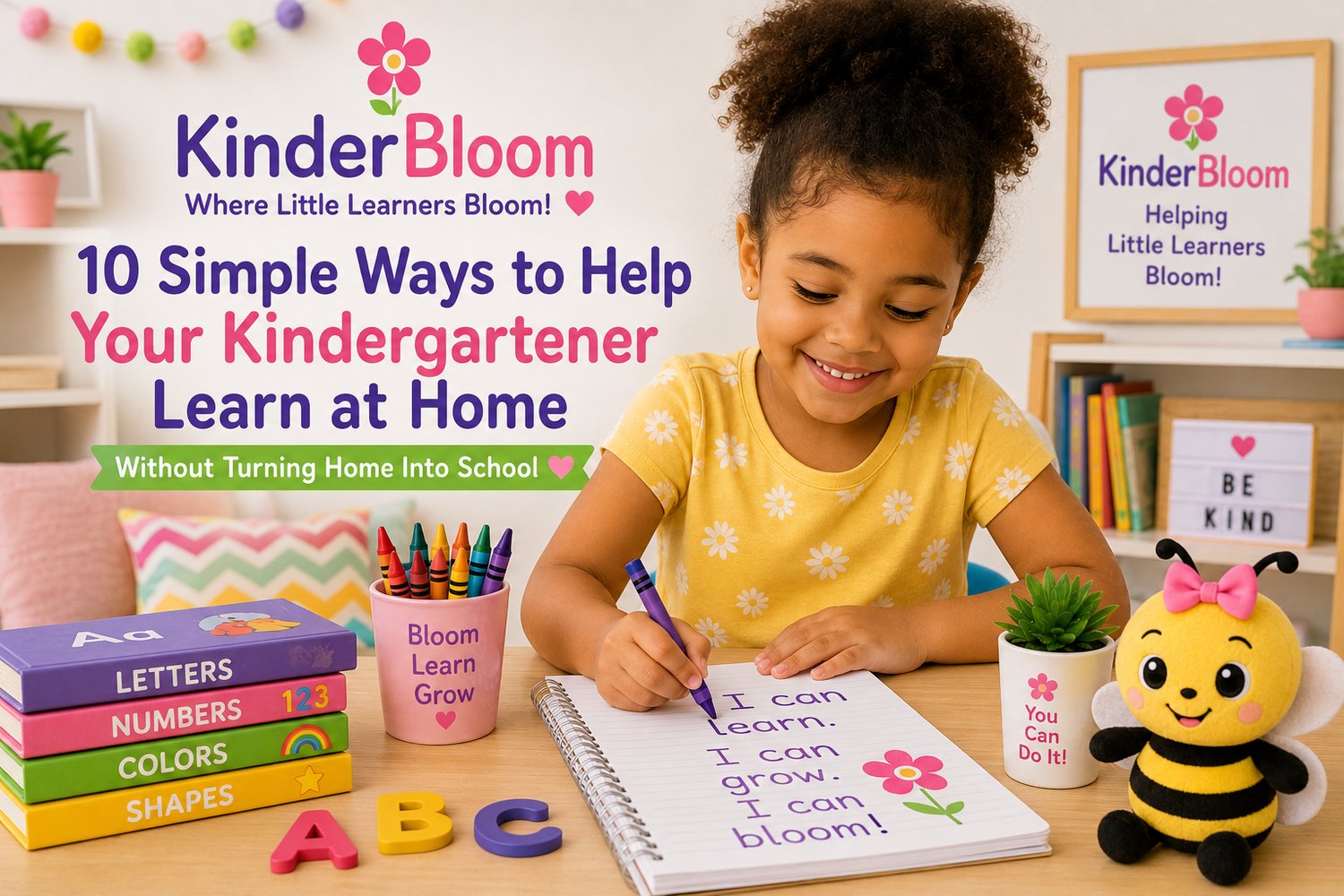
The kindergarten year is filled with exciting firsts—new friends, new routines, new words to read, and new things to discover.
As parents, we naturally want to help our children succeed. But supporting learning at home doesn't mean recreating the classroom at the kitchen table.
In fact, some of the best learning happens during ordinary moments.
At KinderBloom, we believe young children need opportunities to learn, play, explore, and grow. Here are ten simple ways you can support your kindergartener at home without adding pressure to an already busy day.
🌼 1. Read Together Every Day
You don't need an hour-long reading lesson.
Even 10–15 minutes of reading together can become a meaningful part of your child's routine.
While you read, talk about the story. Ask questions such as:
“What do you think will happen next?”
“How is the character feeling?”
“What was your favorite part?”
And don't worry if your child wants to read the same book over and over. Familiar books give children opportunities to notice words, remember story details, and participate in the reading.
🔤 2. Look for Letters Everywhere
Letters aren't just on worksheets.
They're on cereal boxes, street signs, restaurant menus, clothing, toys, and packages.
Turn everyday errands into a letter hunt.
Try asking:
“Can you find an M?”
Or:
“What letter does Target start with?”
These quick conversations help children connect the letters they're learning at school with the world around them.
🐝 3. Play With Beginning Sounds
Beginning sounds are an important step toward learning to read.
Choose a sound and search for things that begin with it.
For example:
/b/ — ball, bed, book, banana
Then make it silly!
“Bella Bloom loves things that begin with /b/. What can we find for Bella?”
Children are practicing phonemic awareness without realizing they're doing a reading activity.
✏️ 4. Let Them Write—Even When It Isn't Perfect
Young children's writing doesn't need to look like adult writing.
Give your child opportunities to make grocery lists, write their name, label pictures, make birthday cards, write notes, or create their own little books.
You may see backwards letters, invented spelling, oversized letters, or a mixture of pictures and words.
That's okay.
Writing develops gradually.
The goal is to help children understand:
“I have ideas, and I can put those ideas on paper.”
🔢 5. Sneak Math Into Everyday Life
Math practice is everywhere.
Count chicken nuggets at dinner.
Count the stairs.
Sort laundry by color.
Compare the sizes of two apples.
Make a pattern with blocks.
Ask your child to bring you five spoons.
These experiences help children develop number sense and understand that math has a purpose beyond completing a worksheet.
🎲 6. Play Games
Board games, puzzles, matching games, memory games, and building activities are wonderful learning tools.
Games can help children practice counting, recognizing numbers, taking turns, following directions, problem-solving, and managing frustration.
Learning how to lose a game gracefully is a kindergarten skill, too!
🖍️ 7. Keep Their Hands Busy
Writing requires strong little hands.
Activities such as coloring, cutting, painting, stringing beads, building with blocks, squeezing play dough, and using child-safe tweezers help strengthen the muscles children use for handwriting.
You don't always need another tracing worksheet.
Sometimes play is the practice.
💬 8. Have Conversations
One of the easiest ways to support literacy development is simply to talk with your child.
Ask about their day—but try going beyond:
“How was school?”
Instead, ask:
“What made you laugh today?”
“What was something difficult?”
“What did you learn that you didn't know yesterday?”
“Who did you play with?”
Conversation helps children develop vocabulary, organize their thoughts, remember events, and communicate their ideas.
🎒 9. Let Them Do Things for Themselves
It may be faster to zip the coat yourself.
It may be easier to pack the backpack for them.
But independence is an important part of kindergarten.
Give your child opportunities to put away belongings, open snack containers, clean up toys, pack their backpack, choose clothes, and complete simple household responsibilities.
Every time a child successfully completes a task independently, they're learning:
“I can do this.”
And that confidence carries into the classroom.
💗 10. Celebrate Effort, Not Just Correct Answers
Children won't get everything right the first time.
That's part of learning.
Instead of only saying:
“Good job!”
Try:
“You kept trying even when that was hard.”
“I noticed you didn't give up.”
“You figured out a different way to solve it.”
“Look how much you've improved!”
We want children to understand that mistakes aren't something to fear.
They're part of growing.
🌸 Home Doesn't Have to Become Another Classroom
After spending several hours at school, kindergarteners need time to decompress, play, move, talk, imagine, and simply be children.
You don't need expensive learning materials or hours of additional schoolwork to support your child academically.
Read together.
Talk together.
Count things.
Notice letters.
Play games.
Let them create.
And most importantly, encourage them.
Small learning moments, repeated consistently, can make a big difference.
🌼 The KinderBloom Reminder
At KinderBloom, we believe learning should help children develop skills without losing their joy and curiosity.
Our goal isn't to rush little learners to the next level.
It's to give them strong foundations, meaningful practice, and the confidence to keep going.
Because every child develops at their own pace—and with patience, practice, and encouragement, little learners bloom. 🌸
KinderBloom
Helping Little Learners Bloom.