
When we think about teaching math to young children, we often think about counting, addition, subtraction, shapes, and number recognition. But before children can become successful mathematicians, there is something else they need to develop: confidence.
At Kinderbloom, we believe math should feel approachable, meaningful, and even fun. Children in Pre-K, Kindergarten, and the primary grades are developing their first ideas about what it means to “be good at math.” The experiences we give them now can shape how they feel about mathematics for years to come.
Make Math Part of Everyday Life
Math doesn't have to begin with a worksheet.
Ask your child to count the apples you're putting into a grocery bag. Let them help divide snacks between family members. Count the stairs as you walk upstairs. Look for circles, rectangles, and triangles while riding in the car.
These simple experiences help children understand that math isn't just something they do at school—math is everywhere!
Let Children Use Their Hands
Young learners benefit from seeing and touching what they're learning.
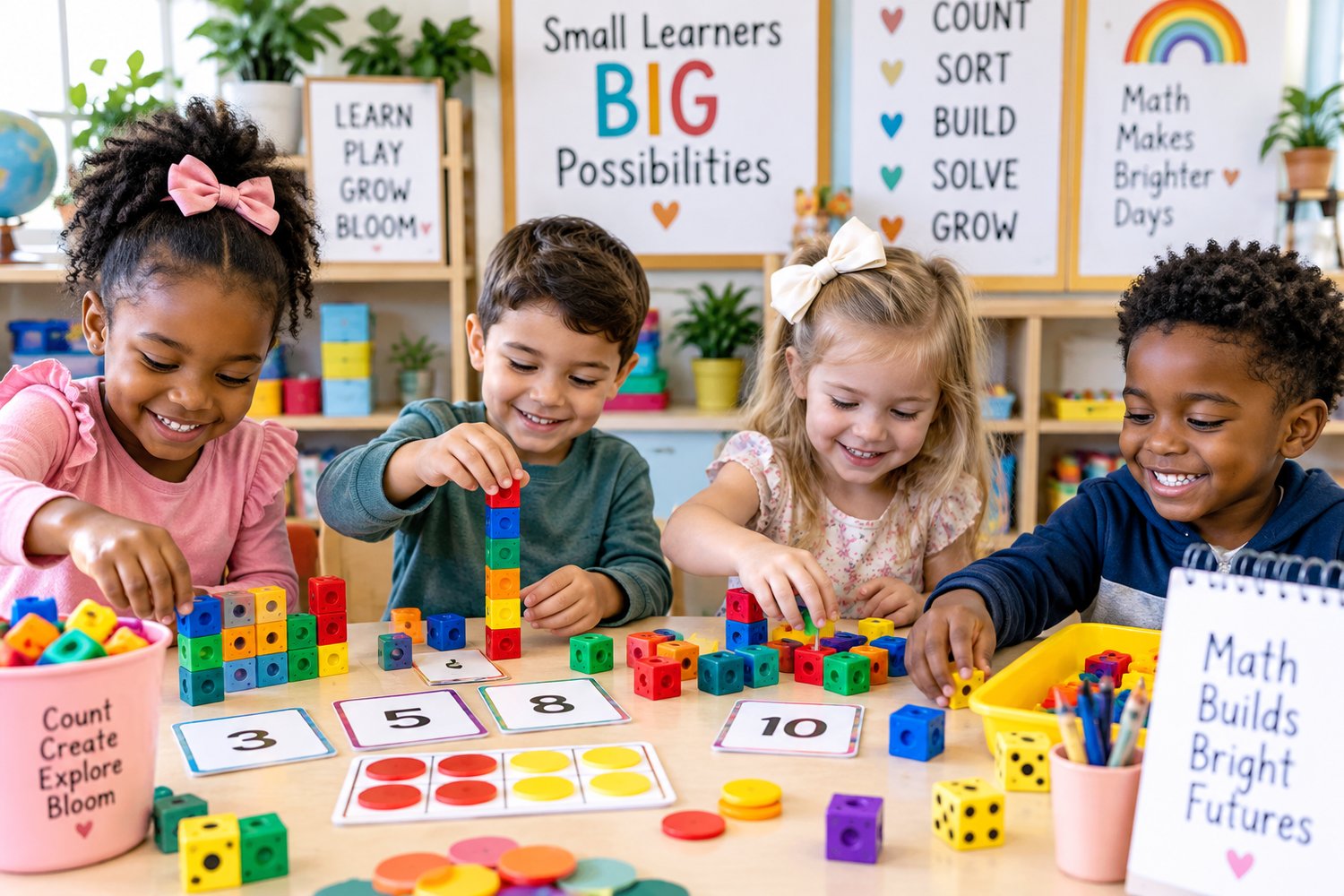
Try using buttons, blocks, toy cars, pom-poms, cereal pieces, or other small objects for counting and simple addition and subtraction.
Instead of only asking:
“What is 5 + 2?”
Give your learner five objects, add two more, and let them discover the answer.
Concrete experiences help children understand why an answer makes sense before they are expected to work with numbers on paper.
Celebrate the Thinking, Not Just the Answer
Sometimes the most important part of a math problem isn't getting the correct answer immediately.
Ask questions such as:
How did you figure that out?
Can you show me another way?
What do you notice?
What do you think will happen next?
When children explain their thinking, they develop problem-solving skills and learn that their ideas matter.
And when they make a mistake? That's okay!
Mistakes give us an opportunity to think again, try another strategy, and learn something new.
Build Strong Number Sense
Before rushing into addition and subtraction, give young learners plenty of opportunities to understand numbers.
Children should practice:
- Counting objects accurately
- Recognizing numbers
- Comparing more and less
- Putting numbers in order
- Making groups
- Recognizing small quantities without counting every object
- Understanding that numbers can be represented in different ways
Strong number sense becomes the foundation for more advanced mathematics later.
Keep Math Fun
Games, songs, movement, puzzles, and hands-on activities can transform math practice into something children look forward to.
Try a number scavenger hunt around the house. Roll dice and count the dots. Build towers and compare which is taller. Create patterns with toys. Play a simple board game that requires counting spaces.
Learning through play doesn't mean children aren't learning seriously. For young children, play is one of the most powerful ways to learn.
Help Your Little Mathematician Bloom 🌼
Every child develops at a different pace. Our job isn't to rush them through skills. It's to give them opportunities to explore, practice, ask questions, make mistakes, and experience success.
A child who begins to say “I can figure this out!” is developing something incredibly valuable.
At Kinderbloom, our goal is to help children build strong academic foundations while developing confidence and a genuine love of learning.
So grab some blocks, count the snacks, look for shapes, play a number game, and make math part of your day.
Because little moments of learning can lead to big blooms. 🌸
Kinderbloom
Helping Little Ones Bloom 🌼