
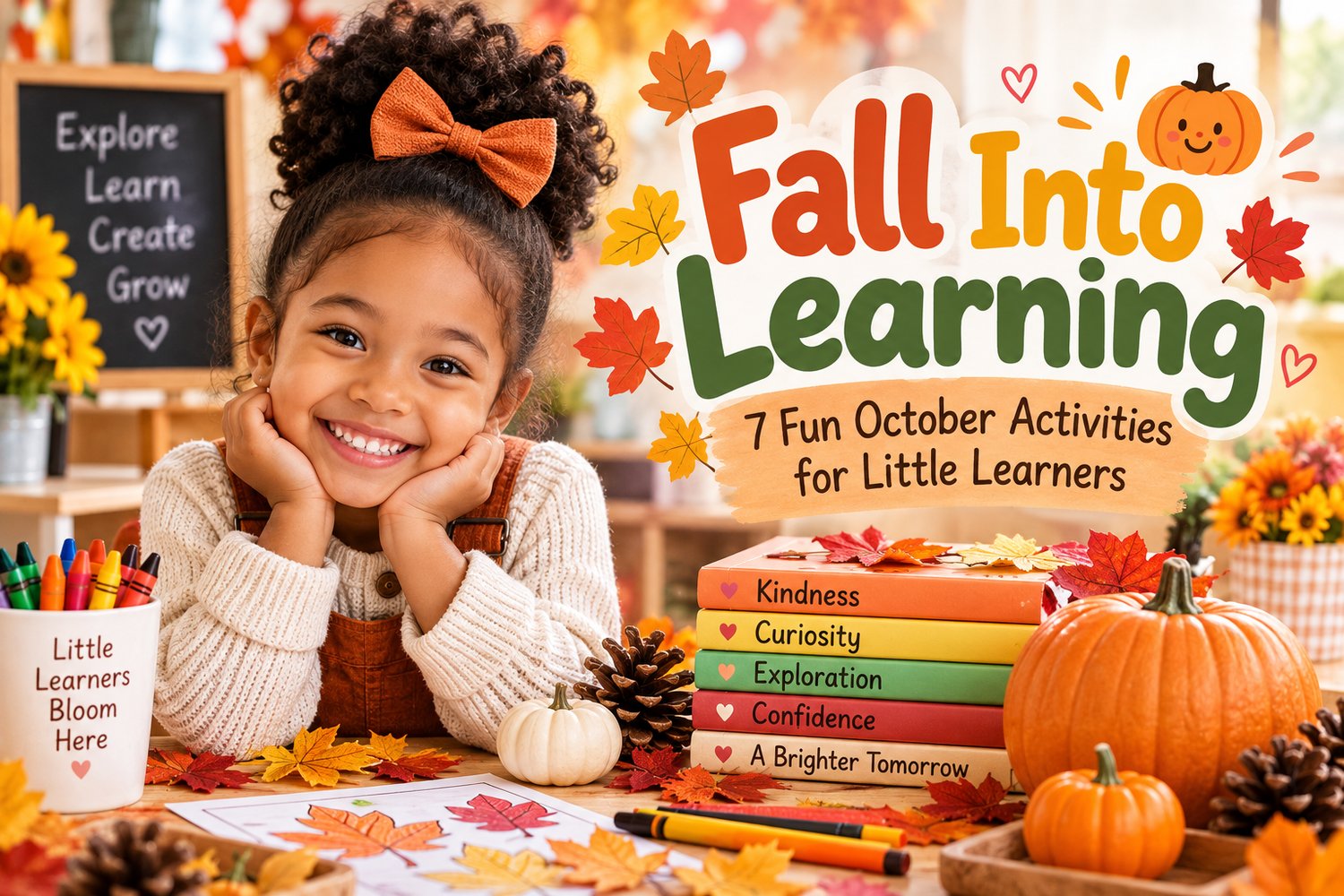
October is such an exciting month for young children! The weather is changing, leaves are falling, pumpkins are appearing everywhere, and there are plenty of opportunities to turn the season into meaningful learning experiences.
For preschool, Pre-K, and kindergarten children, some of the best learning happens when we connect new skills to things they can see, touch, count, sort, and explore.
Here are 7 simple fall activities you can try at school or at home this October.
🍁 1. Go on a Fall Nature Hunt
Take learning outside!
Give your little learner a bag or basket and look for fall treasures such as colorful leaves, acorns, pinecones, sticks, and seeds.
When you return, talk about what you found.
Try questions like:
Which leaf is the biggest?
Which is the smallest?
How many acorns did you find?
Which items are the same?
One simple walk can become a lesson in science, math, vocabulary, and observation.
🎃 2. Practice Pumpkin Math
Pumpkins are perfect for hands-on math.
Children can count mini pumpkins, arrange them from smallest to largest, sort them by color, or compare their sizes.
If you have a real pumpkin, ask your child to guess how many seeds are inside before opening it.
Then count the seeds together!
You can even practice making groups of 2, 5, or 10.
🔤 3. Try a Beginning-Sound Hunt
Choose a letter and challenge your little learner to find objects that begin with that sound.
For example:
B – bat, book, bag
L – leaf, lamp, lid
P – pumpkin, pencil, paper
Remember to focus on the sound the child hears at the beginning of the word—not just memorizing the letter.
This is a simple way to strengthen early phonics skills.
🍎 4. Sort and Graph Fall Favorites
Ask children about their favorite fall things.
Which do they like best?
🎃 Pumpkins
🍎 Apples
🍂 Colorful leaves
🌽 Corn
👻 Halloween
Create a simple picture graph and count the results together.
Ask questions such as:
Which has the most?
Which has the least?
How many children chose apples?
Now you're practicing counting, comparing, and interpreting data!
✂️ 5. Create a Fall Craft
Arts and crafts aren't just fun—they also help develop the fine-motor skills children need for writing.
Let children tear paper to make colorful leaves, cut out pumpkins, glue pieces onto a fall tree, or create a silly scarecrow.
Cutting, coloring, tracing, squeezing glue, and placing small pieces all help strengthen little hands.
And don't worry about making every project look exactly the same.
Let their creativity bloom!
📚 6. Read a Fall Story Together
Choose books about pumpkins, changing leaves, apples, farms, or autumn animals.
Before reading, look at the cover and ask:
“What do you think this story will be about?”
During the story, pause to discuss what's happening.
Afterward, ask your child to tell you their favorite part or retell what happened first, next, and last.
These simple conversations build comprehension and language skills.
🧡 7. Make Learning Part of Everyday Life
You don't always need a worksheet or a formal lesson.
Count pumpkins at the grocery store.
Read letters on signs.
Compare the colors of leaves.
Talk about the weather.
Count the steps to the front door.
Ask your child what they notice.
Young children are naturally curious, and everyday experiences can become powerful learning opportunities when we slow down and explore them together.
🌸 Let Learning Bloom This Fall
October is a wonderful reminder that change and growth go together.
Just as the world around us changes during fall, our little learners are changing too. Every new letter they recognize, number they count, question they ask, and task they complete independently represents growth.
So enjoy the season, get a little messy, explore something new, and remember that learning doesn't only happen at a desk.
Sometimes the best classroom is right outside the door.
🌸 KinderBloom Co. — Where Little Learners Grow.
Keep Growing. Keep Learning. Keep Blooming.