
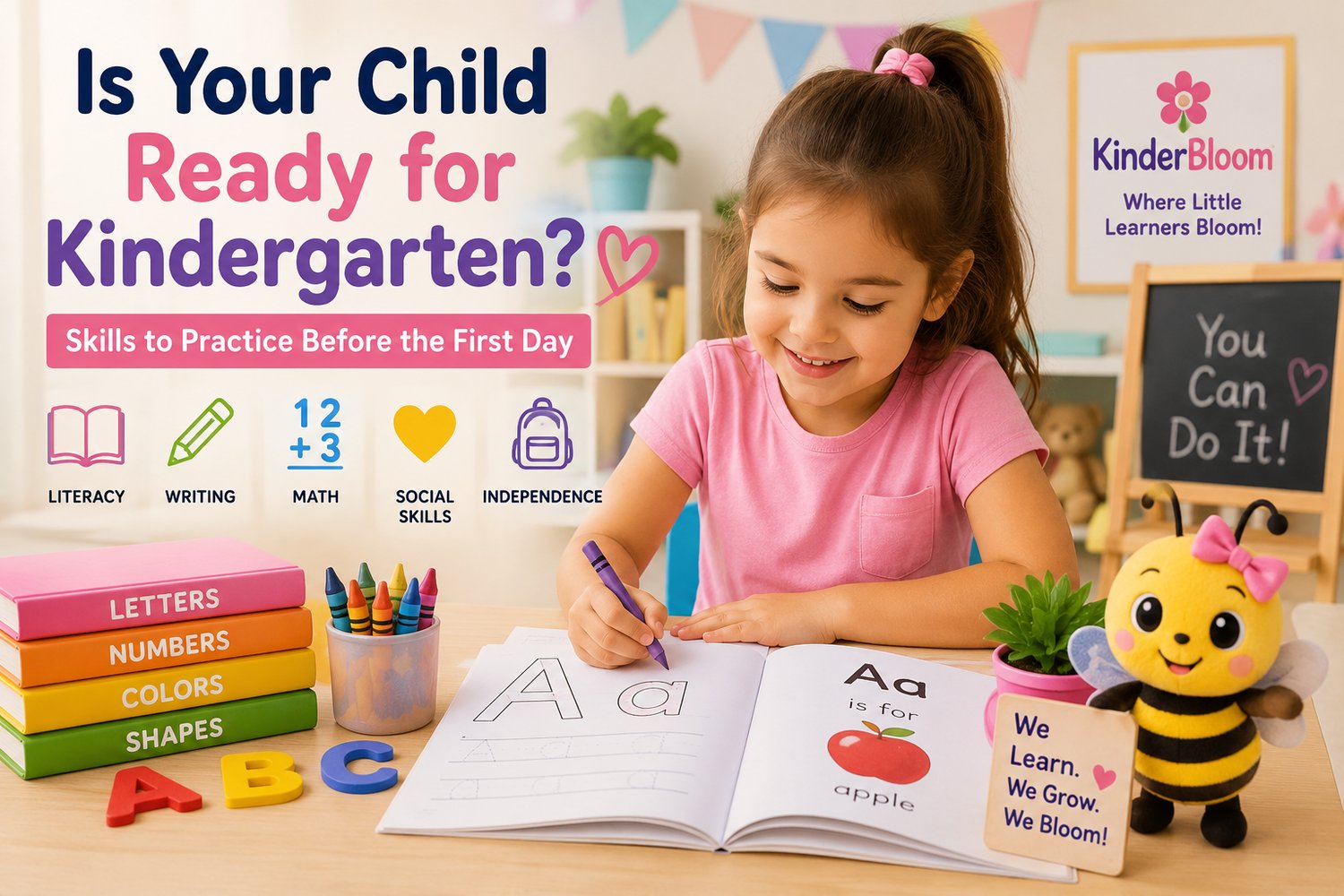
Starting kindergarten is a big milestone. New teachers, new friends, new routines, and new learning experiences are all waiting!
For families, it can also bring one big question:
“Is my child ready for kindergarten?”
Kindergarten readiness isn't about a child already knowing everything they will learn in school. Children enter kindergarten with different strengths, experiences, and abilities. What matters most is giving them opportunities to build foundational skills, confidence, independence, and curiosity.
At KinderBloom, we believe children should have time to learn, practice, play, and grow.
🌸 What Does Kindergarten Readiness Look Like?
Kindergarten readiness includes much more than knowing the alphabet or counting to 20. Children are developing academically, socially, emotionally, and physically.
Here are several areas families can practice before kindergarten begins.
📚 1. Build Early Literacy Skills
Reading together is one of the most valuable things you can do with your child.
Before kindergarten, practice skills such as recognizing uppercase and lowercase letters, noticing beginning sounds, rhyming, listening to stories, answering simple questions about a story, and identifying their own name.
You don't have to turn every moment into a lesson. Read favorite books again and again. Talk about the pictures. Ask your child what they think will happen next.
Most importantly, allow reading to be enjoyable.
✏️ 2. Practice Early Writing
Children need plenty of opportunities to strengthen the small muscles they'll use for writing.
Encourage your child to draw, color, trace, use play dough, cut with child-safe scissors, and practice writing their name.
Letter formation will develop with instruction and practice. Focus on helping your child become comfortable using writing tools while learning that their pictures, letters, and words can communicate ideas.
At KinderBloom, we believe every child has a story to tell.
🔢 3. Make Math Part of Everyday Life
Early math can happen almost anywhere.
Count the apples at the grocery store. Sort socks while doing laundry. Look for circles and rectangles around the house. Compare which cup has more or less.
Children can practice counting objects, recognizing numbers, identifying basic shapes, creating patterns, comparing quantities, and using words such as more, less, bigger, and smaller.
These everyday experiences help children understand that math isn't just something that happens on a worksheet—math is all around us.
🎒 4. Encourage Independence
Some of the most helpful kindergarten preparation doesn't involve academics at all.
Give your child opportunities to practice opening their lunch containers, putting on a jacket, packing a backpack, cleaning up after an activity, using the restroom independently when developmentally appropriate, and taking responsibility for simple belongings.
These little accomplishments can make a big difference when children enter a busy classroom.
💛 5. Practice Social and Emotional Skills
Kindergarten means becoming part of a classroom community.
Children will be learning how to take turns, share materials, listen while someone else is speaking, follow classroom routines, ask for help, express their feelings appropriately, and work through small frustrations.
These skills take time. They don't need to be mastered before the first day of school.
Practice them through games, playdates, conversations, pretend classroom activities, and everyday family routines.
🌼 Don't Turn Kindergarten Readiness Into Pressure
There is no perfect kindergarten checklist.
One child may already be reading simple words but still need help managing frustration. Another may be extremely independent but just beginning to recognize letters.
Both children are learning. Both children are growing.
Instead of trying to rush children ahead, look for their next manageable step.
If your child recognizes the letter B, begin practicing its sound.
If your child can count to 10, practice counting actual objects.
If your child can write their first name, celebrate that accomplishment and continue building from there.
Small steps add up.
🐝 Make Learning Playful
Five- and six-year-olds learn through movement, conversation, exploration, repetition, and play.
Try a letter hunt around the house. Sort toys by beginning sound. Count crackers at snack time. Write letters in shaving cream. Make patterns with blocks. Go outside and search for shapes.
A ten-minute playful activity can provide meaningful practice without making learning feel like a chore.
🌸 The KinderBloom Approach
At KinderBloom, we believe early learning should build both skills and confidence.
Our resources are created to support foundational literacy, writing, mathematics, fine-motor development, and school-readiness skills through developmentally appropriate activities designed especially for little learners.
We want children to be able to say:
“I can try.”
“I can learn.”
“I can do hard things.”
“I am ready to grow.”
Because kindergarten isn't the finish line.
It's the beginning of something wonderful.
🌸 Learn. Grow. Bloom.
KinderBloom — Helping Little Learners Bloom.