

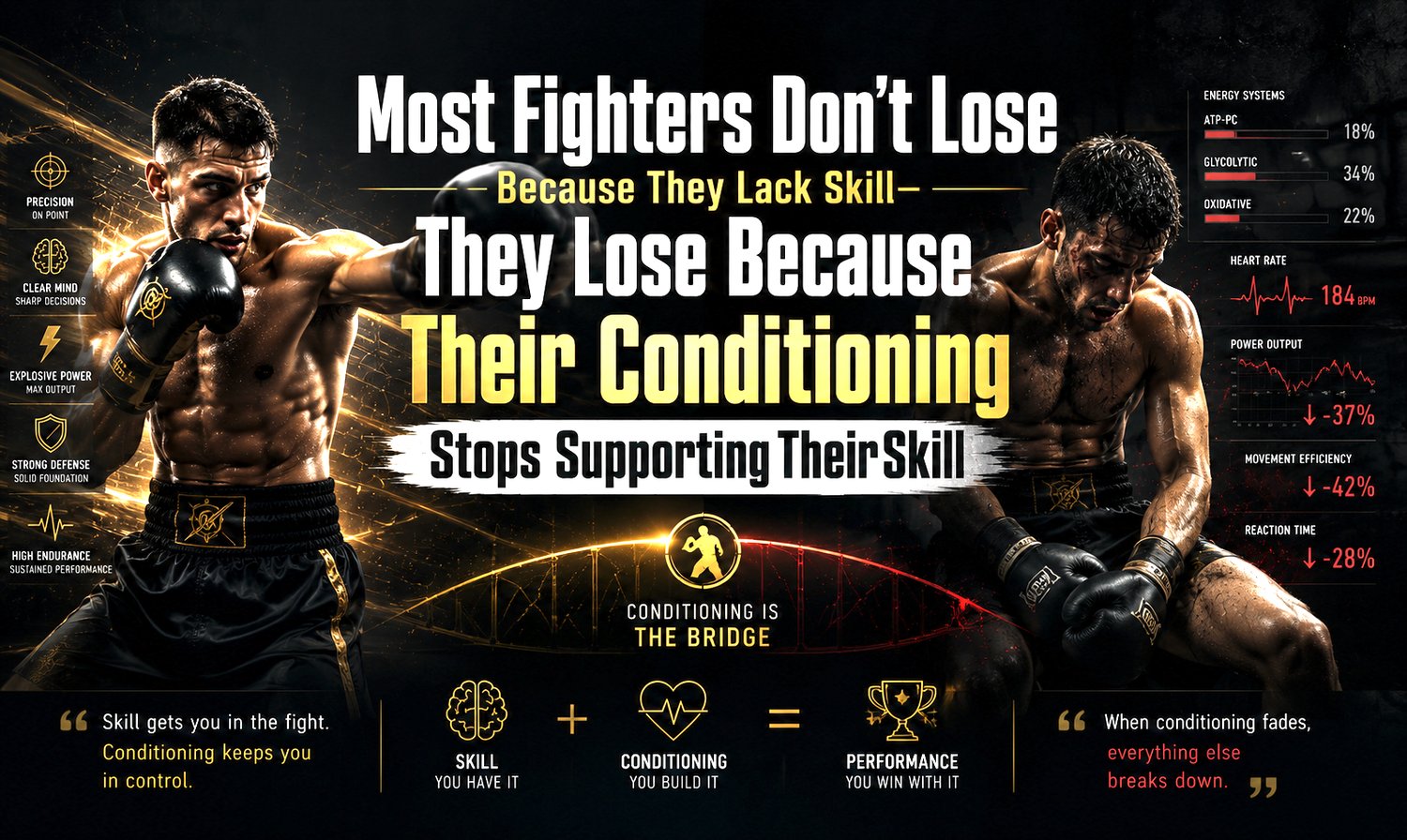
Most Fighters Don't Lose Because They Lack Skill—They Lose Because Their Conditioning Stops Supporting Their Skill
Watch enough fights and you'll start to notice a pattern. A fighter looks sharp for two rounds—clean footwork, tight guard, fast hands. Then, somewhere in round three, something changes. The jab gets lazy. The chin creeps up. The feet stop moving and start planting. By round five, the same fighter who looked like a technician now looks like someone swinging wildly and hoping.
Nothing about their skill disappeared. Their brain still knows the combinations. Their coach didn't forget to teach them defense. What broke down wasn't knowledge—it was the body's ability to keep executing that knowledge under fatigue.
This is the part of fight conditioning that rarely gets talked about honestly. Most fighters and even many coaches treat conditioning as a separate box to check—something you do before practice so you "have the gas" to train technique. But conditioning isn't separate from skill. It's the thing that determines whether your skill is still available to you in the third, fifth, or twelfth round.
If you've ever felt technically sound in the gym but found your technique falling apart late in a fight or hard sparring session, this article is for you. We're going to look at what fatigue actually steals first, why conditioning and skill are far more connected than most training programs treat them, why traditional conditioning often doesn't transfer to the ring, and what a more fight-specific approach—like The Fighter's Kettlebell System—looks like in practice.
Skill Alone Isn't Enough—Here's the Hidden Reason Why
Here's a question worth sitting with: if two fighters have nearly identical technical ability, why does one fade and the other doesn't?
The answer almost never comes down to "who knows more." It comes down to who can still access what they know when their muscles are burning, their breathing is ragged, and their decision-making window has shrunk to a fraction of a second.
Technique isn't a fixed asset you bank early in a fight and spend down. It's a live performance that depends on your nervous system, your muscles, and your cardiovascular system all working together in real time. When conditioning for fighters is built well, that system holds up. When it isn't, the system degrades—and degradation doesn't happen evenly. It happens in a specific, predictable order, and it happens to the things that matter most.
This is the hidden reason skilled fighters break down late: they trained the skill in a state their body can't reproduce under pressure. The skill was never the weak link. The conditioning underneath it was.
What Fatigue Steals First
Fatigue doesn't take everything away at once. It's selective, and understanding the order matters because it tells you exactly where your fight conditioning needs to focus.
1. Fine Motor Control Goes First
The first casualty is precision. Small adjustments—the half-step that lines up your hips for a hook, the slight roll that takes your chin off the centerline, the subtle hand position that keeps your guard tight—start to disappear. These movements require coordinated effort across multiple muscle groups, and they're the first thing your body sacrifices when energy gets tight.
This is why a fighter's jab looks crisp in round one and looks like a shove by round four. The intent is the same. The execution isn't.
2. Posture Collapses
Next goes posture. Tired fighters drop their hands, lean forward from the waist instead of the hips, and let their head drift out over their lead foot. This isn't laziness—it's the body's attempt to conserve energy by letting structural muscles (the ones that hold you upright and stable) do less work.
The problem is that posture is the foundation everything else sits on. Power generation, defense, balance—all of it depends on a stable frame. When posture goes, everything built on top of it becomes less efficient, which burns even more energy. It's a downward spiral.
3. Grip and Forearm Endurance Fade
In grappling-heavy sports and even in boxing (where grip affects guard tightness, clinch control, and the structure of your punches), forearm and grip endurance often fatigues faster than people expect. Once grip goes, control goes with it—control of distance, control of an opponent's posture, control of your own guard.
4. Footwork Becomes Static
Footwork is expensive. It's one of the first things fighters unconsciously cut when they're exhausted, because standing still feels like "resting" even though it isn't safe. A fighter who was cutting angles and controlling range in round one starts squaring up and trading in round four—not because their gameplan changed, but because their legs stopped offering that option.
5. Decision-Making Narrows
Last—and most dangerous—decision-making degrades. Under fatigue, fighters default to the most familiar, least demanding option, even when it's not the right one. A fighter who normally sets up combinations starts throwing single shots. A fighter who normally slips and counters starts covering up and hoping. This isn't a failure of strategy. It's what a depleted nervous system does when it's forced to choose quickly with less available capacity.
Every one of these losses—fine motor control, posture, grip, footwork, decision-making—maps directly onto the skills a fighter spent years building. Fatigue doesn't erase the skill from memory. It removes the physical and mental resources required to execute it.
How Conditioning Supports—or Undermines—Technical Execution
This is the core relationship that most training programs miss: conditioning isn't just about "having gas left in the tank." It's about whether your body can still produce the specific movement patterns your skill depends on, under the specific kind of fatigue your sport produces.
Think about what a jab-cross-hook combination actually requires. It needs trunk stability to transfer force from your legs through your core into your fists. It needs postural control to keep your head off centerline while you punch. It needs footwork to maintain range and angle. It needs grip and forearm tension to keep your guard up between exchanges. And it needs a nervous system clear enough to recognize the opening and commit to the combination instead of hesitating.
Now ask: if a fighter's conditioning program never trains trunk stability under fatigue, never trains postural control while breathing hard, never trains footwork in a depleted state—how is that fighter supposed to produce the combination when it matters most?
This is why "being in shape" and "fight conditioning" aren't the same thing. A fighter can have excellent cardiovascular fitness—able to run for miles, jump rope for an hour—and still gas out technically in round three. The conditioning didn't prepare the specific systems that technique depends on. It built endurance in isolation from skill, so the two never learned to cooperate under stress.
Good conditioning for fighters does the opposite. It trains the body to maintain posture, grip, footwork, and trunk stability while fatigued—so that when the fight gets hard, the skill is still standing on solid ground.
Why Traditional Conditioning Often Fails to Transfer Into the Ring
If most fighters already do conditioning work, why does this gap persist? The answer is that a lot of traditional conditioning—running, cycling, generic circuit work, even standard strength training—doesn't train the qualities a fight actually demands.
It's often single-plane and repetitive. Running builds aerobic capacity, but it trains the body in a straight line, with predictable, repetitive mechanics. Fighting is multi-directional, asymmetrical, and unpredictable. The conditioning doesn't match the demand.
It separates strength from endurance. Many programs treat strength days and conditioning days as separate categories—lift heavy on Monday, run on Tuesday. But in a fight, strength and endurance aren't separate. You need to generate power in round one and round eight, under accumulated fatigue, using the same muscles. If your training never asks strength and endurance to work together, your body never learns to deliver both at once.
It ignores grip, trunk, and postural endurance specifically. General fitness programs rarely target grip endurance, rotational core stability, or the postural muscles that keep a fighter's frame intact under fatigue—exactly the systems we identified as early casualties of fatigue.
It doesn't train decision-making under physical stress. Pure conditioning work, done in isolation from any cognitive or reactive component, never challenges the fighter to think, read, or decide while their body is breaking down. But that's the exact condition late rounds create.
This is the transfer problem in a sentence: conditioning under fatigue is a trainable quality, but only if your training actually recreates the conditions—physical and cognitive—that fatigue creates in a fight. Most programs don't. They build generic fitness and hope it shows up when it's needed. Sometimes it does. Often, it doesn't—and that gap is where skilled fighters lose fights they were technically winning.
A More Practical Approach: The Fighter's Kettlebell System
This is where The Fighter's Kettlebell System takes a different approach—one built around the actual demands identified above, not generic fitness goals.
Kettlebell training, done with fight-specific intent, addresses several of the exact qualities that traditional conditioning misses:
Grip and forearm endurance are built directly into nearly every kettlebell movement. Holding, swinging, and controlling a kettlebell under fatigue trains the same grip endurance that keeps a guard tight and a clinch controlled deep into a fight.
Trunk stability is constantly demanded. Kettlebell movements—swings, carries, get-ups, rotational work—require the core to stabilize the spine while the limbs move and the body is under load. That's the same demand a punch or a takedown defense places on the trunk, and training it under fatigue builds the exact resilience a fight requires.
Posture under load is trained directly. Many kettlebell movements punish poor posture immediately—round the back or let the shoulders collapse, and the movement breaks down. This builds the postural endurance that keeps a fighter's guard up and head positioned correctly even when they're exhausted.
Footwork and lower-body endurance benefit from the ground-based, often single-leg or asymmetrical loading found in well-designed kettlebell programming, which builds the kind of stable, springy legs fighters need for sustained footwork.
Power output under fatigue—the ability to still generate force in your hands, hips, and legs after several rounds—is one of the clearest hallmarks of kettlebell ballistic work like swings and cleans, which train explosive output in conditions of accumulated fatigue rather than fresh, rested states.
And because kettlebell circuits can be structured to mimic round-and-rest patterns, fighters can train decision-making and technical precision while fatigued—closing the gap that generic conditioning leaves open.
The result isn't "better cardio" in the abstract. It's combat sports conditioning that maintains the specific physical qualities—grip, posture, trunk stability, footwork, power—that technique depends on, deep into the rounds where fights are actually decided.
Practical Takeaways
If you take one thing from this article, it's this: fight conditioning isn't a separate category from skill training. It's the infrastructure that keeps skill available under pressure.
A few principles worth applying immediately:
- Train grip endurance specifically—not as an afterthought, but as a core component of your conditioning.
- Build trunk stability under load and under fatigue, not just in isolated ab circuits done fresh.
- Practice maintaining posture (hands up, chin tucked, hips under you) during conditioning work, not just during technical drilling.
- Structure some conditioning around round-and-rest intervals that mirror your sport's actual demands.
- Test your technique when you're tired, not just when you're fresh—because that's the version of you that shows up in late rounds.
Boxing conditioning, wrestling conditioning, or any combat sports conditioning that ignores these principles is leaving a fighter's hard-earned technical skill exposed exactly when it matters most.
The Next Step
If you've recognized yourself in this article—a fighter or athlete whose technique holds up in the gym but slips away when the rounds get hard—the issue isn't your skill. It's the conditioning underneath it.
The Fighter's Kettlebell System was built specifically to close that gap: to train grip, posture, trunk stability, footwork, and power the way a fight actually demands them—under fatigue, under pressure, and under pace. It's conditioning designed not just to make you tired, but to make sure your skill is still there when you are.
If you're ready to stop losing your technique in the late rounds, The Fighter's Kettlebell System is the next step toward conditioning that holds up when it counts.