
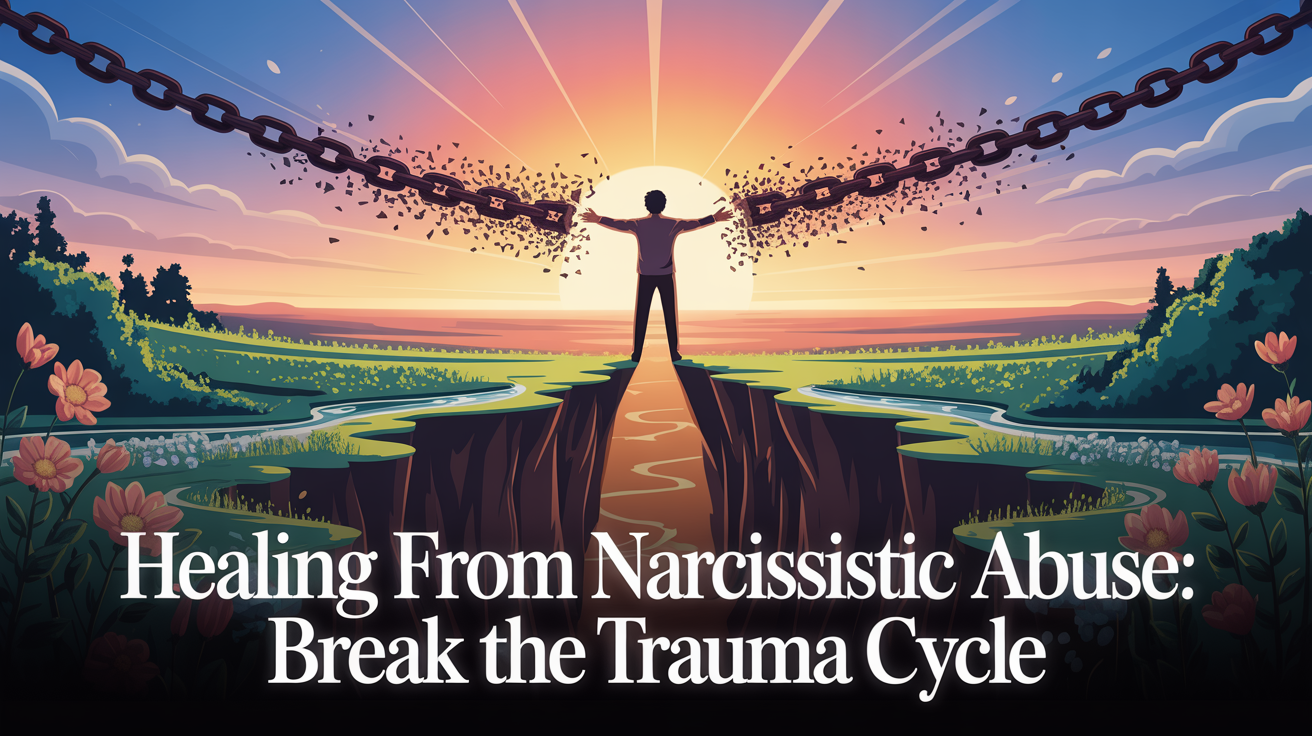
You did the hard thing.
You left.
Or maybe you are still in it, but something has cracked open inside you, and you can finally see it for what it is.
Either way, something has shifted. This marks the beginning of your new awareness.
You have a name for it now.
Gaslighting and trauma bonding.
Love bombing, devaluation, and the cold discard that took your breath away.
Trauma bonding.
Love bombing. Then devaluation. Then a discard so cold it took your breath away.
You know the playbook.
You've sat in your therapist’s parking lot crying before you even walked in, having 2 a.m. conversations with yourself you’d never repeat aloud.
You have sat in the parking lot of your therapist’s office crying before you even walked in.
But you are still not completely free.
And you thought that understanding it would be enough to free you from it.
But you are still not free.
Not completely.
Because they are not in your house anymore, but they are still in your head.
Their voice is still the one you hear when you make a mistake.
Their contempt is still the perspective through which you see yourself on your hardest days.
Your body still braces in certain moments. It still scans certain rooms. It still goes tight in a way you cannot fully explain.
You left the narcissist.
But the narcissist has not left you.
And I want to talk about why. I also want you to know that before we are done, I will share practical steps and tools to help you start loosening the hold this experience still has on you. Support and guidance are on the way, and you will not be left without a map.
Not from a distant or detached perspective.
Not with emotional distance as a defensive barrier.
But with full sympathy and genuine presence.
The way someone who has lived through it sits with someone who is living through it.
Fully present.
Fully willing to sense the weight of it with you.
The Residue Nobody Warns You About

When we talk about recovering from narcissistic abuse, we talk about leaving.
About the bravery it requires.
About rebuilding.
About healing.
But nobody warns you about the residue.
The relationship does not end when it's supposed to.
It follows you—into your next relationship, your parenting, how you respond to conflict, intimacy, silence, and kindness.
Into your next relationship.
Into your parenting.
Into the way you respond to conflict and intimacy and silence and kindness.
Into the way you sometimes catch yourself minimizing your own pain in the exact way they taught you to.
This is not a weakness.
This is what happens when a human nervous system has been trained, through repetition, to expect threat.
Trained responses do not simply switch off when the threat disappears.
They persist.
They protect.
And sometimes they damage the very life you are trying to build on the other side of what you survived.
What They Left Behind

Allow me to name what remains.
Because when you can name it, you can begin to address it.
One of the most devastating effects of narcissistic abuse is how it harms your tie to your own reality.
Through gaslighting. Through manipulation. Through the unrelenting push to make you the problem.
You learned to distrust yourself.
Your memory.
Your perception.
Your instincts.
Your feelings.
You became disconnected from the person you used to be. The person who had opinions was unafraid. had opinions, was not afraid.
Who took up space without apologizing.
Who trusted their gut without needing someone else to confirm it.
That disconnection does not heal automatically just because you walked away.
Reconnecting. It takes time, support, and daily courage to trust yourself in small ways. Only then does trusting yourself feel natural again.
The survival responses are now running in the wrong context.
I need you to hear this carefully.
The behaviors you developed inside that relationship were not character flaws.
The fawning.
The people-pleasing.
The constant reading of the room.
The reflexive apologizing.
The shrinking.
The minimizing of your own needs so that someone else’s needs could take up all the available space.
They were what your nervous system developed in a truly threatening environment.
They kept you functioning. They helped you survive something you should never have had to face. They have been yours to navigate.
The problem is that survival strategies do not know when to retire.
They get carried forward.
Into new relationships.
Into friendships.
Into work, family, and your own self-talk.
What protected you inside the toxic relationship can quietly damage you outside of it.
Recognizing this is not about blaming yourself for having these patterns; it’s about understanding them so you can consciously choose differently.
It is about comprehending where they came from so you can consciously choose something different.
Next is an issue often overlooked: The grief that was never allowed.
This is the one that surprises people most.
You left a toxic relationship.
What is there to grieve?
Everything.
Grief is not only for good things that a narcissistic relationship brings deep, layered, ongoing loss, compounding loss.
The loss of the person you thought they were.
The loss of the future you believed you were building.
The loss of the self you had before the relationship slowly changed you.
The loss of the love you deserved and did not receive.
Until that grief is processed, it does not disappear.
It lives somewhere inside you.
And it shows up.
In dreams.
In triggers that catch you off guard.
In the patterns you find yourself repeating.
In the way certain situations pull something from you that you cannot explain.
Unprocessed pain always seeks completion.
And it will keep surfacing until you give it the space it needs.
What Childhood Has to Do With This

I need to say something that some people find uncomfortable.
But I have been doing this work for over 26 years, and I cannot, in good conscience, leave it out.
The toxic relationship you just survived did not appear from nowhere.
That is not a statement of blame.
Please hear me.
What happened to you was not your fault.
What was done to you was not okay.
Nothing I am about to say changes any of that.
But here is what I know from sitting with hundreds of survivors.
Many of us walked into toxic relationships already carrying wounds.
Wounds from childhood.
From the parent who was cold, critical, unpredictable, or emotionally distant. or emotionally unavailable.
The parent who left.
The parent who stayed physically, the parent whose love depended on how well you performed or complied, or how well you matched what they needed.be exactly what they needed.
Those wounds shape us in ways we often do not recognize.
They shape what feels familiar.
What feels like love.
What we are willing to accept.
What we believe we deserve.
A child who grew up walking on eggshells around an emotionally volatile parent becomes an adult who already knows how to handle an emotionally volatile partner.
Their nervous system recognizes the chaos as familiar, even while their heart longs for something safer.
This is not a personal failing.
This is how unhealed childhood wounds operate in adult relationships.
And here is the part that is hardest to say and most important to hear.
When you carry unhealed childhood trauma into a relationship, it is not fair to you.
And it is not fair to the person you are with.
Unhealed trauma does not stay quietly in the past.
It shows up: in patterns, in triggers, in reactions that feel too large, and in how old wounds are projected onto new people.
In patterns.
In triggers.
In reactions that feel too large for what actually happened.
In the way old wounds get projected onto new people who may not deserve them.
In the way someone can love genuinely and still cause the same harm that was done to them.
Healing is not optional.
Not if you want your relationships, your parenting, and your relationship with yourself to look different from what you experienced.
The cycle will not break itself.
The Partner Who Is Still Carrying It

I want to speak to a specific situation I encounter regularly.
The person who left the narcissist.
Who did their healing work?
Who moved forward?
Who is now in a new relationship or working on their marriage with someone who still carries their own unhealed wounds.
Their trauma radar is perfectly calibrated.
They are not being unreasonable.
They have been given real, concrete reasons to question what is true.
When they say they can see the patterns, they are right.
When they say something feels familiar, they should trust that.
And when they say they have their own trauma and they chose to do the work before bringing it into this relationship, they are not being self-righteous.
They are exhausted from being gaslit.
They have armored up.
Not because they are closed.
Not because they are unwilling to love.
But because they know what damage looks like now.
And they are not willing to absorb it again.
If that is you, I need you to hear this.
Your calibration is not the problem.
It is the gift.
The work is not to lower your standards.
The work is to find someone who has done enough of their own healing to be genuinely safe.
And if the person you are with has not done that work, the most loving thing you can do for both of you is to be honest about what you need.
Real safety.
Real accountability.
Real healing.
Not promises made in tender moments.
Not intentions that look good in conversations.
Work.
Sustained, humble, courageous work.
Spiritual Identity Absent Emotional Honesty Is Incomplete
To those of you who are people of faith, I want to say something directly.
Because I have seen this pattern too many times to stay quiet about it.
It is possible to have a genuine, sincere relationship with God and still be carrying unhealed wounds that are damaging the people closest to you.
It is possible to pray faithfully and still be running patterns that originated in your childhood.
It is possible to be sincere in your beliefs and still not have done the grief work around what happened to you.
Prayer is real.
Faith is real.
And they are most powerful when they are paired with emotional honesty.
When they are paired with the willingness to sit in a counselor’s office and say the things you have been afraid to say.
To look honestly at your patterns.
To grieve what needs to be grieved.
To take responsibility for what is yours.
God works by processes.
Through therapists and counselors, and safe communities where the truth can finally be spoken out loud.
Spiritual identity, absent emotional honesty, is incomplete.
And the people in your life, the ones who love you, the ones who are being affected by your unhealed wounds, whether you intend it or not, deserve the complete version.
So do you.
You cannot Invite Someone Into Healing You Have Not Done.

This is the invitation I want to extend today.
Not only to those who are healing from narcissistic abuse.
But to anyone who recognizes themselves in these words.
Anyone who suspects what happened in childhood is still showing up in their present relationships.
Anyone who has noticed the same patterns repeating.
Anyone who loves deeply but keeps ending up in the same dynamics.
Anyone who is tired of surviving and ready to begin something different.
Your childhood does not have to be your destiny.
But the cycle will not break on its own.
It takes one brave enough to say, "This stops with me."
Let that someone be you.
If you know something needs to change, but you do not know where to start.
If you are tired of surviving and ready to start healing.
The narcissist may still be living in your head.
But eviction is possible.
And it starts here.
Let that work start with you.
You can book a call with me at www.durte.coach/bookacall
With love and deep belief in your healing,
Nancy Duarte
Life Coach | Victim Advocate | Toxic Relationship Expert
Founder of Life on Earth Ministries
If you or someone you know is in immediate danger, please contact the National Domestic Violence Hotline at 1-800-799-7233