
— USA Today
Watch Punch’s full story on PBS NewsHour: https://www.youtube.com/watch?v=EiNtaRfYBkg
Because We Are Punch
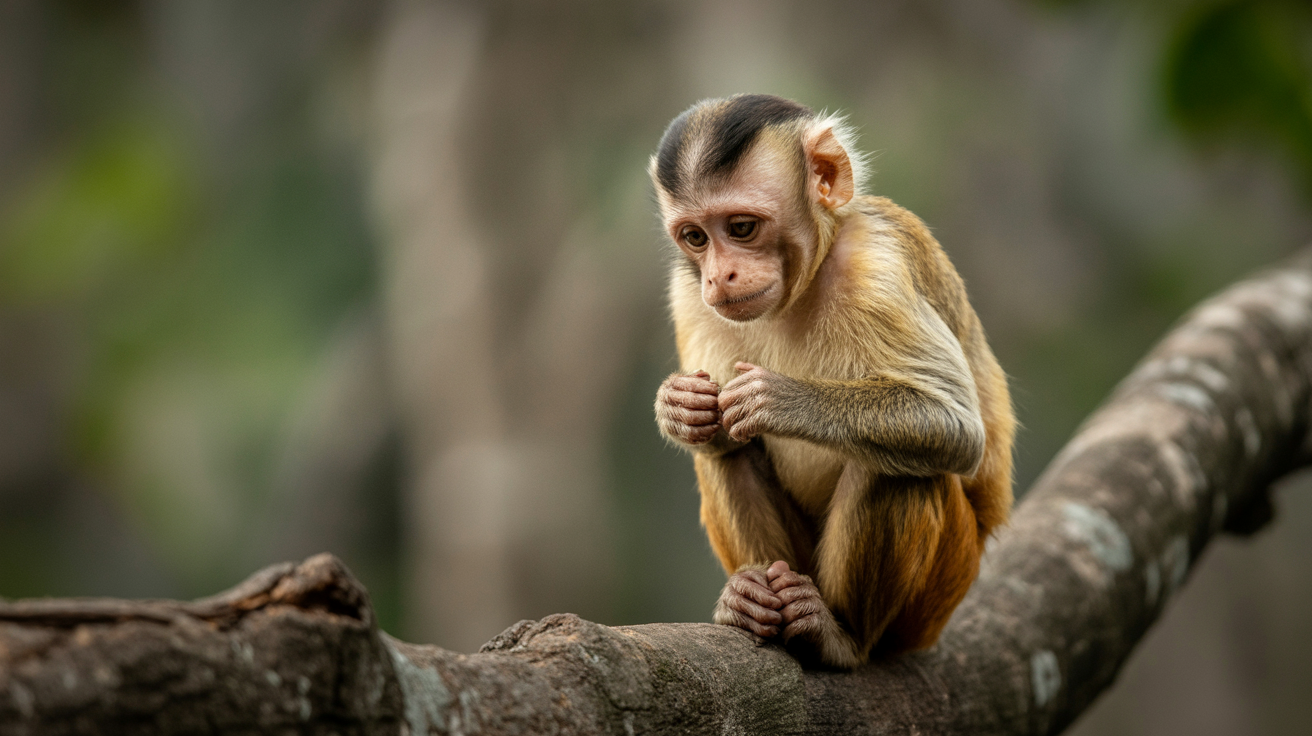
 A young monkey curiously studies its reflection in a small handheld mirror in the jungle.
We did not fall in love with a monkey. We fell in love with a mirror.
Because every single person who watched that video and felt their chest tighten, who felt their eyes sting, who whispered oh, that poor baby, wasn't simply watching a monkey.
They were watching themselves.
The version of themselves that was abandoned. Rejected. Pushed away by the people who were supposed to love them. The version that held on to whatever they could find, a relationship, a role, a performance of “I’m fine” — because there was nothing else to hold on to.
One woman posted on social media: “I am Punch, and he is me.”
And millions of people felt the same thing. Because everyone knows what it feels like to be small and confused, circling a group and seeking a way in. Everyone knows what it is like to be rejected by the people whose approval they wanted most.
And everyone, everyone. knows what it feels like to cling to something that is not real love, simply because it is the closest thing available.
What Rejection Actually Does to You

Rejection does not just hurt your feelings. It rewires your nervous system.
When you are abandoned by a parent who could not see you, by a partner who disregarded you, by a family system that told you that you were not quite enough, your brain does not file it away as a memory. It stores it as a belief. A rule. A survival strategy.
And the belief almost always sounds the same:
I am not enough. There is something wrong with me. If I were more, better, sweeter, quieter, less needy, they would have stayed. They would have chosen me. They would have loved me.
That belief becomes the lens through which you see every relationship for the rest of your life. You give more than you want to, hoping the giving will earn you a place. You shrink yourself, your needs, your voice, your wants, because somewhere deep inside, you believe that who you actually are is not enough to keep someone.
You perform love instead of receiving it.
You hold on to a stuffed animal, a relationship, a role, an identity, because it is the closest thing to safety you have ever known, even though it is not real.
You become Punch. Walking through a world that pushes you around, clinging to whatever offers comfort, even when that comfort cannot love you back.
The Stuffed Animals We Cling To

In toxic relationships, the dynamic is painfully similar to what Punch experienced.
You are with someone who alternates between tenderness and cruelty, between affection and disregard. One day, they make you feel chosen. The next day, you are invisible. One moment, you are “everything.” The next time you are not enough. The highs are intoxicating. The lows are devastating. And the cycle, that unyielding push and pull, becomes the rhythm of your life.
You stay. Not because you are weak. But because your nervous system has been trained to associate that cycle with love. Because the person who causes the pain is also the person who offers the relief. Because walking away feels like being abandoned all over again, and you have already been abandoned enough for one lifetime.
The narcissistic partner. The emotionally unavailable spouse. The parent who could never see you. The friend who takes and takes, rarely giving back. The relationship where you do all the reaching, all the planning, all the adapting, all the performing, and call it love because it is all you have ever known.
These are the stuffed animals we cling to.
They feel like a connection. They look like they belong. But they cannot hold us back. They cannot see us. They cannot choose us. They are substitutes for the real thing, just like Punch’s orangutan plush.
And just like Punch, we deserve more.
This Is What It Looks Like
Abuse does not always leave bruises. Sometimes it leaves beliefs.
Emotional abuse tells you that your feelings are too much, that you are overreacting, that your needs are unreasonable. It erodes your reality so slowly that by the time you realize it is happening, you have already learned to question yourself before you question them.
Verbal abuse tells you who you are, in their words, not yours. Stupid. Dramatic. Crazy. Ungrateful. You hear it often enough, you start believing it. And then you start proving them right because the belief has become your identity.
Neglect is the quietest form of abuse. No one yells. No one hits. They simply do not show up. They do not see you. They do not acknowledge your existence. You become invisible in your own home. And, over time, invisibility teaches you that you are not worth seeing.
Financial abuse tells you that you cannot survive without them. That you are dependent. That freedom is a luxury you cannot afford.
Spiritual abuse uses God, faith, or scripture to justify the control. It tells you that submission is holiness. That questioning is rebellion. That suffering is your calling.
And in every single one of these dynamics, the same thing happens:
You are taught, slowly and systematically, that you are less than. That your worth is conditional. That love is something you earn by shrinking yourself enough to fit inside someone else’s limitations.
And so you hold on. To the role. To the performance. To the stuffed animal. Because letting go feels like free-falling into nothing.
When the Rejection Started at Home

For many of us, the first rejection did not come from a partner. It did not come from a friend, a boss, or a stranger. It came from the people who were supposed to love us unconditionally.
It came from our parents.
Punch’s mother walked away from him hours after he was born. And while we do not often use that language for our own childhoods, the truth is that many of us grew up with parents who walked away, too. Maybe not physically. But emotionally. Psychologically. Spiritually.
The parent who was there but never truly present. The parent who made everything about them. The parent who withheld affection as punishment and offered it as a reward. The parent who raged, who criticized, who controlled, who shamed. The parent who was so consumed by their own wounds that they had nothing left to give you. The parent who looked at you and did not see a child who needed love, but an image that needed to reflect them.
Growing up with a toxic parent does not just affect your childhood. It spreads into every area of your adult life.
It walks into your relationships. You choose partners who feel familiar, and familiar to you means chaotic. You are drawn to people who withhold love the same way your parent did, because your nervous system learned early that love is something you chase, not something you receive.
It walks into your friendships. You over-give. You over-function. You become the planner, the organizer, the one who holds everything together, because that is how you secured your place in your family, and you do not know any other way to belong.
It walks into your parenting. You swear you will never be like them. And then one day, you hear their words come out of your mouth. Or you swing the other direction so hard that you lose yourself trying to be everything they were not, and you burn out trying to give your children the childhood you never had.
It walks into your career. You overwork to demonstrate your value. You accept less than you deserve because you were taught that your value is conditional. You do not advocate for yourself because a child who spoke up in your household was punished for it.
It walks into your self-worth. You look in the mirror and hear their voice. Not yours. Theirs. The one that told you that you were too much or not enough, that you were the problem, that you should be grateful for what you got.
It walks into your body. The anxiety. The hypervigilance. The tight chest. The insomnia. The exhaustion that no amount of sleep fixes. Your body is still carrying the stress of a child who never felt safe, even though that child grew up decades ago.
This is what it means to be an adult child of a toxic parent. You are grown. You have your own home, your own family, your own life. But inside, there is still a version of you that is Punch, a small, bewildered child clinging to whatever offers comfort, trying to earn a place in a troop that was never safe.
The wound did not stay in childhood. It grew up with you. It lives in how you love, how you parent, how you work, how you see yourself, and how you move through the world. Until you look at it directly, it will keep running the show.
If this is your story, if you grew up with a parent who could not see you, could not love you the way you needed, could not stop their own pain long enough to protect yours, I want you to know two things:
First: It was never your fault. You were a child. You deserved more than you got. And no amount of performing, achieving, or shrinking yourself would have changed a parent who lacked the capacity to give you what you needed.
Second: You do not have to keep living by the rules they installed in you. Those rules kept you alive as a child. But they are suffocating you as an adult. And there is a way out.
But Here Is What Punch Teaches Us

The most beautiful part of Punch’s story is not the rejection. It is what happened after.
Slowly, day by day, Punch started putting the stuffed animal down.
He started playing with the other monkeys. He started eating on his own. He started moving through the troop without his surrogate. He began, tentatively, bravely, to find a real connection.
The zookeepers said something that stopped me in my tracks:
They will know Punch is really okay when he finally gives up his beloved surrogate.
Read that again. Because it is true for you, too.
You will know you are really healing when you can let go of the things you have been clinging to that were never real love. The toxic relationship. The performing. The earning. The shrinking.
The stuffed animal that looked like a connection but could never hold you back. But letting go does not happen all at once. It is a gentle, gradual process, a series of small steps, tiny moments of courage. Healing isn't measured by how quickly you put everything down, but by your willingness to try. It is completely okay if you move forward in your own time, one day at a time. There is no right way or pace to this. Each soft effort is worth celebrating.
Healing does not mean you were never hurt. It means you stop letting the hurt decide how you live.
Punch did not stop being rejected overnight. He did not wake up one morning and suddenly feel at home. He kept showing up. He kept reaching. He kept trying to locate his place, even when the troop pushed him away. Even when it hurt.
And eventually, the troop made room for him.
That is resilience. That is hope. That is the identical courage that lives inside every person who has been rejected, abused, disregarded, and made to feel invisible, and still gets up in the morning and says: I want more than this. I deserve more than this.
You Were Never Meant to Do This Alone

Here is the part of Punch’s story that people do not talk about enough.
Punch did not heal alone.
He had zookeepers who hand-raised him. He had a surrogate who kept him safe while he built the strength to try again. And eventually, he had a troop, an imperfect, sometimes rough, but real community, that began to accept him.
You cannot heal in isolation. You were not broken in isolation. You were broken in a relationship, and you will be healed in a relationship.
Not in the toxic relationship that hurt you. In a safe one. A community of people who understand. People who have been punched. People who know what it feels like to cling to the stuffed animal, to be pushed away by the troop, to feel small and rejected and not enough, and who chose, despite all of it, to keep showing up.
That is what we have built.
Where you are not “almost enough.” Where are you seen? Heard. Understood. By people who have walked through the same fire and are standing on the other side of it, reaching back for you.
It does not matter if you are just beginning to heal, if you are still holding tightly to your stuffed animal, or if you have already started to let go. No matter where you are on your journey, you are welcome here.
Our community embraces you at every stage, including those who feel unsure or hesitant about taking the first step.
Punch is learning to put down the stuffed animal because he finally found a troop that will hold him.
You can find yours.
— — —
You were not meant to do life alone.
Join our community. Be seen. Be heard. Be part of a troop that will not push you away.
When you join, you will have access to regular online group meetings where you can connect with others on your journey. You will also be invited to join a helpful online forum where you can share, ask questions, or simply read and know you are not alone. We also offer live support calls and resources to help you heal. These spaces are confidential, welcoming, and made for wherever you are on your path.
Your stuffed animal kept you safe. And when you are ready, whether that is today, tomorrow, or sometime in the future, you can reach for the real thing. There is no hurry. You get to decide when it feels right to let go. Until then, know that you are supported, wherever you are on your journey.
— — —
Not Sure Where to Start?

If you grew up with a toxic parent and you are just beginning to see how it has affected your relationships, your parenting, your career, your health, and your sense of self, you do not have to figure this out alone.
Book a free call with me. No pressure. No pitch. Just a conversation about where you are, what you have been carrying, and how the wounds from your childhood are still showing up in your adult life.
Your privacy and comfort are always protected. Everything you share is confidential, and I approach every conversation with deep respect and a trauma-informed perspective. Sometimes, just hearing someone say “Yes, that is what happened to you, and no, it was not your fault” is enough to change everything.
Book Your Free Call: duarte.coach/bookacall
You have spent your whole life being Punch, holding on, pushing through, earning your place.
It is time to put the stuffed animal down and let real people hold you.
— Nancy Duarte, Coach
lifecoachnancy.com