

Have you ever reacted to your child and later thought:
👉 “Did I handle that the right way?”
👉 “Why does my child shut down or explode like this?”
If yes—you’re not alone.
Every parent has moments where emotions take over.
But what most parents don’t realize is this:
👉 Your reaction is quietly shaping your child’s emotional development.
______________________________________________________________________________
🧠 Empathy + Problem (Make them feel understood)
Children are not born knowing how to handle big emotions.
They learn emotional behavior by watching the adults around them.
So when a child is:
- crying
- angry
- scared
- overwhelmed
They are not just expressing emotion…
They are also learning:
👉 “Is it safe to feel this?”
👉 “How should I respond when I feel this?”
This means every response you give becomes part of their emotional blueprint.
Not because parents are doing something wrong—but because children are constantly learning from reactions.
_______________________________________________________________________________
🌱 Teach / Awareness Shift (System thinking)
Different reactions create different emotional patterns:
- Dismissal → children learn to hide emotions
- Anger → children learn fear or shutdown
- Validation → children learn emotional awareness
- Guidance → children learn emotional regulation
The goal is not perfect parenting.
The goal is emotionally aware responses that teach skills over time.
_________________________________________________________________________________
🧸 Real-Life Examples (Keep your structure)
🧸 Scenario 1: Child is Crying After Losing a Game
❌ Common Reaction:
“Stop crying. It’s just a game.”
🌿 Better Response:
“I can see you’re really upset. Losing can feel disappointing. Do you want a hug or a moment?”
💡 Why This Works:
You’re not agreeing with the behavior—you’re validating the feeling. This teaches emotional awareness instead of suppression.
🎒 Scenario 2: Child Refuses to Go to School
❌ Common Reaction:
“You’re going. No excuses.”
🌿 Better Response:
“You don’t seem okay today. Do you want to tell me what’s bothering you about school?”
💡 Why This Works:
Children often act out when they can’t explain their emotions. This opens a safe space for communication.
🧩 Scenario 3: Child Gets Angry and Throws Toys
❌ Common Reaction:
“What is wrong with you?! Go to your room.”
🌿 Better Response:
“I see you’re feeling really angry. Throwing toys can hurt someone. Let’s find a safer way to let that anger out.”
💡 Why This Works:
You’re setting boundaries without shaming. This helps the child learn emotional regulation, not fear.
🍽️ Scenario 4: Child Says “I Hate You!”
❌ Common Reaction:
“That’s so rude. Don’t say that!”
🌿 Better Response:
“Wow, that sounds like a really big feeling. Are you feeling angry right now?”
💡 Why This Works:
Children don’t always mean what they say—they express what they feel. Your response teaches them better language over time.
🛏️ Scenario 5: Child is Scared at Night
❌ Common Reaction:
“There’s nothing to be scared of. Go to sleep.”
🌿 Better Response:
“I understand that it feels scary. I’m here with you. Let’s check the room together.”
💡 Why This Works:
Dismissing fear doesn’t remove it—it teaches children to hide it. Support builds trust and emotional security.
______________________________________________________________________________
What children learn from repeated reactions:
- “My feelings are wrong”
- “I should hide emotions”
OR
- “My feelings are safe to express”
- “I can learn how to handle this”
This is where emotional identity is formed.
______________________________________________________________________________
🌟 How to Start Responding Better (Simple Framework)
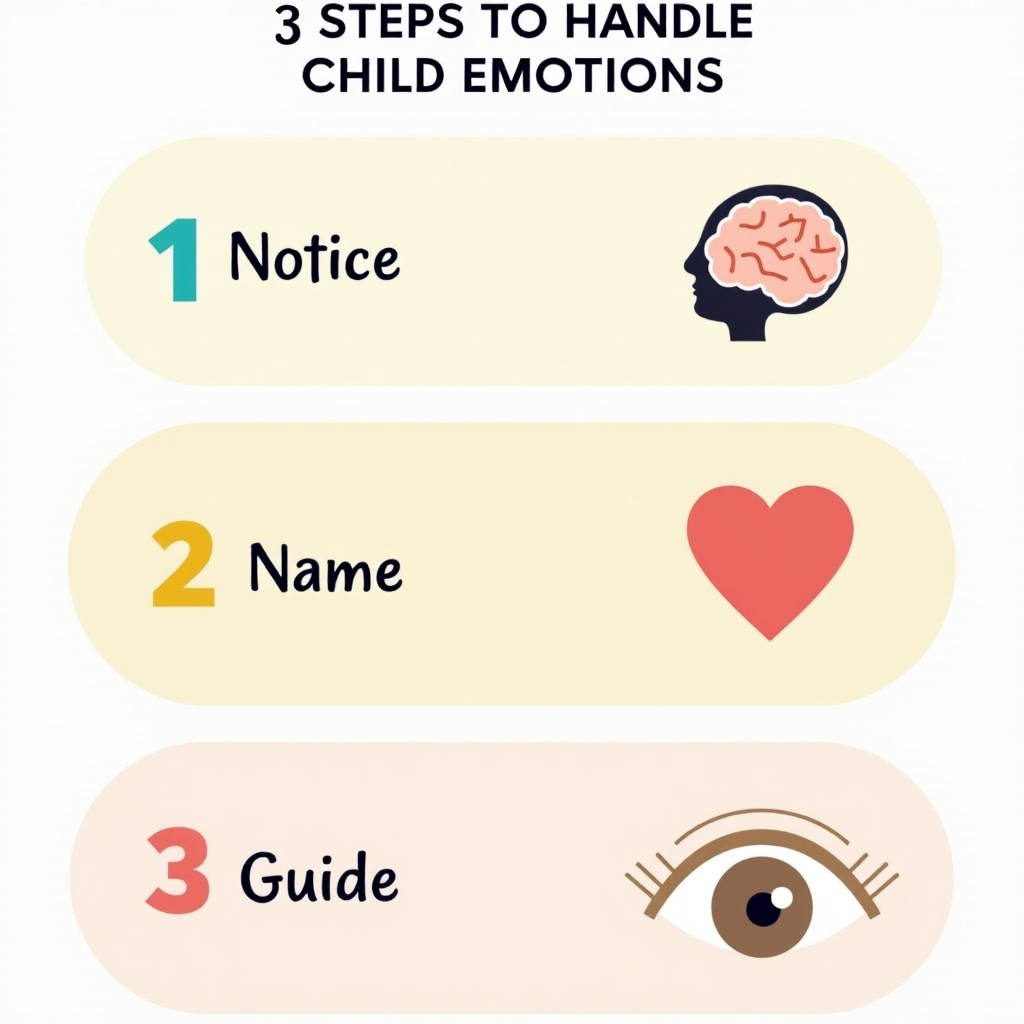
🌿 The 3-Step Emotional Response Method:
✔ Notice → “I see you’re upset.”
✔ Name → “This looks like frustration or disappointment.”
✔ Guide → “Let’s figure out what we can do together.”
This turns emotional moments into learning opportunities instead of conflict.
_______________________________________________________________________________
Even when parents understand what to say…
In real emotional moments, it’s not always easy to:
- identify emotions quickly
- find the right words
- stay calm under pressure
Most parents don’t struggle because they don’t care…
They struggle because they don’t have a simple emotional system to follow in real time.
_________________________________________________________________________________
That’s why structured emotional tools can make such a big difference.
For example:
👉 10 Emotional Flashcards for Kids
Help children visually recognize and name emotions like:
happy, sad, angry, scared, frustrated, proud, and more.
This makes emotional conversations easier in real situations—especially when kids can’t find the words.
----------------------------------------------------------------------------------------------------------------------------------------
👉 Parent’s Guide to Emotional Conversations
A simple step-by-step guide that helps you:
- know what to say during emotional moments
- respond calmly instead of reacting
- guide children through big feelings
- build emotional intelligence at home
Instead of guessing how to respond, you have a clear system.
________________________________________________________________________________
You don’t need to be a perfect parent.
But your responses do shape how your child understands emotions for life.
Every pause.
Every calm response.
Every moment of understanding.
👉 It all becomes part of your child’s emotional foundation.
_________________________________________________________________________________
If you want to make emotional responses easier and more natural:
👉 Start with the 10 Emotional Flashcards and Parent Guide
and build a simple emotional communication system at home or in the classroom.
__________________________________________________________________________________
Thanks for stopping by — we’re so excited to grow bright minds with you!
Warmly,
The LumenSapling Team
Comments ()