
Creative movement is a widely used term in music education, but what does it really refer to and why is it good for children?
What you'll find in this blog post:
- Explanation of what creative movement is and is not
- Four ideas for incorporating creative movement into your lessons
- Bonus phrase and question to ask which help to boost your students' creativity
Let's define creative movement
I think it's helpful to take a step back and use an analogy for the creative process.
Imagine that you and I are sitting next to each other in art class. In one scenario, the teacher gives us step-by-step instructions on how to draw a monkey. We both end up with similar sized monkeys, rounded ears, same curly tail, both dark brown, etc. Our two drawings are almost exact replicas because we followed the same directions.
In another scenario, the teacher gives us parameters about drawing a monkey, but also gives complete flexibility about color, size, background, etc. We are allowed to use our imaginations and we each come up with our own unique masterpiece.
I believe that when we're using movement in our music lessons it can look very similar to this art class analogy. The first scenario is when we teach patterned dance motions: think a line dance for example. While there is definitely value in kids learning to follow specific steps and participating in a group dance - if we want to take their creativity up a notch - we need to incorporate some different ways for children to move.
Creative movement is NOT...
giving the same step-by-step dance instructions, where everyone looks the same
turning on some party music and letting kids dance crazy however they want to
Creative movement IS...
giving students parameters on how they can move (space, appropriate gestures, physical boundaries)
allowing flexibility for different ideas
Four Fun Ideas
Here's some great ideas for how you might incorporate creative movement into your music lessons:
Movement with scarves
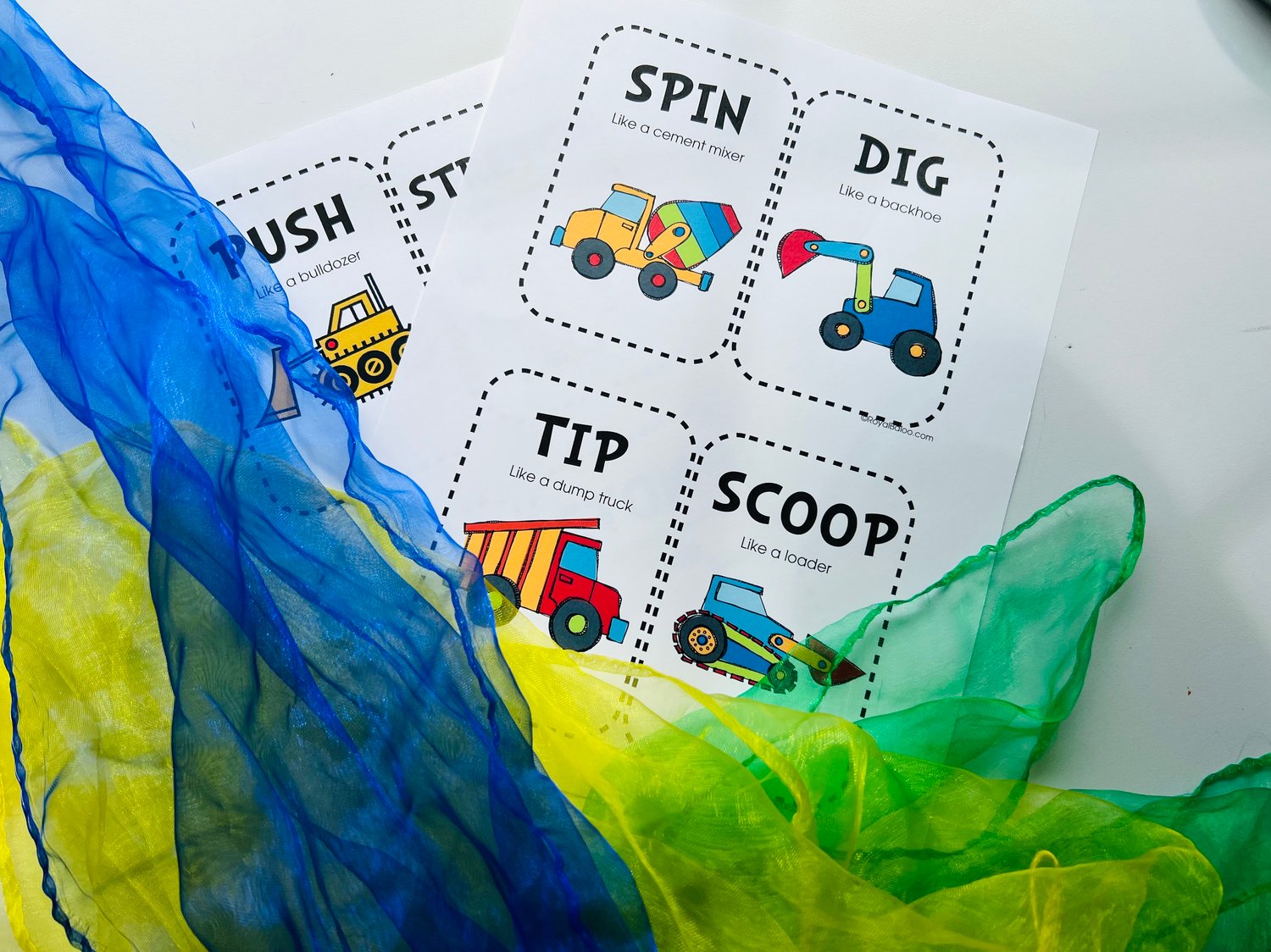
Grab some soft, colorful scarves like these ones from Amazon. Adding something soft and flowing like scarves provides a great tactile experience for kids. I also like how it gets them thinking outside the box. Ask them this question: "Besides the obvious up-and-down or side-to-side motions, what's another way we can move our scarves that looks different?" Possible answers might be a rainbow motion overhead, or spinning quickly like a cyclone. Kids will come up with some really interesting answers!
Printed movement cards
I love a good movement theme like animals, vehicles, holidays, etc. You can find lots of good printable options like this construction set from Royal Baloo. I prefer to use movement cards that are more open-ended, where every kid doesn't pick the exact same motion. Remember, the goal is not for everyone to look the same, but to set parameters and then let their imaginations flow!
Partner mirroring
Two kids will face each other; one is designated as the leader and one is the follower (or mirror). Partner A creates movement to accompany some music and Partner B needs to closely watch and mimic their motions like a mirror reflection. After a minute or two, allow the partners to switch roles. I really like to challenge kids to think about using their whole space. Referring back to the scarf example - what else can you do besides up/down/side-to-side? What if they move backwards or forwards, then what should their mirror reflection do?
Create one section of a larger dance
If you are already teaching a patterned dance (such as a line dance), why not allow students to come up with one section of dance entirely on their own? This works best with songs that have clearly defined sections, think part A/part B/wherever you hear a new change in the music. It could look something like this:
Part A - we all march in a circle
Part B - we alternate patting knees and clapping hands
Part C - a short interlude...ask students to create their own movement during this section...or to volunteer ideas for how the whole group can move
I find that students love it when they get to be part of choreographing movement for a larger dance.
Bonus phrase & question
Any time you're using creative movement as part of your music lesson, there's still a way you can bump it up a notch and get kids thinking outside the box. Begin with the phrase, "I notice that _____" and follow up with the question, "How else could you _____?"
"I notice that you're using a lot of spinning motions with your scarf; how else could you make the scarf move fast?"
The point here is not to critique the student's movement, as if it were right or wrong. The goal is to get them to try new things and imagine different ways of moving.
Creative movement can be such a fun way to get kids' brains and bodies working together. If you want to see more about how I teach this, check out the YouTube video from Morning Basket Music.
Comments ()