
Perhaps your kids have been learning about the four instrument families of the orchestra: Strings, Woodwinds, Brass, and Percussion. But do they know about a V.I.P. called...(drumroll)...the conductor?
In today's Musical Mondays post we'll be discussing the role of a conductor and how they use non-verbal communication to lead a group of musicians. I'll also be sharing three fun, easy activities you can do at home to help your kids practice conducting on their own!
What you'll find in this blog post:
- Explanation of the role of a conductor
- Three conducting activities for different age groups
- Bonus game idea with the 4/4 conducting pattern
What does a conductor do?
The conductor is in charge of leading a group of musicians: whether it be a band, chorus, or orchestra.
I always tell students that this person is a V.I.P. in the music world. "Why??" they ask.
Let's think about all the things a conductor needs to communicate:
- when to start and stop
- which instruments should be playing
- play fast or slow
- play quiet or loud
- smooth sounds/bumpy sounds
- keep everyone together on the same beat
- etc.

Oh, and one more important detail - they do all of this without using any words! During a performance, the conductor will use hand gestures and other forms of non-verbal communication (including facial expressions) to show the musicians what they want to hear. Sometimes you will also see them holding a magic wand, I mean conducting stick, called a baton which makes it easier for the players to see when they are further away.
So I think we can all agree that the conductor has a highly skilled job which requires many hours of rehearsing. However, even young kids can begin how to watch a conductor and learn about some of their special gestures.
Conducting activity for young kids
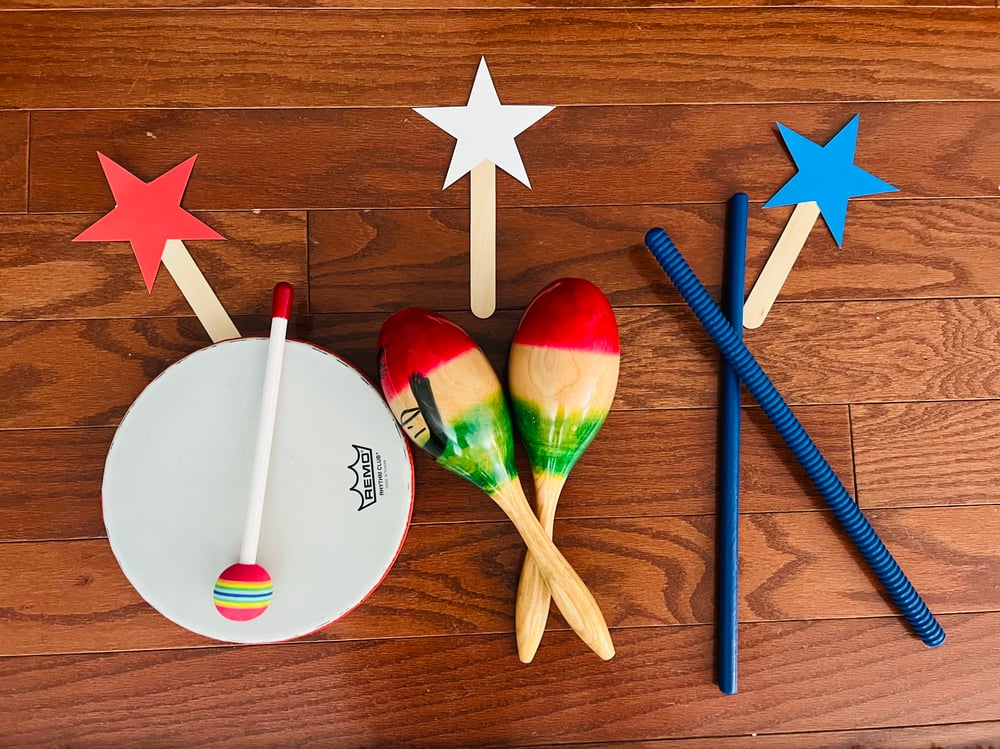
One of the first skills that young kids (even preschoolers) can practice is how to pay attention to start/stop signals. For this activity, you will need to gather three popsicle sticks and attach three different colors or shapes. I like to customize them to whatever season/holiday we're in. Next, you'll assign three different instruments to play the steady beat when they see their particular color. In the photo below you'll see that drums play on red, shakers play on white, and sticks play on blue.
If you don't own any instruments - no problem! You can easily substitute something homemade (yes, pots and pans will work), or you can assign three different body percussion sounds such as: pat/clap/snap.
You will act as the conductor and show your kids when to start and stop playing. Make your signals obvious by holding one color UP when it's time to start, and laying it DOWN when it's time to stop. With your free hand you can also point at them to indicate 'start' and make a closed fist to indicate 'stop'. Remember, conducting is all about non-verbal communication so these signals help students watch and pay close attention.
Each instrument group will play the steady beat on their turn. Consider adding some themed background music to make it more interesting. And if your kids are ready for a challenge you can try holding up multiple sticks at a time.
Conducting activity for elementary
Once kids have mastered start/stop signals, they are ready to try something a bit different. I like to call this activity "conducting in reverse." The normal scenario would be that a conductor uses his/her gestures to show the players how to play. But I'm guessing you probably don't have a live orchestra sitting in your living room to practice with. 😉 Instead, kids will listen to a recording and then create hand gestures to reflect what they hear in the music.
We're less concerned about them tapping the steady beat in the air (although it's fine if they choose to do so) but rather, we're watching to see if their motions match the music. For example, do their hands speed up as the music gets faster? One of my favorite pieces to use for this type of activity is "Variations on Simple Gifts" from Appalachian Spring by Aaron Copland. Many types of theme-and-variation pieces will have several changes in the music that kids can try conducting.
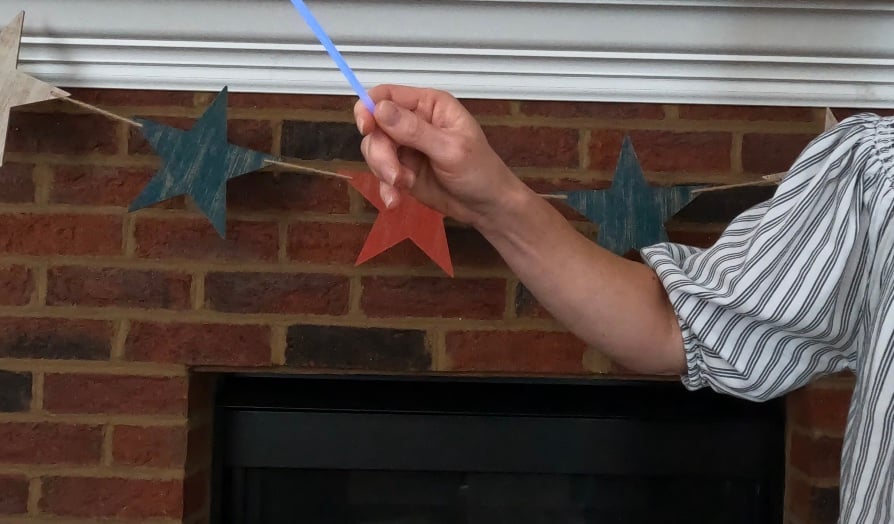
Now, in case this activity only sounds mildly fun so far - here's where we bump it up a notch! Consider picking up a pack of glow sticks at your local dollar store. They make great batons and kids always go nuts for these things. "You mean we're going to conduct with light sabers?!" See what I mean? The fun level automatically increases.
Conducting activity for late elementary/middle school
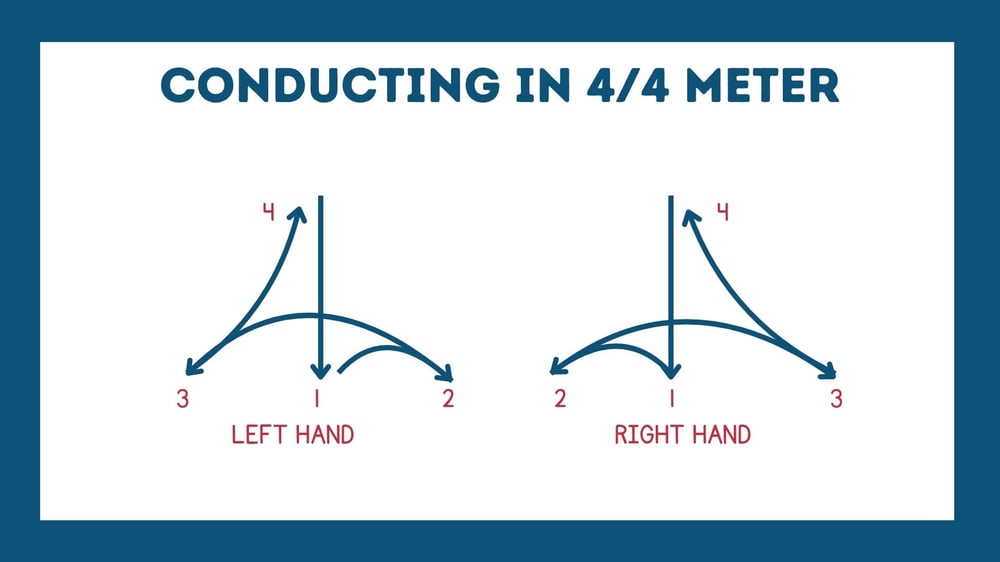
Kids in this older age range can begin to learn some actual conducting patterns. I recommend starting with a 4/4 pattern because this is the most common grouping of beats that you'll find in music. Listen to a recording such as "Stars and Stripes Forever", or "Imperial March" from Star Wars, and see if you can feel the strong downbeat on beat 1 - then count three beats after it.
Next, slowly practice the gestures below with a single hand. I find it helpful when teaching these motions to also speak them out loud. "Down, Left, Right, Swoop-up...Down, Left, Right, Swoop-up."
Once kids have mastered the pattern and can speed it up a bit, try having them conduct one of the songs mentioned above.
Bonus game idea
Here's an idea to extend the 4/4 conducting pattern and turn it into a game. There are two roles: the conductor and the follower(s). The conductor will not use any background music. Instead, he/she will assign the followers a set of motions to perform on any given beat. For example, "Clap on beat one, and snap on beat three." This challenges whoever is following to pay close attention to the conducting pattern and know which beat is shown.
Considering switching roles after each round, and make it even more challenging by assigning a different motion on each of the four beats.
I hope you have a new appreciation for the role of a music conductor, and that you'll be inspired to try some of these exercises with your kids. If you want to see any of these activities in action, check out this YouTube video from Morning Basket Music.
Happy music making!
Comments ()