
Digital transformation is no longer something reserved for large corporations with enormous technology budgets.
Today, businesses of all sizes are using technology to improve how they operate, serve customers, manage information, protect data and compete in increasingly digital markets.
But how do you know when your business actually needs digital transformation?
Sometimes the signs are obvious. Your systems may be outdated, employees may spend hours performing repetitive tasks, or customers may be frustrated by slow processes.
Other times, the warning signs are hidden in everyday operations.
Perhaps employees are using spreadsheets to manage information that should be automated. Maybe different departments use disconnected software. Your business may even be growing faster than your technology infrastructure can handle.
These are all signals worth paying attention to.
Digital transformation isn't simply about buying new technology. It is about using technology strategically to improve the way a business operates and creates value.
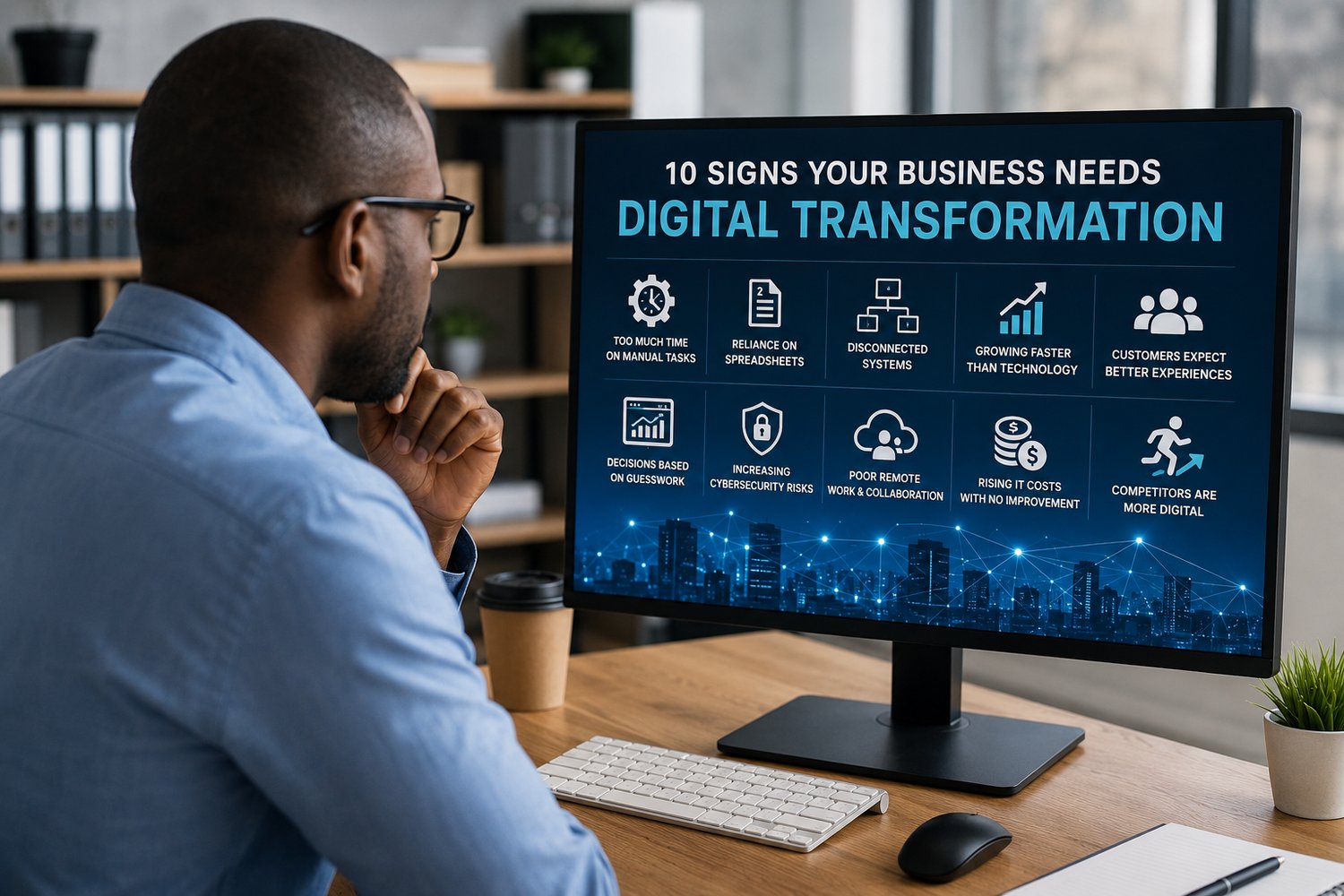
Here are 10 signs that your organization may be ready for its next digital transformation journey.
1. Your Employees Spend Too Much Time on Manual Tasks
One of the clearest signs is excessive reliance on repetitive manual work.
Employees may spend hours:
- Entering the same information into different systems
- Creating reports manually
- Sending repetitive emails
- Processing documents
- Updating spreadsheets
- Moving data between applications
- Tracking tasks manually
- Approving requests through email
Imagine an employee receiving an order and then manually entering the same customer information into three different systems.
That's not just inconvenient. It creates opportunities for:
- Human error
- Duplicate data
- Delays
- Lost information
- Employee frustration
Automation can eliminate many repetitive processes and allow employees to concentrate on activities requiring human judgment and creativity.
The question to ask
"What tasks are our employees doing repeatedly that technology could handle automatically?"
If the answer is "a lot," your business may have significant opportunities for digital transformation.
2. Your Business Relies Too Heavily on Spreadsheets
Spreadsheets are incredibly useful.
But there comes a point when a spreadsheet stops being a helpful tool and starts becoming an operational risk.
If your business uses spreadsheets to manage:
- Customers
- Inventory
- Employees
- Sales
- Projects
- Financial information
- Stock movements
- Business reporting
you may eventually encounter problems with version control, duplicated information, accidental changes and limited visibility.
For example, imagine five employees maintaining different versions of the same customer database.
Which spreadsheet contains the correct information?
That's where things become messy.
Modern business software can centralize information and provide authorized employees with access to the same current data.
3. Your Software Systems Don't Communicate With Each Other
Another major warning sign is disconnected technology.
Your business might use:
CRM + Accounting Software + HR System + Inventory System + Email + Reporting Tools
Individually, each system may work perfectly.
The problem occurs when they don't communicate.
Employees may have to manually move information from one system to another.
This creates what is commonly called data silos.
For example:
A sales employee records a customer in the CRM.
The finance department then enters the same customer into the accounting system.
The operations team creates another record.
The result is multiple versions of the same information.
Digital transformation can involve integrating these systems so information flows more efficiently across the organization.
4. Your Business Is Growing Faster Than Your Technology
Growth is exciting.
But growth can expose weaknesses in your technology environment.
A system that worked perfectly when you had 10 employees may struggle when you have 100.
You may start experiencing:
- Slow applications
- Network congestion
- Storage limitations
- Increasing support requests
- Difficulty managing users
- Poor reporting
- Security challenges
Your technology needs to grow alongside your organization.
A scalable technology strategy can help prevent today's systems from becoming tomorrow's bottleneck.
5. Customers Are Expecting Better Digital Experiences
Customers have become accustomed to fast and convenient digital services.
They increasingly expect businesses to provide:
- Online communication
- Fast responses
- Digital payments
- Self-service options
- Online booking
- Mobile-friendly experiences
- Quick access to information
If your customers constantly have to phone, email or physically visit your business to complete simple processes, there may be opportunities to improve the customer experience.
Digital transformation can help businesses create smoother customer journeys.
For example:
Traditional process:
Customer → Phone call → Employee → Manual processing → Waiting
Digitized process:
Customer → Online platform → Automated workflow → Notification → Completion
The difference can be substantial.
6. Decision-Making Is Based on Guesswork
Good business decisions require good information.
If management cannot easily answer questions such as:
- Which products are performing best?
- Where are we losing money?
- Which customers are most valuable?
- How productive are different departments?
- Where are operational delays occurring?
- What are our current sales trends?
then your business may have a data problem.
Digital transformation can introduce:
- Business intelligence
- Automated reporting
- Dashboards
- Data analytics
- Real-time monitoring
- Centralized information
Instead of waiting for someone to manually compile a report at the end of the month, decision-makers can potentially access important information much faster.
7. Your Business Has Increasing Cybersecurity Risks
Digital transformation and cybersecurity must go hand in hand.
As businesses adopt more:
- Cloud applications
- Remote working
- Connected devices
- Online platforms
- Business applications
- Digital payment systems
their digital attack surface can increase.
Warning signs may include:
- Employees sharing passwords
- Outdated systems
- No multi-factor authentication
- Uncontrolled user access
- Unprotected devices
- Poor backup procedures
- No security monitoring
- Lack of employee security awareness
Modernization without security can simply create a faster way to become vulnerable.
A successful digital transformation strategy therefore needs cybersecurity built into the process from the beginning.
8. Employees Struggle to Work Remotely or Collaboratively
Modern businesses increasingly operate across multiple locations.
Employees may work from:
- Home
- Offices
- Customer sites
- Branches
- Different cities
- Different countries
If employees struggle to access files, communicate with colleagues or securely connect to business systems outside the office, your technology infrastructure may need modernization.
Cloud solutions, collaboration platforms, secure remote access and centralized systems can help organizations create more flexible working environments.
The goal isn't simply to enable remote work.
It is to enable employees to work effectively and securely wherever business requires them to work.
9. Your IT Costs Keep Increasing Without Improving Productivity
Spending money on technology isn't necessarily a problem.
The real question is:
Are you getting sufficient business value from your technology investment?
Some organizations continuously purchase new hardware and software without addressing the underlying problems.
They may have:
- Multiple overlapping applications
- Unused software licenses
- Expensive legacy systems
- Inefficient infrastructure
- Repetitive manual processes
- High IT maintenance costs
Digital transformation provides an opportunity to step back and evaluate the entire technology environment.
Instead of asking:
"What technology should we buy?"
ask:
"What business problem are we trying to solve?"
That simple change in thinking can lead to better technology decisions.
10. Your Competitors Are Becoming More Digital
Perhaps the biggest warning sign is happening outside your organization.
Your competitors may already be:
- Automating operations
- Using AI
- Moving to cloud platforms
- Improving customer experiences
- Using business analytics
- Implementing CRM systems
- Strengthening cybersecurity
- Offering digital services
If your organization continues operating exactly as it did five or ten years ago while competitors modernize, the gap can eventually become difficult to close.
Digital transformation isn't necessarily about becoming the most technologically advanced company.
It is about ensuring that your technology does not become a competitive disadvantage.
What Digital Transformation Actually Looks Like
Digital transformation doesn't necessarily mean replacing every system in your organization.
It can involve relatively focused improvements.
For example:
Software
Replacing disconnected applications with integrated business software.
Cloud
Moving appropriate workloads and services to secure cloud platforms.
Cybersecurity
Strengthening identity management, endpoint protection, monitoring and data protection.
Automation
Automating repetitive processes to reduce manual work.
Data
Creating centralized reporting and analytics.
Infrastructure
Modernizing networks, servers, connectivity and other ICT infrastructure.
Smart Buildings
Introducing intelligent access control, CCTV, automation and energy management.
The transformation should be based on business requirements, not technology trends.
A Simple Digital Transformation Roadmap
If you recognize several of the signs above, don't immediately start purchasing technology.
Start with an assessment.
Step 1: Identify the Problems
Document the processes causing the greatest frustration, delays or costs.
Step 2: Understand Your Current Technology
Review your:
- Software
- Hardware
- Network
- Cloud services
- Security controls
- Data
- Business processes
Step 3: Prioritize
Not every problem needs to be solved at once.
Identify the improvements that could create the greatest business value.
Step 4: Create a Technology Roadmap
Determine what should happen now, what can happen later and what should be avoided.
Step 5: Implement Gradually
Large technology changes should be planned carefully to minimize disruption.
Step 6: Train Employees
Technology only delivers value when people know how to use it effectively.
Step 7: Measure Results
Track improvements such as:
- Time saved
- Reduced errors
- Lower operating costs
- Improved customer satisfaction
- Increased productivity
- Better security
- Faster decision-making
Digital Transformation Doesn't Mean Replacing People
One common misconception is that digital transformation is about replacing employees with technology.
That's not necessarily the objective.
The strongest transformation strategies use technology to augment people.
For example, instead of an employee spending four hours compiling a report, automation could produce the report while the employee spends that time analyzing what the information means.
Instead of employees manually searching through hundreds of documents, intelligent systems can help them locate information faster.
Instead of employees spending their day entering data, automation can allow them to focus on customers and strategic work.
The goal is to make people more productive, not simply to add more technology.
How NTKays Innovations Can Help
At NTKays Innovations, digital transformation connects many of the technology services we provide.
Our solutions span:
Software Solutions
- Enterprise applications
- Business management systems
- ERP and CRM solutions
- Custom software development
- Integration and automation
- Licensing and support
Cloud Solutions
- Cloud migration
- Microsoft 365 and Google Workspace
- Cloud hosting and storage
- Backup and disaster recovery
- Virtual desktop solutions
- Scalable cloud services
Cybersecurity Solutions
- Endpoint protection
- Network security
- Threat detection and monitoring
- Vulnerability assessment
- Data protection and privacy
- Security awareness training
- Compliance and risk management
ICT Infrastructure
- Servers and storage
- Networking and connectivity
- Data centre and rack solutions
- Structured cabling
- Wi-Fi and wireless solutions
- IT support and maintenance
- Hardware supply and management
Smart Building Solutions
- Intelligent access control
- Smart doors and security systems
- CCTV and surveillance
- Building automation
- Energy management
- Integrated building technologies
This allows us to look at technology from a broader perspective rather than treating every business problem as an isolated IT issue.
Final Thoughts
Digital transformation doesn't begin when a company buys new software.
It begins when leadership recognizes that the way the business operates can be improved through technology.
If your employees are spending too much time on manual tasks, your systems don't communicate, your customers expect better digital services, your IT environment is becoming difficult to manage or your competitors are moving ahead, it may be time to rethink your technology strategy.
The best transformation isn't necessarily the biggest one.
It is the one that solves the right problems, improves measurable business outcomes and creates a stronger foundation for future growth.
NTKays Innovations is committed to empowering Southern Africa through technology by helping businesses become more secure, connected, efficient and ready for the future.
Is your business ready for digital transformation?
Let NTKays Innovations help you identify technology gaps, explore practical solutions and develop a technology strategy aligned with your business goals.
Contact us today to discuss your digital transformation journey.