
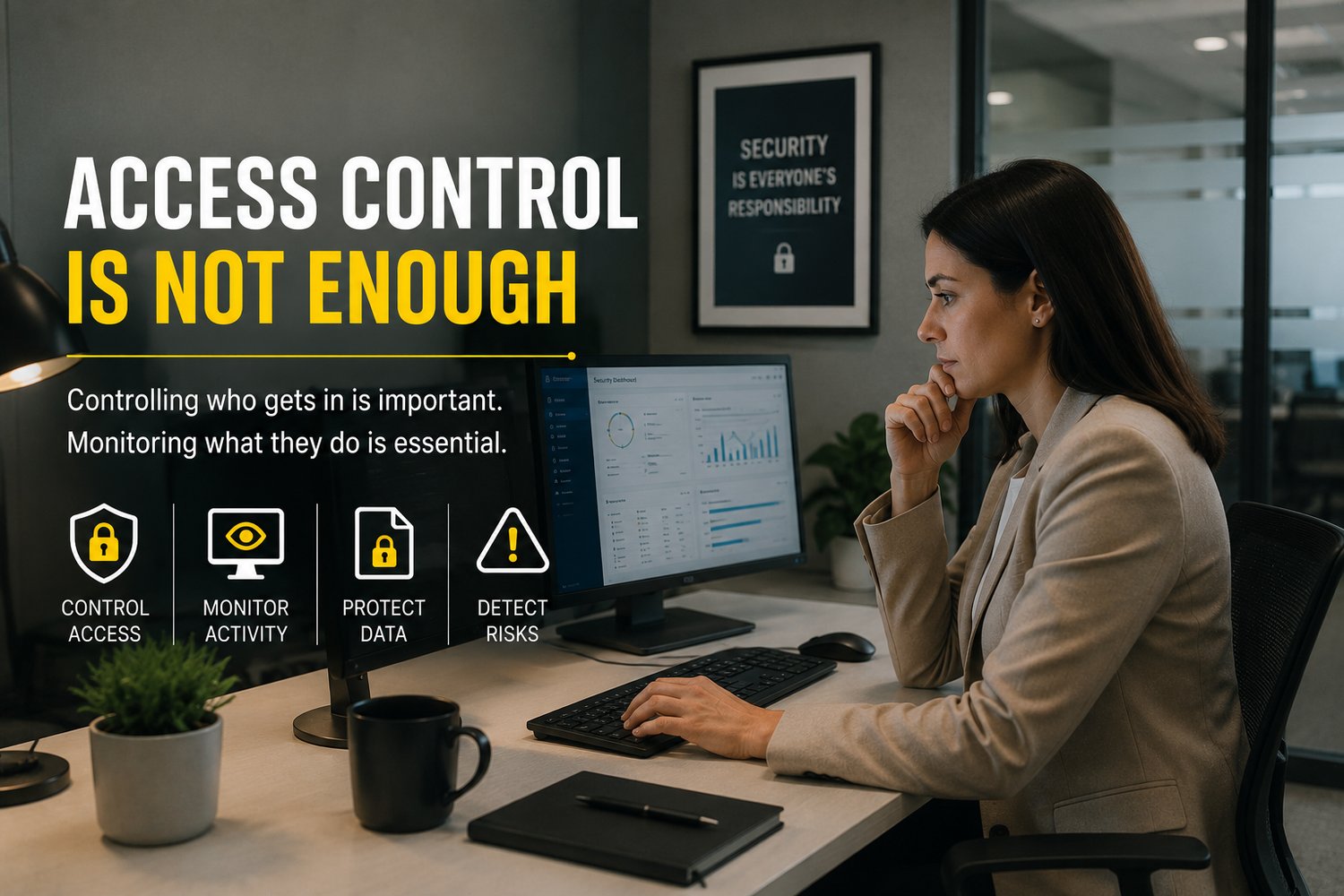
For years, organizations have treated access control as the foundation of cybersecurity.
If users had the correct usernames, passwords, permissions, and authentication methods, systems were considered secure.
But modern cyber risks have changed.
Today, many of the most damaging security incidents do not happen because attackers bypass access controls.
They happen because authorized users misuse legitimate access.
This is why access control alone is no longer enough.
Modern cybersecurity requires visibility into what users do after access is granted.
Understanding Traditional Access Control
Access control is designed to answer one primary question:
Who is allowed to enter a system?
Organizations typically manage this through:
- usernames and passwords
- multi-factor authentication (MFA)
- role-based access control (RBAC)
- privileged account management
- identity verification systems
These controls are essential.
Without them, organizations would have little protection against unauthorized external access.
However, access control focuses primarily on entry, not behavior.
The Modern Security Gap
Once a user successfully logs in, many organizations lose visibility into what happens next.
This creates a dangerous blind spot.
A user may have legitimate access while still engaging in risky activity such as:
- downloading sensitive files
- copying confidential information
- transferring data externally
- abusing privileged access
- accessing systems outside normal responsibilities
Traditional access systems often treat these actions as normal because the user is authenticated.
This is where insider risk begins.
Why Insider Threats Bypass Access Controls
Insider threats are uniquely difficult because they originate from trusted users.
These may include:
- employees
- contractors
- administrators
- third-party vendors
- remote workers
In many cases, insider incidents occur without any failed login attempts or obvious security alerts.
The user already has access.
The real issue becomes:
How is that access being used?
Access Does Not Equal Trust
Many organizations mistakenly assume that authorized access automatically means safe behavior.
It does not.
An employee with valid credentials can still:
- accidentally expose sensitive data
- misuse information intentionally
- violate policies unknowingly
- create operational risks through negligence
Modern cybersecurity must move beyond identity verification toward behavioral visibility.
Visibility Is the Missing Layer
Strong security today depends on understanding user activity after authentication.
Organizations need visibility into:
- application usage
- website activity
- file access behavior
- clipboard usage
- session activity
- data movement patterns
This helps security teams identify abnormal behavior before incidents escalate.
The Role of User Activity Monitoring
User activity monitoring helps organizations understand:
- what users access
- how systems are used
- when suspicious behavior occurs
- where sensitive data moves
Unlike traditional access control, monitoring focuses on behavior and context.
For example:
A login from a trusted employee may appear normal.
But:
- downloading thousands of files suddenly
- accessing systems at unusual hours
- copying confidential data repeatedly
- transferring files externally
may indicate growing insider risk.
Why Privileged Accounts Require Extra Attention
Privileged users represent one of the highest security risks because they often have broad system access.
This includes:
- IT administrators
- database managers
- finance personnel
- executives
If privileged accounts are abused or compromised, the impact can be severe.
Organizations need visibility into privileged user activity, not just access permissions.
Remote Work Has Increased the Challenge
Remote and hybrid work environments have made access control even more complex.
Employees now access systems through:
- home networks
- cloud applications
- personal devices
- remote desktops
- mobile environments
Traditional perimeter-based security becomes less effective when work happens everywhere.
Organizations need continuous visibility into activity, regardless of location.
Security Requires Continuous Verification
Modern cybersecurity is shifting toward a principle known as:
Never trust. Always verify.
This means organizations should continuously evaluate:
- user behavior
- access patterns
- operational anomalies
- risk indicators
Security is no longer a single login event.
It is an ongoing process of validation and visibility.
Building a Stronger Security Strategy
Access control remains essential.
But it must be combined with additional capabilities such as:
- user activity monitoring
- session recording
- behavioral analytics
- insider threat detection
- data loss prevention (DLP)
- file activity monitoring
Together, these tools create a more complete security posture.
Final Thought
Access control answers an important question:
Who can enter?
But modern cybersecurity also requires organizations to answer:
What happens after entry?
Without visibility into user behavior, organizations risk operating in partial awareness while insider threats, data exposure, and operational misuse develop quietly inside trusted environments.
At NTKays Innovation, we help organizations strengthen security beyond traditional access controls through intelligent monitoring, insider threat prevention, and workforce visibility solutions designed for modern digital environments.
Because in today’s cyber landscape, controlling access is only the beginning.