
Cloud computing has changed the way businesses think about technology.
Not long ago, companies that wanted reliable computing systems often needed to purchase servers, maintain storage infrastructure, manage backup equipment and dedicate physical space to IT systems.
Today, businesses can access many of these capabilities through cloud services.
From small businesses to large organizations, cloud technology can support everything from email and collaboration to software applications, data storage, backup, disaster recovery and virtual infrastructure.
But why are businesses making the move?
The answer isn't simply that "the cloud is modern."
Businesses are looking for technology that can help them become more flexible, scalable, accessible and efficient while supporting their long-term digital strategies.
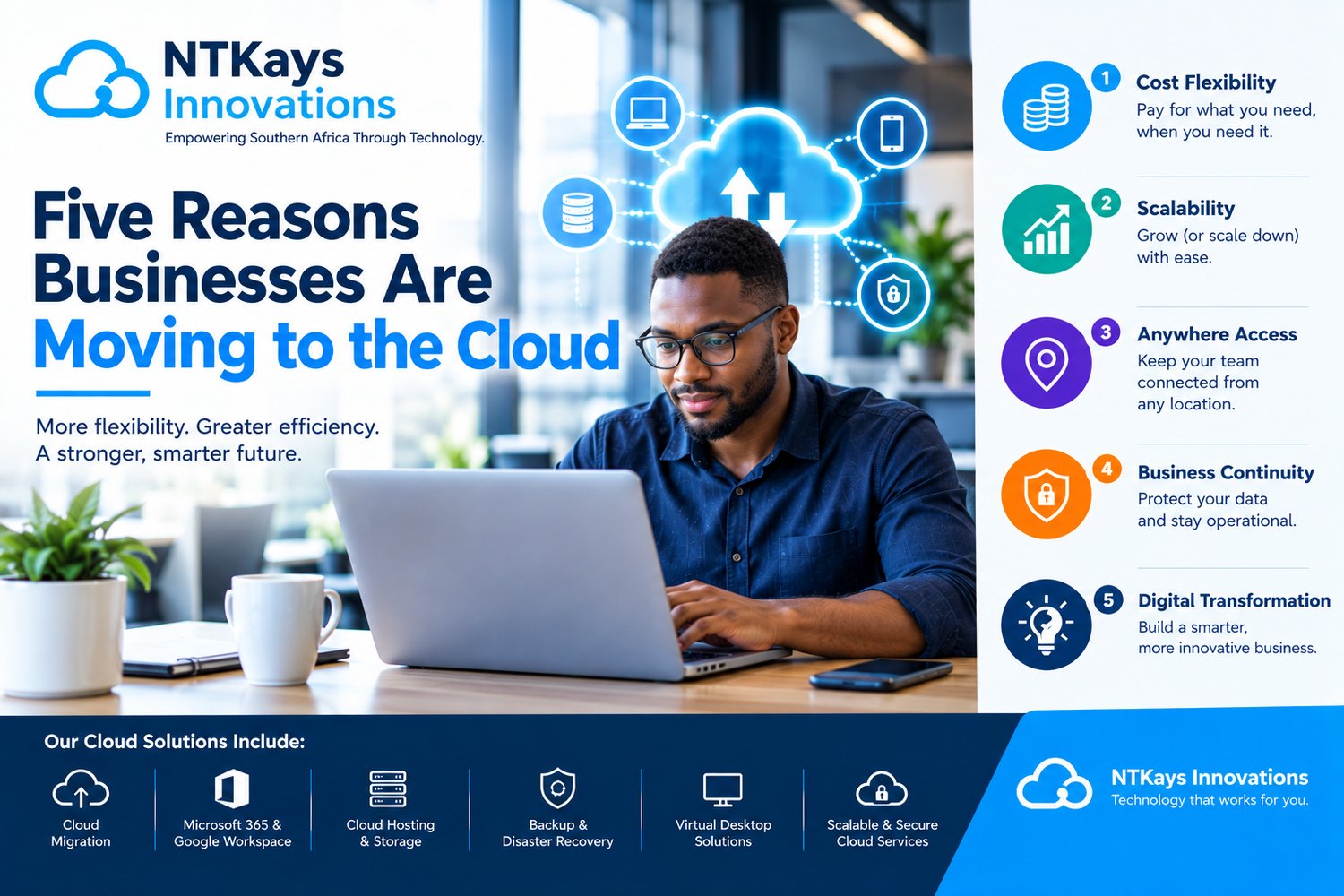
Here are five major reasons behind the shift.
1. Businesses Want Greater Cost Flexibility
Traditional IT infrastructure can require significant upfront investment.
A business may need to purchase:
- Servers
- Storage
- Networking equipment
- Backup infrastructure
- Software licences
- Power protection
- Cooling systems
And that's before considering maintenance.
Cloud computing can provide an alternative model where businesses access computing, storage and applications as services.
Instead of purchasing large amounts of infrastructure upfront, organizations can select services according to their requirements.
This can make IT spending more flexible.
For example:
A growing company may need additional storage as its customer database expands.
With traditional infrastructure, this could require purchasing additional hardware.
With cloud storage, the organization can increase its capacity according to its requirements and the capabilities of the service it uses.
However, cloud computing does not automatically mean lower costs.
Poorly managed cloud environments can become expensive.
Businesses should monitor:
- Resource usage
- Subscriptions
- Storage
- Computing capacity
- Data transfer
- Unused services
The goal is not simply to move expenses from hardware to a monthly cloud bill.
The goal is to use technology resources more efficiently.
2. Businesses Need Scalability
Businesses don't stay the same size forever.
A company may experience:
Growth → Expansion → More employees → More customers → More data → Greater technology requirements
Traditional infrastructure can make scaling more complicated because additional hardware may need to be purchased and installed.
Cloud services can provide greater flexibility for increasing or decreasing resources, depending on the specific service and architecture.
This can be useful for businesses experiencing:
- Rapid growth
- Seasonal demand
- New projects
- Expansion into new markets
- Temporary increases in workload
For example, an online retailer may experience significantly higher demand during a major promotional period.
A cloud environment can provide infrastructure that is capable of adapting to changing workloads when properly designed.
3. Employees Need Access From Almost Anywhere
The modern workplace isn't necessarily a single office building.
Employees may work from:
- Offices
- Homes
- Customer sites
- Different cities
- Different countries
Cloud-based applications can make it easier for authorized employees to access business resources from different locations.
Services such as cloud email, collaboration platforms, document management and business applications can support distributed teams.
For example, an employee working from home might need to:
Access a document → Update it → Collaborate with colleagues → Share the completed version
Cloud collaboration tools can make this workflow possible without requiring everyone to be sitting in the same office.
Of course, remote access must be properly secured.
Businesses should consider:
- Multi-factor authentication
- Identity management
- Access controls
- Endpoint security
- Encryption
- Monitoring
Convenience without security is simply a different kind of problem.
4. Businesses Need Better Business Continuity
What happens if your main server fails?
What happens if ransomware affects your systems?
What happens if a physical office becomes inaccessible?
What happens if critical data is accidentally deleted?
These questions highlight the importance of backup and disaster recovery.
Cloud technology can support business continuity strategies by providing options for:
- Cloud backups
- Off-site data storage
- Disaster recovery
- Application recovery
- Redundant infrastructure
Instead of keeping all critical information in one physical location, organizations can use appropriately designed cloud services to create additional layers of resilience.
But cloud storage should not be confused with a complete backup strategy.
Businesses still need to establish:
- What data should be backed up
- How frequently backups occur
- How long backups are retained
- Who can access them
- How recovery works
- How restoration is tested
A backup plan is only useful if you can actually restore your information when you need it.
5. Businesses Are Pursuing Digital Transformation
Perhaps the biggest reason businesses are moving toward cloud technology is that cloud computing can serve as a foundation for broader digital transformation.
Modern organizations increasingly want to use:
- Artificial intelligence
- Data analytics
- Automation
- Digital workflows
- Online customer platforms
- Integrated business applications
- Remote collaboration
- Modern cybersecurity tools
Many of these technologies can operate effectively alongside cloud infrastructure.
For example:
Cloud Infrastructure
↓
Business Applications
↓
Data
↓
Analytics
↓
Automation & AI
↓
Better Business Processes
Cloud technology isn't the transformation itself.
It can provide part of the infrastructure that enables transformation.
Cloud Migration Is More Than Moving Servers
One common misconception is that cloud migration simply means taking an existing server and moving it to a cloud data centre.
In reality, businesses can approach migration in several ways.
Rehost
Move an application to the cloud with minimal modification.
Replatform
Move the application while making selected improvements.
Refactor
Redesign the application to take greater advantage of cloud capabilities.
Replace
Replace an older system with a suitable cloud-based application.
Retire
Remove applications that are no longer required.
This is why businesses should develop a cloud migration strategy before moving important workloads.
What About Cybersecurity?
Moving to the cloud does not mean cybersecurity becomes someone else's problem.
Cloud environments still require strong security practices.
Businesses should consider:
- Identity and access management
- Multi-factor authentication
- Endpoint protection
- Encryption
- Network security
- Security monitoring
- Data protection
- Backup
- Vulnerability management
Cloud providers may secure parts of the underlying infrastructure, but customers generally remain responsible for securing their own users, configurations, data and applications according to the service model.
A secure cloud environment therefore requires both technology and good management practices.
Five Questions Businesses Should Ask Before Moving to the Cloud
Before starting a cloud migration, ask:
1. What are we trying to achieve?
Is the objective cost optimization, scalability, remote access, modernization or something else?
2. Which systems should move?
Not every application needs to be migrated immediately.
3. What will the migration cost?
Consider both migration costs and ongoing operational costs.
4. How will we protect our data?
Security and privacy requirements should be considered from the beginning.
5. How will we manage the environment afterwards?
Cloud migration is not the finish line.
The environment needs continuous monitoring, security and cost management.
How NTKays Innovations Can Help
At NTKays Innovations, cloud solutions form part of our broader technology offering for businesses across Southern Africa.
Our cloud solutions include:
Cloud Migration
Helping businesses assess and plan their move toward appropriate cloud environments.
Microsoft 365 & Google Workspace just for example
Supporting modern collaboration and productivity environments.
Cloud Hosting & Storage
Providing scalable options for business applications and data.
Backup & Disaster Recovery
Supporting business continuity and recovery planning.
Virtual Desktop Solutions
Supporting flexible access to business computing environments.
Scalable & Secure Cloud Services
Helping businesses develop cloud environments aligned with their operational and security requirements.
Cloud technology can also be integrated with our:
Software Solutions | Cybersecurity Solutions | ICT Infrastructure | Smart Building Solutions | Strategic Partnerships
This integrated approach allows businesses to consider cloud technology as part of their wider ICT strategy.
Final Thoughts
Businesses are moving to the cloud because the way organizations operate is changing.
They need technology that can adapt to changing workloads, support distributed teams, improve resilience and provide a foundation for digital innovation.
The five major drivers are:
Cost flexibility
Scalability
Anywhere access
Business continuity
Digital transformation
But cloud adoption should never be about following a technology trend simply because everyone else is doing it.
The right question is:
"How can cloud technology solve our specific business challenges?"
When cloud migration is properly planned, secured and managed, it can become an important part of a modern business technology strategy.