
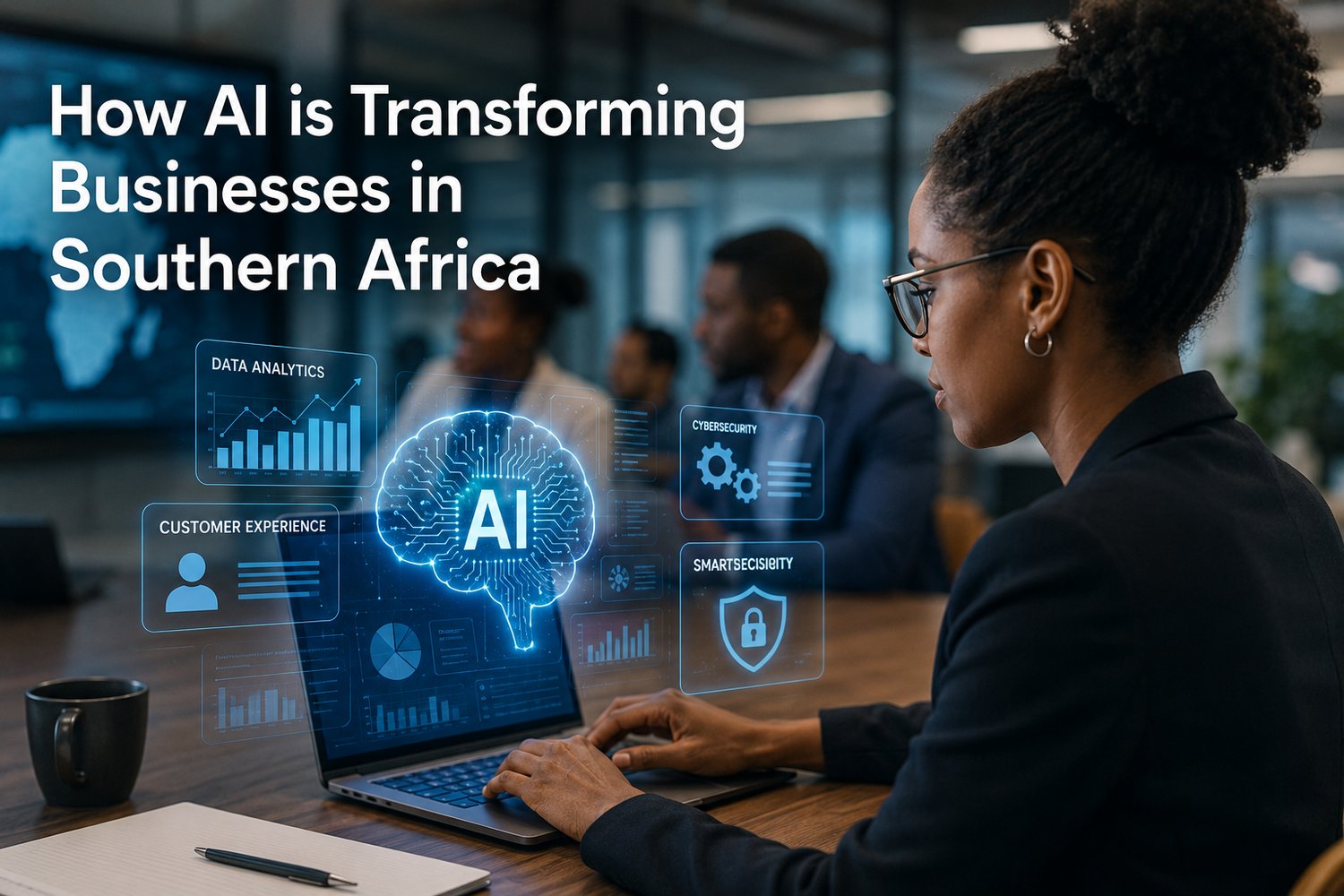
Artificial intelligence has moved from being a futuristic concept discussed in technology conferences to becoming a practical business tool.
Across Southern Africa, organizations are exploring how AI can help them reduce repetitive work, improve customer experiences, analyse information, strengthen cybersecurity, support employees and make better decisions.
South Africa is currently one of the continent's more developed AI ecosystems, with adoption expanding across sectors such as financial services, retail, healthcare, mining, manufacturing and government. Recent research also shows a gap between experimenting with AI and successfully scaling it across entire organizations.
For businesses, the important question is therefore no longer simply:
"What is AI?"
The more useful question is:
"Where can AI solve a real business problem?"
This article explores how AI is transforming businesses in Southern Africa, the opportunities it creates, the challenges organizations need to consider and how companies can begin adopting AI responsibly.
What Is Artificial Intelligence?
Artificial intelligence refers to technologies that allow computer systems to perform tasks that traditionally require human intelligence.
These can include:
- Understanding language
- Recognising patterns
- Analysing data
- Generating text and images
- Making predictions
- Detecting anomalies
- Recommending actions
- Automating decisions
- Assisting with customer interactions
Generative AI is one of the most visible forms of AI today. It can help generate content, summarize information, analyse documents, assist programmers and support employees with everyday tasks.
But AI is much broader than chatbots.
Businesses can use AI for fraud detection, forecasting, cybersecurity, predictive maintenance, customer analytics, logistics, document processing and operational optimization.
Why AI Matters for Southern African Businesses
Businesses in Southern Africa operate in a particularly interesting environment.
Organizations need to improve productivity while dealing with challenges such as:
- Rising operating costs
- Skills shortages
- Infrastructure constraints
- Competitive pressure
- Cybersecurity threats
- Changing customer expectations
- Increasing amounts of business data
AI doesn't eliminate these challenges, but it can provide new ways of addressing some of them.
Recent PwC research found that African organizations are widely experimenting with AI, while the bigger challenge is turning those experiments into enterprise-wide value. The research also found that workers are already adopting AI quickly, creating significant potential for businesses that can provide the right systems, skills and governance.
1. AI Is Automating Repetitive Business Tasks
One of the most immediate applications of AI is automation.
Businesses often have employees spending hours on repetitive activities such as:
- Data entry
- Document processing
- Scheduling
- Report preparation
- Email classification
- Information retrieval
- Customer enquiries
- Invoice processing
- Administrative tasks
AI can assist with many of these activities.
For example, an organization receiving hundreds of customer emails could use AI to categorize enquiries and direct them to the appropriate department.
Employees can then spend less time sorting information and more time dealing with complex customer needs.
The result?
Less repetitive work + faster processes + more productive employees.
2. AI Is Improving Customer Service
Customer expectations are changing.
People increasingly want answers quickly, regardless of whether they contact a company during traditional office hours.
AI-powered chatbots and virtual assistants can help businesses provide:
- Frequently asked questions
- Product information
- Order updates
- Appointment assistance
- Basic troubleshooting
- Customer guidance
- Initial support
AI can also help human customer-service agents by summarizing previous conversations and retrieving relevant information.
This creates a combination of AI assistance + human expertise rather than forcing businesses to choose one or the other.
3. AI Is Helping Businesses Understand Their Data
Businesses collect enormous amounts of information.
The problem isn't always a lack of data.
Sometimes the problem is having too much data and not enough insight.
AI can analyse large datasets and help identify:
- Customer trends
- Sales patterns
- Unusual activity
- Operational problems
- Demand patterns
- Potential risks
- Opportunities
For example, a retailer could use analytics to understand which products are selling at different times of the year.
A logistics company could analyse delivery data to identify recurring delays.
A financial institution could use AI to identify unusual transaction patterns.
AI turns data from something businesses simply store into something they can potentially use more intelligently.
4. AI Is Supporting Better Decision-Making
Business leaders frequently have to make decisions with incomplete information.
AI can provide additional analytical support.
For example, AI could help management analyse:
Sales + customer behaviour + inventory + market information
and identify patterns that might otherwise take employees considerably longer to discover.
AI should not automatically replace human decision-makers.
Instead, it can act as a powerful analytical assistant.
The human still provides:
- Context
- Judgment
- Accountability
- Business experience
- Ethical oversight
This human-AI combination is particularly important when decisions affect employees, customers, finances or regulated activities.
5. AI Is Transforming Cybersecurity
Cybersecurity is another area where AI is becoming increasingly important.
Modern businesses generate enormous quantities of security information.
AI and machine learning can help security teams identify unusual patterns across:
- Network traffic
- User activity
- Devices
- Login behaviour
- Applications
- System events
For example, if an account suddenly begins behaving very differently from its normal pattern, automated systems can flag the activity for investigation.
AI can therefore support:
- Threat detection
- Anomaly detection
- Fraud detection
- Security monitoring
- Vulnerability analysis
- Incident response
But there is another side to this story.
Cybercriminals are also using AI.
That means businesses need to think about AI as both a security opportunity and an emerging security risk.
6. AI Is Changing Marketing
Marketing teams can use AI to assist with:
- Content creation
- Customer segmentation
- Campaign analysis
- Market research
- Personalization
- Search optimization
- Social media planning
Instead of creating every piece of content manually, teams can use AI to generate initial ideas and drafts before human review.
AI can also analyse customer behaviour and help businesses understand which messages are resonating with different audiences.
The most effective approach is not necessarily:
AI creates everything.
It is often:
AI accelerates the work + humans provide strategy, creativity and quality control.
7. AI Is Improving Business Forecasting
Predicting the future has always been difficult.
AI cannot see the future, but it can analyse historical information and identify patterns that may help organizations make better forecasts.
Businesses can potentially use AI for:
- Sales forecasting
- Demand forecasting
- Inventory planning
- Cash-flow analysis
- Customer churn prediction
- Resource planning
- Supply-chain forecasting
For example, if a business understands seasonal demand patterns, AI may help it anticipate future inventory requirements.
That can reduce the risk of having either too much or too little stock.
8. AI Is Supporting Manufacturing and Operations
Manufacturing is another area where AI can create significant opportunities.
AI can support:
- Predictive maintenance
- Quality control
- Production planning
- Supply-chain optimization
- Energy management
- Demand forecasting
- Operational monitoring
Instead of waiting for equipment to fail, predictive systems can analyse machine data and identify signs that maintenance may be required.
This can potentially reduce unexpected downtime.
Recent PwC research found strong expectations among South African manufacturing executives that AI could improve profitability, although actual financial returns remain uneven and many organizations are still moving from pilots toward broader implementation.
9. AI Is Creating Opportunities in Mining
Mining is particularly important in Southern Africa.
AI can potentially support:
- Equipment monitoring
- Predictive maintenance
- Safety systems
- Geological analysis
- Production optimization
- Fleet management
- Operational decision-making
In South African mining, AI and other digital technologies are increasingly being explored as ways to address challenges including rising costs, deeper ore bodies, infrastructure constraints and skills shortages.
The opportunity is significant because even small improvements in productivity, safety or equipment availability can have major operational consequences.
10. AI Is Changing Retail
Retail businesses can use AI to improve both back-office operations and customer experiences.
Applications include:
- Personalized recommendations
- Inventory forecasting
- Customer analytics
- Fraud detection
- Marketing
- Demand prediction
- Conversational shopping assistants
South African retailers are already experimenting with AI-powered customer experiences. For example, Pick n Pay has deployed an AI shopping assistant that can help customers build shopping baskets and plan meals.
This illustrates an important trend:
AI is moving closer to the customer.
It isn't only operating behind the scenes.
11. AI Can Help Small and Medium-Sized Businesses
AI isn't only for large corporations.
Small businesses can use relatively accessible AI tools for:
- Customer communication
- Marketing
- Document processing
- Administrative work
- Data analysis
- Content creation
- Scheduling
- Research
- Customer support
This can potentially help smaller organizations compete more effectively without needing the enormous technology budgets traditionally associated with advanced digital systems.
However, SMEs should avoid adopting AI simply because everyone else is talking about it.
The better question is:
"What business problem can this technology solve?"
12. AI Is Changing the Workplace
AI will also change how employees work.
Some tasks will become automated.
Other jobs will evolve.
Employees may increasingly work alongside AI systems that assist with:
- Research
- Writing
- Analysis
- Coding
- Customer service
- Administration
- Decision support
This means businesses need to invest in AI literacy and employee development.
Recent PwC research found that African workers are already showing strong openness to AI, but many are concerned about whether their current skills will remain relevant.
The message for businesses is clear:
AI adoption should include people, not just technology.
AI Is Not About Replacing Everyone
One of the biggest concerns surrounding AI is job displacement.
The reality is more nuanced.
Some tasks may become automated.
Some roles may change.
New roles may also emerge.
For many businesses, the more productive approach is to ask:
"How can AI help our employees perform their jobs better?"
Consider an accountant who previously spent several hours preparing a preliminary report.
If AI can assist with gathering and organizing the information, the accountant can spend more time reviewing the results, advising clients and identifying financial issues.
The technology handles some of the repetitive workload.
The professional provides judgment.
The Challenges of AI Adoption in Southern Africa
AI presents enormous opportunities, but organizations should not ignore the challenges.
1. Cost
AI implementation can require investment in:
- Software
- Infrastructure
- Cloud services
- Data
- Training
- Security
- Specialist expertise
Businesses should therefore start with high-value use cases rather than attempting to implement AI everywhere.
2. Data Quality
AI depends heavily on data.
If business data is incomplete, inaccurate, duplicated or poorly organized, AI systems may produce unreliable results.
Better AI often starts with better data.
3. Skills Shortages
Organizations need people who understand both technology and business requirements.
Employees may need training in:
- AI literacy
- Data management
- Prompting
- Cybersecurity
- Responsible AI
- Data analysis
4. Privacy and Data Protection
Businesses need to be careful about what information they provide to AI systems.
Sensitive information may include:
- Customer data
- Employee information
- Financial records
- Intellectual property
- Confidential business information
Organizations need appropriate policies and controls to determine what data can be used with AI tools.
5. Accuracy and Hallucinations
AI systems can produce incorrect information while presenting it confidently.
This means important outputs should be reviewed.
AI should not be treated as an infallible oracle with a Wi-Fi connection.
Human verification remains important, particularly in high-impact business decisions.
6. Cybersecurity
AI systems themselves need protection.
Businesses should consider:
- Access controls
- Data security
- Identity management
- Monitoring
- Secure integrations
- Vendor risk
- AI-specific threats
AI adoption without cybersecurity planning can create new vulnerabilities.
How Businesses Can Start Using AI
Businesses don't need to begin with a massive AI project.
A practical approach is to start small.
Step 1: Identify Repetitive Processes
Look for tasks employees perform repeatedly.
Step 2: Identify Business Pain Points
Where are you experiencing:
- Delays?
- High costs?
- Errors?
- Poor customer service?
- Too much manual work?
Step 3: Evaluate AI Use Cases
Ask whether AI could realistically improve the process.
Step 4: Check Your Data
Make sure the necessary information is available, accurate and appropriately protected.
Step 5: Start With a Pilot
Test the technology in a controlled environment.
Step 6: Measure the Results
Look at:
- Time saved
- Cost reduction
- Productivity
- Accuracy
- Customer satisfaction
- Revenue impact
Step 7: Scale What Works
If the pilot delivers measurable value, expand it.
This approach reduces the risk of spending heavily on technology that doesn't solve a meaningful business problem.
AI Needs the Right Technology Foundation
AI adoption doesn't happen in isolation.
Businesses need supporting infrastructure.
AI initiatives may depend on:
Cloud Solutions
For computing, storage, applications and scalable workloads.
ICT Infrastructure
For reliable networks, connectivity, servers, storage and devices.
Cybersecurity
To protect AI systems, users, data and business environments.
Software Solutions
To integrate AI into everyday business processes.
Smart Building Technologies
To support intelligent environments, monitoring, automation and connected systems.
This is where a broader technology strategy becomes important.
How NTKays Innovations Can Help
At NTKays Innovations, we believe AI should be connected to real business objectives.
Our broader technology solutions include:
Software Solutions
- Enterprise applications
- Business management systems
- Custom software development
- Integration and automation
Cloud Solutions
- Cloud migration
- Cloud hosting and storage
- Microsoft 365 and Google Workspace
- Backup and disaster recovery
- Virtual desktop solutions
Cybersecurity Solutions
- Endpoint protection
- Network security
- Threat detection and monitoring
- Vulnerability assessment
- Data protection and privacy
- Security awareness training
ICT Infrastructure
- Servers and storage
- Networking and connectivity
- Data centre solutions
- Structured cabling
- Wi-Fi and wireless solutions
- IT support and maintenance
Smart Building Solutions
- Intelligent access control
- CCTV and surveillance
- Smart security systems
- Building automation
- Energy management
- Integrated building technologies
This broader ecosystem matters because successful AI adoption often requires more than an AI application. It requires secure infrastructure, reliable connectivity, quality data, suitable software and people who understand how to use the technology.
The Future of AI in Southern Africa
The AI journey in Southern Africa is still developing.
There is significant enthusiasm, but organizations are at different stages of maturity.
Some are experimenting with generative AI.
Others are deploying AI into customer service, cybersecurity, operations and analytics.
The next challenge is scaling successful use cases while maintaining security, governance and measurable business value.
PwC's 2026 research highlights this "scale gap": many African organizations are running AI pilots, but relatively few have moved to enterprise-wide adoption.
That creates an important opportunity.
Businesses that learn how to implement AI responsibly and connect it to real operational problems may be better positioned to compete in an increasingly digital economy.
Final Thoughts
AI is not simply another technology trend.
It is becoming part of how businesses operate, make decisions, communicate with customers and manage information.
For Southern African businesses, the opportunity is particularly significant.
AI can help organizations:
Automate → Analyse → Predict → Protect → Personalize → Innovate
But successful AI adoption requires more than purchasing an AI tool.
It requires a strategy.
Businesses need to consider their:
- People
- Processes
- Data
- Infrastructure
- Cybersecurity
- Software
- Governance
- Business objectives
The organizations that benefit most from AI are unlikely to be those that simply use the most AI tools.
They will be the organizations that use AI to solve meaningful problems and create measurable value.
Is Your Business Ready for AI?
NTKays Innovations can help businesses explore how modern technology, AI, cloud solutions, software, cybersecurity and ICT infrastructure can work together to create a more efficient, secure and future-ready organization.