
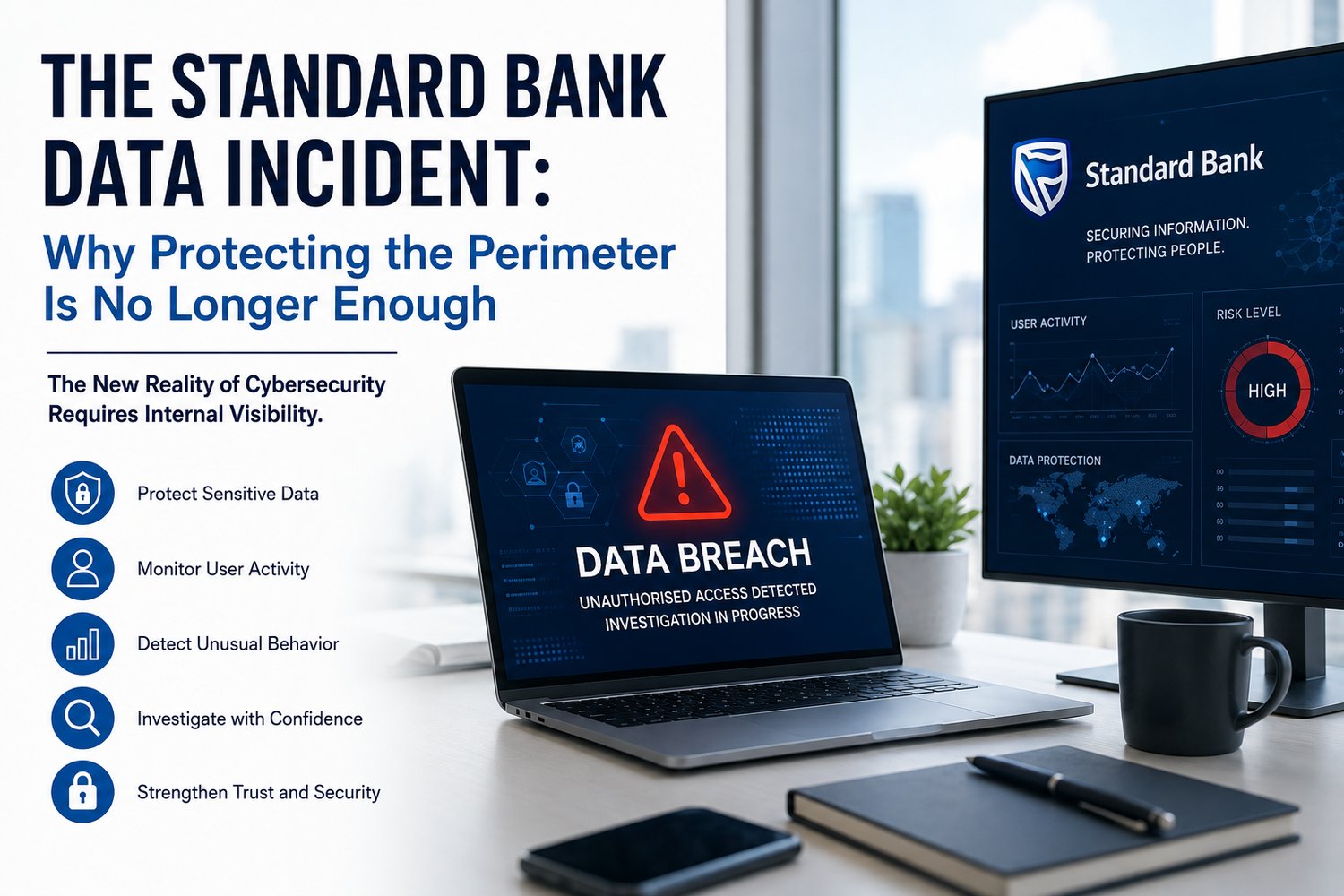
In cybersecurity, some incidents become more than just news stories.
They become lessons.
The data incident disclosed by Standard Bank South Africa in March 2026 is one such example. It highlights a critical reality for every organisation that handles sensitive customer, employee, or business information:
Protecting the outside of your organisation is only part of cybersecurity. You must also understand and secure what happens inside.
Standard Bank announced on 23 March 2026 that it had identified an incident involving unauthorised access to select data and had immediately taken steps to secure its environment. The bank stated that its transactional banking systems remained secure and operational, and that client funds and accounts were not affected.
As the investigation progressed, Standard Bank said the affected systems were internal administrative and document-filing systems rather than its core transactional banking systems. The bank reported that information potentially affected included names, identification or registration numbers, contact details, and account numbers. It also later stated that, in limited cases, certain credit card details, including card numbers and expiry dates, were affected, while CVV numbers were not.
On 14 April, the bank further stated that client and company-related data appeared to have been published, escalating the significance of the incident and reinforcing concerns about the potential misuse of exposed personal information.
The incident is a reminder that cybersecurity is no longer simply about keeping attackers outside the network.
It is about knowing what is happening across the entire digital environment.
The New Cybersecurity Reality
For many years, organisations built their security strategies around the perimeter.
Firewalls.
Antivirus.
Endpoint protection.
Passwords.
Multi-factor authentication.
These technologies remain essential, but the modern threat landscape has changed.
Organisations now operate across cloud environments, remote workplaces, third-party platforms, mobile devices, and increasingly complex digital ecosystems.
Employees and contractors access sensitive systems from multiple locations.
Administrators have elevated privileges.
Third-party service providers may have access to internal platforms.
Customer information moves between applications and systems.
This creates a much larger security challenge.
The question is no longer simply:
"Who is trying to get in?"
The question is also:
"What is happening after access has been granted?"
Access Control Does Not Tell the Whole Story
Access control is an important security foundation.
It determines who is authorised to access a system or information.
But access permissions alone do not tell an organisation everything it needs to know.
They do not necessarily explain:
- What information a user accessed
- Whether the access was unusual
- How much data was viewed or downloaded
- Whether sensitive information was copied
- Whether files were transferred elsewhere
- Whether a privileged account behaved abnormally
- Whether a compromised account was being used
This is where organisations need greater visibility.
A user can have legitimate credentials and still create risk.
An account can be compromised and appear legitimate.
An employee can make an accidental mistake.
A contractor can access information outside normal responsibilities.
A privileged administrator can perform actions that require investigation.
In each case, authentication alone may not provide enough context.
The Importance of Internal Visibility
The Standard Bank incident demonstrates an important principle for organisations across every industry:
Sensitive information needs protection wherever it exists, not only within the systems considered most critical.
An organisation may have highly secure transactional platforms while still holding sensitive information in administrative systems, document repositories, file servers, employee workstations, and other internal environments.
These systems can contain valuable information.
And valuable information attracts risk.
This is why organisations need visibility across their entire information environment.
Security teams should be able to understand:
- Who accessed sensitive information?
- When did the access occur?
- What files or records were accessed?
- Was the activity consistent with normal behaviour?
- Was information copied or transferred?
- Did the user suddenly change their normal behaviour?
- Can the organisation reconstruct what happened during an investigation?
Without this visibility, security teams may only discover the problem after information has already been exposed.
Insider Risk Does Not Always Mean a Malicious Employee
The term "insider threat" is sometimes misunderstood.
It does not automatically mean that an employee deliberately attacked the organisation.
Insider risk can arise from several situations.
Malicious insiders
An individual may intentionally misuse access to steal or disclose confidential information.
Negligent insiders
An employee may accidentally expose information by using an insecure application, sending data to the wrong recipient, or failing to follow security procedures.
Compromised insiders
An employee's legitimate credentials may be stolen by an external attacker.
The attacker can then operate through an account that appears to belong to a trusted user.
Third-party risk
Contractors, suppliers, and service providers may have legitimate access to organisational systems and data.
Each scenario requires a different response.
But they all have one thing in common:
Visibility matters.
Why User Activity Monitoring Matters
User Activity Monitoring provides organisations with deeper insight into how systems are actually being used.
Depending on the organisation's policies and legal requirements, monitoring can provide visibility into activities such as:
- Application usage
- Website activity
- File access
- File transfers
- Clipboard activity
- USB device usage
- Session activity
- Login behaviour
- Privileged account activity
This information can help security teams identify unusual patterns.
For example, an employee who normally accesses a limited number of documents may suddenly begin downloading hundreds of sensitive files.
A privileged account may start accessing systems outside its normal operating pattern.
A compromised account may begin operating from an unusual device or location.
These behaviours do not automatically prove malicious activity.
But they may provide an important signal that further investigation is required.
Behavioural Analytics Adds Another Layer
This is where technologies such as User and Entity Behavior Analytics (UEBA) can become valuable.
Rather than relying only on fixed security rules, behavioural analytics can help establish patterns of normal activity and identify deviations.
Imagine an employee who normally:
- Logs in during business hours
- Uses a small number of applications
- Accesses a specific group of files
Suddenly, that same account:
- Logs in at an unusual time
- Accesses unfamiliar systems
- Downloads a large volume of data
- Transfers information to an external location
Each action on its own may not be enough to trigger concern.
Together, however, they may represent a significant change in behaviour.
This is where behavioural intelligence can help security teams prioritise potential risks.
Investigations Need Evidence
When an incident occurs, organisations need more than assumptions.
They need evidence.
Security teams may need to establish:
- What happened?
- When did it happen?
- Which account was involved?
- What information was accessed?
- Was the activity authorised?
- Was data transferred?
- What happened immediately before and after the incident?
Technologies such as session recording, screenshot monitoring, file activity monitoring, and detailed audit trails can provide additional context for investigations, subject to appropriate policies, privacy requirements, and applicable laws.
The goal is not simply to monitor people.
The goal is to understand events accurately.
Because when sensitive information is involved, assumptions are not enough.
The Lesson for Banks and Other Data-Intensive Organisations
Financial institutions are not the only organisations that need this level of visibility.
The same principles apply to:
- Insurance companies
- Healthcare organisations
- Call centres
- Telecommunications companies
- Government departments
- Utilities
- Educational institutions
- Retail organisations
- Professional services firms
- Technology companies
Any organisation that collects and processes sensitive information faces insider risk.
The information may be different, but the fundamental challenge remains the same:
How do you protect sensitive data when legitimate users need access to it?
The Future of Cybersecurity Is Visibility
The Standard Bank incident is a useful reminder that cybersecurity strategies must continue to evolve.
Firewalls are important.
Authentication is important.
Access controls are important.
But organisations must also understand what happens after access is granted.
Modern security strategies increasingly require a combination of:
- Access control
- User Activity Monitoring
- Insider Risk Management
- Behavioural Analytics
- Session Recording
- File Activity Monitoring
- Data Loss Prevention
- Privileged User Monitoring
- Incident Investigation
Together, these capabilities help organisations move from simply controlling access to understanding behaviour.
Five Questions Every Business Leader Should Ask
Every organisation handling sensitive information should ask:
1. Do we know who is accessing our sensitive information?
2. Can we identify unusual user behaviour before it becomes an incident?
3. Can we investigate suspicious activity with reliable evidence?
4. Do we have visibility into privileged and high-risk accounts?
5. Are our security controls protecting data throughout its lifecycle, not only at the network perimeter?
If the answer to these questions is unclear, there may be a visibility gap that deserves attention.
Final Thought: Trust Must Be Supported by Visibility
The Standard Bank incident reinforces an important cybersecurity lesson.
Organisations cannot rely solely on trust, authentication, or access permissions.
They need visibility.
They need accountability.
And they need the ability to identify unusual behaviour before a security event becomes a business crisis.
The goal is not to create a workplace where every employee is treated as a threat.
The goal is to create a security environment where legitimate users can work efficiently while sensitive information is protected through appropriate controls, monitoring, and accountability.
At NTKays Innovations, in partnership with StaffCop and other Tech Giants, we help organisations strengthen their internal security posture through solutions designed to provide greater visibility into user activity, identify potential insider risks, support investigations, and help protect sensitive business information.
Because modern cybersecurity is not simply about keeping threats out.
It is about understanding what is happening inside.
And in an environment where data is one of an organisation's most valuable assets, visibility is no longer optional.
It is a critical part of security.