
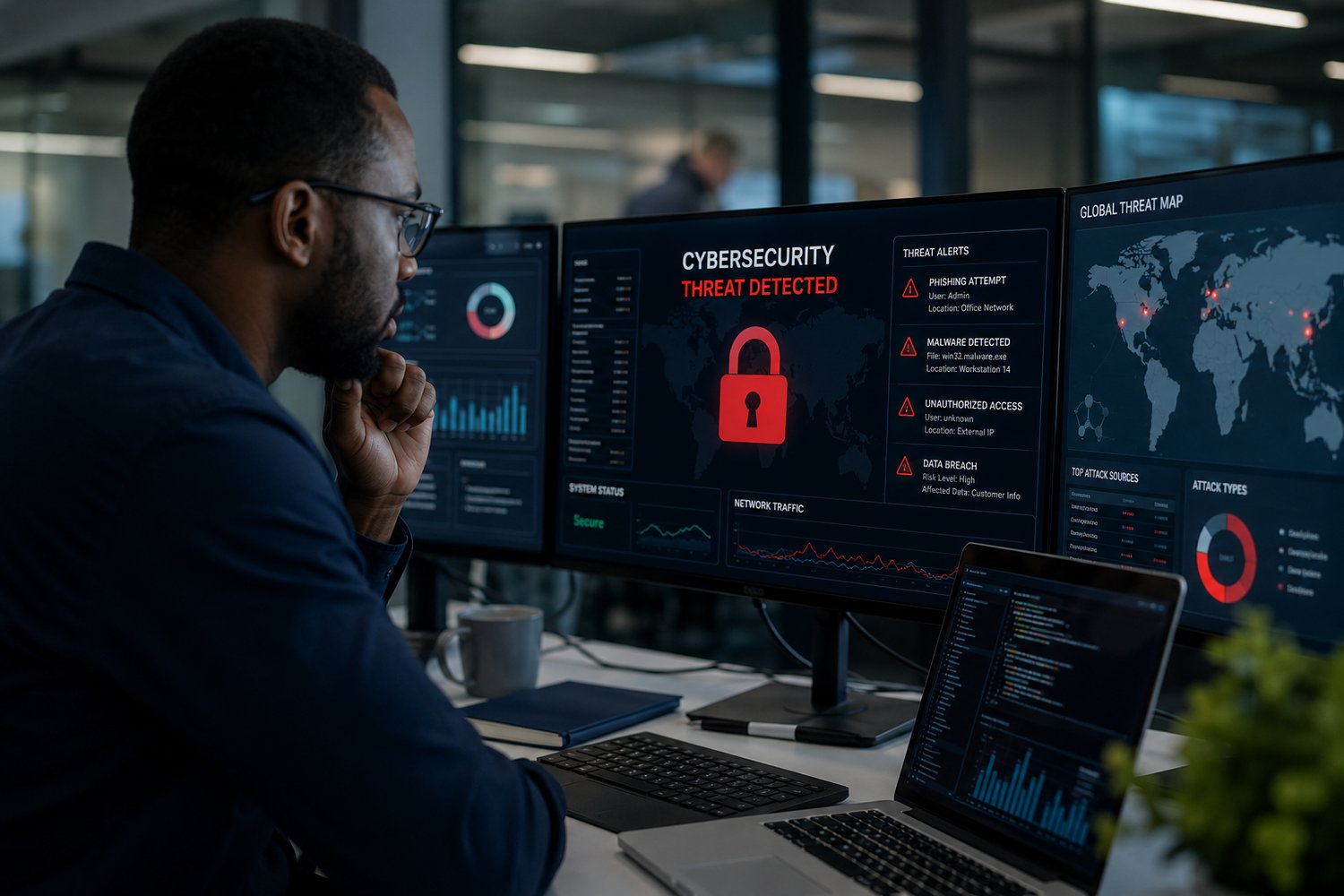
Technology has transformed the way businesses across Southern Africa operate. Organizations now rely on cloud platforms, online banking, digital communication, remote working, business applications, connected devices and online customer services to keep their operations moving.
But there is another side to this digital transformation: greater exposure to cyber threats.
Cybercriminals are becoming more organized, more sophisticated and increasingly willing to target businesses of all sizes. A company does not need to be a large multinational to become a target. Small and medium-sized businesses can be particularly attractive because they may hold valuable information while having fewer cybersecurity resources.
The threat is not theoretical. INTERPOL's 2025 Africa Cyberthreat Assessment identified online scams, ransomware, business email compromise (BEC), digital sextortion and identity theft among the most reported cyberthreats across Africa. The report also noted that South Africa experienced the highest number of ransomware detections among the African countries covered by its cited Trend Micro data for 2024, with 17,849 detections.
South African government sources have likewise highlighted phishing, ransomware, malware, identity theft and personal-data theft as important cyber risks.
For businesses operating in Southern Africa, cybersecurity therefore needs to be treated as a business priority, not simply an IT problem.
Let's examine the major threats organizations should understand and prepare for.
1. Phishing and Targeted Malicious Emails
Phishing remains one of the simplest and most effective ways for criminals to gain access to an organization.
An attacker may send an email pretending to be:
- A bank
- A supplier
- A manager
- A government department
- A technology provider
- A customer
- A colleague
The message may ask the employee to click a link, open an attachment, confirm account information or make a payment.
The attacker is essentially trying to turn a trusted employee into the doorway into the organization.
South Africa's Cybersecurity Readiness Report identified targeted malicious emails as the top threat, with 64% of respondents listing them among their organization's top three threats.
How businesses can reduce the risk
Organizations should implement:
- Email security and filtering
- Multi-factor authentication
- Employee security awareness training
- Link and attachment protection
- Domain protection
- Regular phishing simulations
- Clear procedures for reporting suspicious messages
Employees should also be encouraged to verify unusual payment requests through another communication channel.
2. Ransomware
Ransomware is one of the most disruptive cyber threats facing businesses.
During a ransomware attack, criminals may gain access to an organization's systems, encrypt files and demand payment for their recovery. Modern attacks can also involve data theft, with criminals threatening to publish stolen information if the victim refuses to pay.
INTERPOL's 2025 assessment notes the continued importance of ransomware across Africa and describes double-extortion attacks in which attackers both encrypt data and threaten to leak it.
The consequences can include:
- Business interruption
- Lost revenue
- Data loss
- Recovery expenses
- Reputational damage
- Legal and regulatory consequences
How businesses can reduce ransomware risk
A strong ransomware defence should include:
- Regular offline or otherwise protected backups.
- Endpoint protection.
- Network segmentation.
- Multi-factor authentication.
- Patch management.
- Least-privilege access.
- Employee awareness training.
- Continuous monitoring.
- A tested incident-response plan.
Backups are particularly important, but simply having backups is not enough. Organizations should regularly test whether they can actually restore critical systems.
3. Business Email Compromise
Business Email Compromise, or BEC, targets business communications rather than simply trying to infect a computer.
An attacker may compromise an employee's email account or impersonate an executive, supplier or customer.
For example, an attacker could send: "Please process this payment urgently. The banking details have changed."
Everything may look legitimate.
The employee follows the instructions, and the money goes directly to the criminal.
INTERPOL identifies BEC as one of Africa's major cyberthreats, and its 2025 operations included investigations into significant financial losses linked to BEC schemes.
Protection measures
Businesses should consider:
- MFA for email accounts
- Conditional access
- Email authentication controls
- Payment verification procedures
- Separation of financial duties
- Monitoring for unusual account activity
- Executive impersonation awareness training
Most importantly, urgent financial requests should never bypass normal verification procedures.
4. Malware
Malware is a broad category covering malicious software designed to damage systems, steal information, spy on users or provide unauthorized access.
It can include:
- Trojans
- Spyware
- Keyloggers
- Remote-access malware
- Information stealers
- Worms
- Botnets
- Ransomware
Malware can enter an organization through phishing emails, malicious websites, compromised applications, infected removable devices or vulnerable systems.
South Africa's National Treasury reported in 2025 that its security environment was dealing with threats including phishing attempts, malware infections and spam attacks.
Protection measures
Organizations should maintain:
- Endpoint detection and response
- Antivirus/anti-malware protection
- Application controls
- Patch management
- Web filtering
- Email security
- Network monitoring
5. Data Breaches and Data Theft
Businesses collect enormous amounts of information.
This may include:
- Customer information
- Employee records
- Financial information
- Identity information
- Intellectual property
- Passwords
- Contracts
- Business plans
Cybercriminals know that this information has value.
A data breach can occur when attackers exploit vulnerabilities, steal credentials, compromise an application or gain unauthorized access to an employee account.
The consequences can extend beyond the immediate technical problem.
Businesses may face:
- Regulatory obligations
- Financial losses
- Customer complaints
- Legal costs
- Reputational damage
- Loss of customer confidence
For organizations processing personal information in South Africa, data protection and cybersecurity therefore need to work together.
6. Weak Passwords and Stolen Credentials
Passwords remain a major attack surface.
Employees may reuse passwords across multiple services or use passwords that are easy to guess.
Cybercriminals can also obtain credentials through:
- Phishing
- Malware
- Data breaches
- Credential-stealing websites
- Password reuse
- Social engineering
Once an attacker obtains legitimate credentials, the activity may appear normal.
This makes stolen credentials particularly dangerous.
Businesses should implement
- Multi-factor authentication
- Strong password policies
- Password managers
- Conditional access
- Privileged access controls
- Regular access reviews
- Monitoring for unusual login behaviour
7. Insider Threats
Not every cybersecurity incident begins with an external hacker.
Sometimes the risk comes from inside the organization.
An insider threat may involve an employee, contractor or other authorized user who:
- Steals company information
- Shares confidential files
- Misuses privileged access
- Installs unauthorized software
- Deliberately damages systems
- Accidentally exposes sensitive information
Insider threats can be particularly difficult to detect because the user may already have legitimate access.
Organizations should therefore monitor unusual behaviour while respecting employee privacy and applicable legal requirements.
Useful controls include:
- User activity monitoring
- Privileged-user monitoring
- Access controls
- Data-loss prevention
- File-access monitoring
- Behaviour analytics
- Security awareness training
8. Vulnerable and Unpatched Systems
Cybercriminals actively search for systems containing known vulnerabilities.
An outdated:
- Operating system
- Router
- Firewall
- Server
- Application
- Plugin
- Cloud configuration
can potentially provide an entry point.
Organizations often have hundreds or thousands of technology assets, making vulnerability management challenging.
A practical approach
Businesses should maintain an accurate asset inventory and establish a regular process for:
Discover → Assess → Prioritize → Patch → Verify → Monitor
Not every vulnerability has the same level of risk. Critical vulnerabilities affecting internet-facing systems should receive urgent attention.
9. Cloud Security Risks
Cloud computing offers enormous benefits, but moving workloads to the cloud does not automatically make them secure.
Security problems can arise from:
- Misconfigured storage
- Weak identity controls
- Excessive permissions
- Compromised accounts
- Poorly configured applications
- Inadequate monitoring
- Exposed credentials
As more Southern African businesses adopt cloud platforms, cloud security needs to become part of their broader cybersecurity strategy.
Businesses should implement:
- Strong identity management
- MFA
- Least-privilege access
- Encryption
- Security monitoring
- Backup strategies
- Regular configuration reviews
10. Remote and Hybrid Working Risks
Remote work has created greater flexibility for businesses, but it has also expanded the security perimeter.
Employees may access company systems from:
- Homes
- Hotels
- Airports
- Coffee shops
- Customer premises
- Personal networks
Unsecured devices, weak home networks and public Wi-Fi can increase risk.
South African government education material has highlighted the relationship between remote or hybrid working and reported breaches, emphasizing the need for organizations to maintain appropriate security controls as working patterns evolve.
Businesses should consider:
- Secure VPN or zero-trust access
- Endpoint protection
- MFA
- Device management
- Security awareness
- Data-loss prevention
- Remote monitoring and incident response
11. Social Engineering
Cybercriminals do not always attack technology directly.
Sometimes they attack people.
Social engineering involves manipulating individuals into revealing information or performing actions that benefit the attacker.
An attacker might pretend to be:
- An IT technician
- A manager
- A supplier
- A bank representative
- A government official
The goal could be to obtain credentials, authorize payments or gain access to systems.
Training employees to question unusual requests can significantly reduce this risk.
12. AI-Powered Cyberattacks
Artificial intelligence is creating opportunities for legitimate businesses, but criminals are also using AI to improve their attacks.
AI can help attackers create:
- More convincing phishing messages
- Better social-engineering campaigns
- Fake documents
- Deepfake audio
- Deepfake video
- Automated scams
- More personalized attacks
INTERPOL has specifically highlighted AI-driven fraud as an emerging concern in Africa's cyber threat landscape.
This means employees can no longer rely solely on obvious spelling mistakes or strange-looking messages to identify fraud.
Organizations need stronger verification processes and layered security controls.
13. Denial-of-Service Attacks
A Distributed Denial-of-Service attack, commonly called a DDoS attack, attempts to overwhelm an online service with large amounts of traffic.
The objective is to make a website or service unavailable to legitimate users.
For businesses that depend heavily on online operations, downtime can quickly translate into lost revenue and customer frustration.
Organizations with critical online services should consider:
- DDoS protection
- Traffic monitoring
- Network redundancy
- Web application firewalls
- Incident-response procedures
South Africa's Cybersecurity Readiness Report identified denial-of-service attacks among the notable threats reported by organizations.
Why Southern African Businesses Need a Proactive Approach
Cybersecurity cannot simply begin after an organization has been attacked.
By then, the attacker may already have:
- Stolen credentials
- Accessed sensitive information
- Installed malware
- Compromised systems
- Extracted data
A proactive cybersecurity strategy focuses on identifying weaknesses before criminals exploit them.
This means combining technology, people and processes.
A Practical Cybersecurity Checklist for Businesses
Businesses can begin with these fundamental measures:
Protect identities
Implement MFA and strong access controls.
Secure endpoints
Protect laptops, desktops, mobile devices and servers.
Protect email
Deploy modern email security and train employees to recognize phishing.
Protect data
Encrypt sensitive information and maintain tested backups.
Monitor activity
Look for unusual login, file-access and network behaviour.
Patch vulnerabilities
Keep operating systems, applications and infrastructure updated.
Train employees
Make cybersecurity awareness part of the company culture.
Secure cloud environments
Review permissions, configurations and identities regularly.
Prepare for incidents
Create and test an incident-response plan.
Assess security regularly
Conduct vulnerability assessments, security reviews and risk assessments.
How NTKays Innovations Can Help
Cybersecurity is one of the core solution areas of NTKays Innovations, alongside cloud solutions, software solutions, ICT infrastructure, smart building solutions and strategic partnerships.
Our cybersecurity approach can help businesses strengthen their security posture through solutions such as:
- Endpoint protection
- Network security
- Threat detection and monitoring
- Vulnerability assessments
- Data protection and privacy
- Security awareness training
- Compliance and risk management
- User activity monitoring
- Insider-threat protection
- Access and privileged-user monitoring
The objective is not simply to install another security product.
It is to help organizations understand their risks, strengthen their technology environment and build a more resilient business.
Final Thoughts
The cybersecurity landscape in Southern Africa is evolving rapidly.
Phishing, ransomware, business email compromise, malware, data theft, insider threats, cloud vulnerabilities and AI-powered attacks can affect organizations across virtually every industry.
The good news is that businesses do not have to wait for an incident before taking action.
A combination of strong technology, well-trained employees, effective policies, continuous monitoring and proactive risk management can significantly improve an organization's ability to prevent, detect and respond to cyber threats.
Cybersecurity is no longer simply about protecting computers. It is about protecting business operations, customer trust, sensitive information and the future of the organization.
NTKays Innovations is committed to empowering Southern Africa through technology by helping businesses become more secure, resilient and ready for the digital future.
Ready to strengthen your cybersecurity?
Book a consultation with NTKays Innovations and discuss how your organization can identify vulnerabilities, improve security controls and build a stronger cybersecurity strategy.