
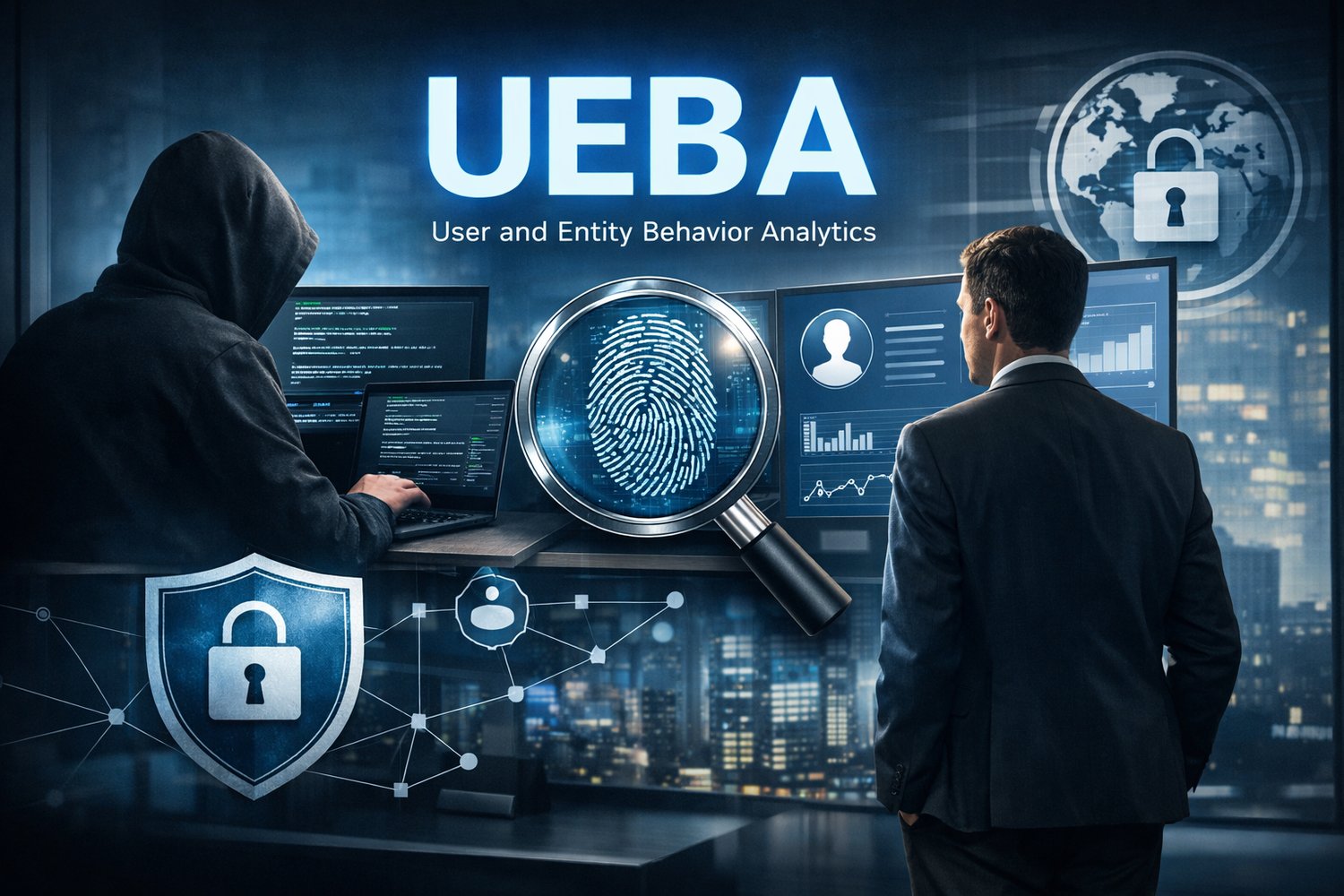
Cybersecurity is no longer just an IT responsibility.
Today, it is a business priority that affects operations, financial stability, regulatory compliance, and organizational reputation. As cyber threats continue to evolve, business leaders are increasingly expected to understand not only how attacks occur but also how modern security technologies help reduce risk.
One technology that is transforming cybersecurity is User and Entity Behavior Analytics (UEBA).
While the name may sound highly technical, the concept is straightforward.
UEBA helps organizations identify unusual behavior that could indicate insider threats, compromised accounts, fraud, or policy violations before they develop into major security incidents.
For executives and business decision-makers, understanding UEBA is becoming just as important as understanding financial controls or operational risk management.
What Is UEBA?
User and Entity Behavior Analytics (UEBA) is a cybersecurity approach that uses behavioral analytics and machine learning to identify activities that deviate from normal patterns.
Instead of relying only on predefined security rules, UEBA continuously learns how users, devices, and systems normally behave.
It then detects behaviors that appear unusual or risky.
These behaviors may involve:
- employees
- administrators
- contractors
- service accounts
- devices
- applications
The goal is simple:
Identify abnormal behavior before it becomes a security incident.
Why Traditional Security Is No Longer Enough
Traditional security tools are excellent at detecting known threats.
For example, they can identify:
- malware
- unauthorized login attempts
- blocked websites
- suspicious network traffic
However, they often struggle to detect activity performed by users with legitimate access.
Examples include:
- downloading unusually large numbers of files
- accessing systems outside normal working hours
- visiting systems unrelated to job responsibilities
- excessive data transfers
- unusual application usage
Because the user has valid credentials, traditional security controls may see nothing unusual.
UEBA focuses on the behavior rather than just the login.
How UEBA Works
UEBA continuously analyzes activity across an organization's digital environment.
It establishes a baseline of normal behavior by learning patterns such as:
- typical login times
- frequently used applications
- common file access
- normal website usage
- regular working locations
- routine system interactions
When activity falls outside these patterns, UEBA generates alerts for further investigation.
For example, if an employee who normally accesses a handful of files each day suddenly downloads thousands of confidential documents late at night, UEBA recognizes the deviation and flags it as potentially risky.
Why Business Leaders Should Care
UEBA is not just an IT tool.
It helps organizations protect business assets.
The benefits include:
Earlier Detection of Insider Threats
Employees and contractors often have legitimate access to sensitive information.
UEBA helps identify suspicious behavior before significant damage occurs.
Protection Against Compromised Accounts
Even when cybercriminals steal legitimate credentials, their behavior often differs from normal user patterns.
UEBA helps identify these anomalies quickly.
Reduced Financial Risk
Data breaches can result in:
- financial losses
- regulatory penalties
- legal costs
- operational disruption
Detecting unusual behavior early reduces the likelihood of costly incidents.
Better Compliance
Many regulatory frameworks require organizations to monitor access to sensitive information.
UEBA strengthens:
- security governance
- audit readiness
- compliance reporting
- accountability
Real-World Examples
Imagine these situations:
Finance Department
An accountant suddenly accesses engineering project documents.
UEBA identifies the behavior as unusual because it falls outside the employee's normal responsibilities.
Human Resources
An HR administrator begins downloading hundreds of personnel records shortly before resigning.
UEBA detects the unusual volume and timing.
Remote Employee
A remote worker who normally logs in from UK suddenly appears to access systems from multiple countries within a short period.
UEBA identifies the anomaly for investigation.
IT Administrator
A privileged administrator performs system changes during unusual hours that differ from established behavior.
UEBA highlights the activity for review.
UEBA Works Best with Other Security Technologies
UEBA becomes even more powerful when combined with:
- User Activity Monitoring
- Session Recording
- Screenshot Monitoring
- File Activity Monitoring
- Website Monitoring
- Clipboard Monitoring
- Data Loss Prevention (DLP)
- Insider Threat Detection
Together, these technologies provide both behavioral intelligence and visual evidence.
Common Misconceptions About UEBA
"UEBA Replaces Security Teams."
It does not.
UEBA helps security professionals prioritize risks more effectively.
"UEBA Only Detects Malicious Employees."
Not true.
It also identifies accidental mistakes, compromised accounts, and unusual operational behavior.
"Only Large Enterprises Need UEBA."
Organizations of all sizes handle sensitive information.
Small and medium-sized businesses can benefit just as much from behavioral analytics.
The Business Value of UEBA
Organizations implementing UEBA often experience:
- earlier threat detection
- improved incident response
- stronger compliance
- reduced insider risk
- better operational visibility
- more informed security decisions
Most importantly, UEBA helps organizations become proactive instead of reactive.
Final Thought
Cybersecurity is no longer just about blocking unauthorized access.
It is about understanding behavior.
User and Entity Behavior Analytics gives organizations the ability to detect subtle warning signs that traditional security controls often miss.
For business leaders, UEBA represents more than another cybersecurity technology.
It is a strategic capability that protects data, strengthens governance, and reduces business risk.
At NTKays Innovations, we help organizations implement intelligent monitoring and behavioral analytics solutions that provide deeper visibility into user activity, detect insider threats early, and strengthen overall cyber resilience.
Because in today's digital world, understanding behavior is just as important as controlling access.