
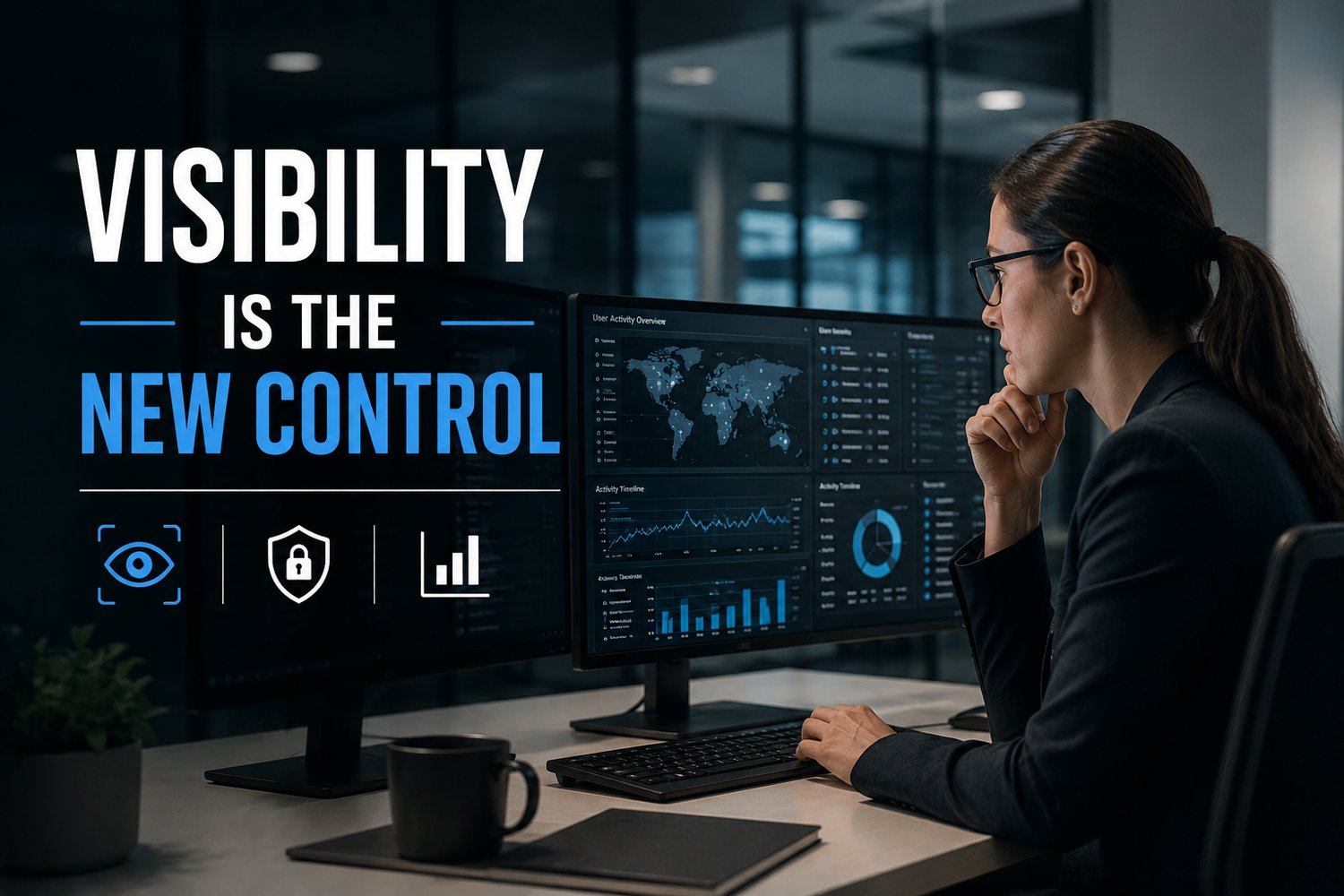
For decades, cybersecurity strategies were built around prevention.
Organizations invested in firewalls, antivirus software, passwords, access controls, and network defenses designed to keep threats out. The primary goal was simple: prevent unauthorized access and block external attackers.
While these controls remain important, the modern threat landscape has changed dramatically.
Today, some of the greatest risks originate from inside the organization.
Employees, contractors, third-party vendors, and even compromised internal accounts often operate with legitimate access. As a result, traditional security controls alone are no longer enough.
Modern cybersecurity is increasingly defined by one principle:
Visibility is the new control.
Organizations can no longer rely solely on controlling who gets access. They must also understand what happens after access is granted.
The Shift from Perimeter Security
Traditional cybersecurity focused heavily on protecting the perimeter.
Security teams asked questions such as:
- Who is trying to access our systems?
- Is the user authorized?
- Can external threats be blocked?
Today, the more important question often becomes:
What are users doing once they are inside?
This shift reflects the reality that many security incidents occur through legitimate accounts performing unexpected actions.
Why Access Control Has Limits
Access control remains a critical security foundation.
It helps organizations determine:
- who can access systems
- which resources users can reach
- what permissions are assigned
However, access control provides limited insight into behavior.
For example:
An employee may have permission to access sensitive files.
But access control alone cannot determine:
- whether those files are being copied excessively
- whether information is being transferred externally
- whether unusual browsing activity is occurring
- whether privileged access is being abused
Permissions explain what users are allowed to do.
Visibility explains what users actually do.
Understanding Modern Insider Risk
Most insider incidents do not begin with hacking.
They begin with normal-looking activity.
Examples include:
- downloading large volumes of files
- accessing unusual systems
- excessive copying and pasting of information
- transferring data to external platforms
- using unauthorized applications
Without visibility, these activities often remain unnoticed until damage has already occurred.
Visibility Creates Context
Security teams need context to make informed decisions.
Visibility provides insights into:
- user activity
- application usage
- website activity
- file access patterns
- data movement
- behavioral anomalies
This information helps distinguish normal operations from potential security concerns.
Instead of reacting after incidents occur, organizations can identify risk indicators much earlier.
Why User Activity Monitoring Matters
User activity monitoring has become one of the most valuable sources of security intelligence.
It helps organizations answer questions such as:
- What applications are employees using?
- Which files are being accessed?
- Are unusual behaviors emerging?
- Is sensitive information being handled appropriately?
- Are policies being followed?
The answers help transform raw activity into actionable security insights.
Visibility Supports Faster Investigations
When incidents occur, speed matters.
Without visibility, investigations often rely on fragmented logs and assumptions.
With visibility, security teams can:
- reconstruct events accurately
- understand user behavior
- identify affected systems
- verify policy violations
- gather evidence quickly
This significantly improves incident response effectiveness.
The Remote Work Challenge
The rise of remote and hybrid work has made visibility even more important.
Employees now operate across:
- home networks
- cloud environments
- personal devices
- distributed teams
Traditional perimeter-based security becomes less effective when work happens outside corporate offices.
Visibility helps organizations maintain awareness regardless of where employees work.
Visibility Improves Accountability
When users understand that activities are monitored appropriately, organizations often experience:
- improved policy compliance
- stronger security awareness
- reduced risky behavior
- better operational accountability
Visibility supports both security and governance objectives.
Building a Visibility-Driven Security Strategy
Modern organizations are increasingly combining traditional security controls with technologies such as:
- User Activity Monitoring
- Session Recording
- Screenshot Monitoring
- File Activity Monitoring
- Clipboard Monitoring
- Website Activity Monitoring
- Insider Threat Detection
- Data Loss Prevention (DLP)
Together, these capabilities create a more complete view of organizational risk.
The Future of Cybersecurity
Cybersecurity is no longer just about preventing access.
It is about understanding behavior.
Organizations that rely only on perimeter defenses risk missing the activities that occur within trusted environments.
The future belongs to organizations that can see, understand, and respond to user behavior in real time.
Final Thought
Access control remains important.
But visibility is what transforms security from reactive to proactive.
Organizations that understand user behavior can detect threats earlier, investigate incidents faster, and protect sensitive information more effectively.
At NTKays Innovation, we help organizations gain deeper visibility into workforce activity through intelligent monitoring and insider threat prevention solutions that strengthen security, accountability, and operational awareness.
Because in today's digital workplace, you cannot protect what you cannot see.