
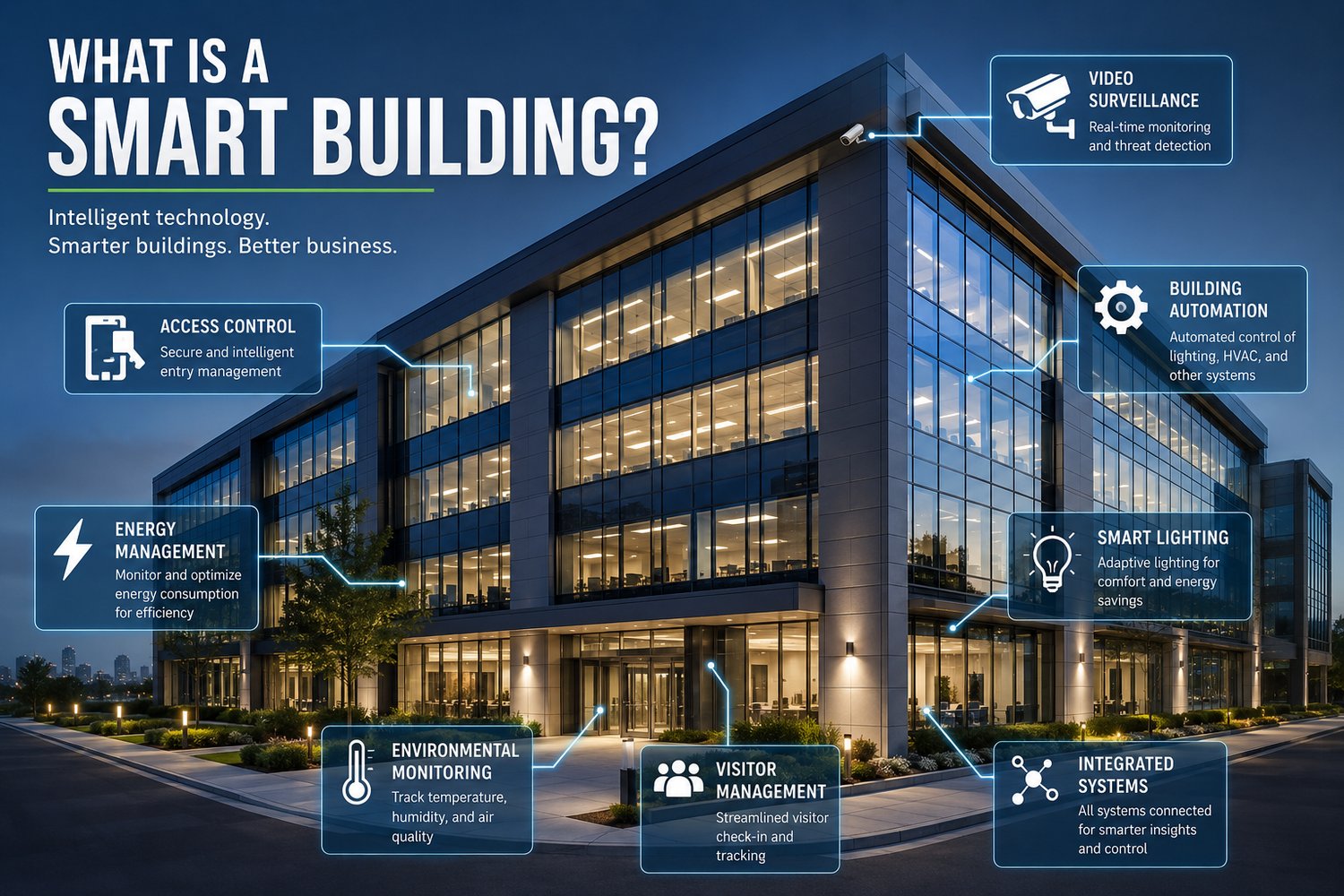
Buildings are becoming more than walls, doors, offices and electrical systems.
Modern technology is turning buildings into connected environments that can monitor conditions, automate processes, improve security, manage resources and respond intelligently to the people using them.
This is the idea behind a smart building.
A smart building uses connected technologies, sensors, software, communication networks and automated systems to monitor and manage different aspects of a building.
Instead of having separate systems operating independently, a smart building can bring technologies together to create a more connected, efficient, secure and responsive environment.
For businesses, this can mean better security, improved operational efficiency, greater visibility and potentially more effective management of resources.
But what exactly makes a building "smart"?
What Is a Smart Building?
A smart building is a building that uses technology to collect information about its environment and operations and then uses that information to help automate, monitor or optimize building systems.
These systems can include:
- Access control
- CCTV and surveillance
- Lighting
- Heating, ventilation and air conditioning
- Energy management
- Building automation
- Fire and safety systems
- Wi-Fi and connectivity
- Security systems
- Smart doors
- Sensors
- Visitor management
- Monitoring platforms
The key difference is connectivity and intelligence.
A traditional building may have a CCTV system, access control and lighting.
A smart building can connect these technologies and use information from them to make operations more responsive.
How Does a Smart Building Work?
A smart building generally brings together four important elements:
1. Sensors
Sensors collect information from the building.
For example, sensors can detect:
- Movement
- Temperature
- Occupancy
- Light levels
- Door activity
- Energy consumption
- Air conditions
2. Connectivity
The information needs to move between devices and systems.
This can involve:
- Wired networks
- Wi-Fi
- Structured cabling
- Internet connectivity
- IoT networks
3. Software and Control Systems
Software processes information and allows building managers to monitor and control different systems.
4. Automated Actions
The building can respond based on predefined rules or information received from sensors.
For example:
Occupancy detected → lighting activated
or:
Unauthorized access attempt → security alert generated
This is where a building starts becoming genuinely "smart."
1. Smart Access Control
One of the most important components of a smart building is intelligent access control.
Traditional access may rely on physical keys.
Smart access systems can use technologies such as:
- Access cards
- PIN codes
- Biometrics
- Mobile credentials
- Electronic locks
- Smart doors
Businesses can control who is allowed to enter specific areas.
For example, employees may have access to general office areas while only authorized personnel can enter server rooms, records departments or restricted areas.
This can improve both security and access management.
2. Smart Doors and Security Systems
Doors can become part of an integrated security environment.
Smart door technologies can support:
- Controlled entry
- Electronic locking
- Access monitoring
- Visitor management
- Security integration
- Activity tracking
Instead of simply opening and closing, the door becomes part of the building's security ecosystem.
For businesses dealing with sensitive information, equipment or restricted areas, this can be particularly valuable.
3. CCTV and Intelligent Surveillance
CCTV has been an important security technology for decades.
Modern surveillance systems can go beyond simply recording video.
Depending on the technology deployed, intelligent surveillance can assist with:
- Monitoring
- Motion detection
- Alerts
- Activity analysis
- Perimeter monitoring
- Incident investigation
A smart building can integrate surveillance with other security systems.
For example:
Access control event → CCTV verification → Security alert
This creates a more connected security environment.
4. Building Automation
Building automation allows different building systems to be monitored and controlled centrally.
Automation can involve:
- Lighting
- Climate control
- Access systems
- Security systems
- Energy systems
- Equipment
For example, lights could be configured to operate according to schedules or occupancy.
Climate systems can be adjusted according to building conditions.
This can reduce the amount of manual intervention required by facility teams.
5. Smart Energy Management
Energy costs are an important concern for many organizations.
Smart building technologies can help businesses understand how energy is being consumed.
Monitoring can provide information about:
- Electricity usage
- Equipment consumption
- Lighting
- Heating and cooling
- Peak usage
- Energy patterns
This information can help organizations identify opportunities to reduce unnecessary consumption.
For example, if a meeting room remains empty while lights and climate systems continue operating, automated controls may be able to adjust those systems.
The goal is not simply to use less energy.
It is to use energy more intelligently.
6. Smart Lighting
Lighting is another area where automation can make a difference.
Smart lighting systems can respond to:
- Occupancy
- Time schedules
- Daylight
- Building activity
Imagine entering an office and having lighting automatically adjusted based on the room's occupancy and environmental conditions.
Instead of relying entirely on employees to switch lights on and off, the building can assist with the process.
7. Smart Heating, Ventilation and Air Conditioning
Climate control can have a significant impact on both comfort and energy consumption.
Smart systems can monitor environmental conditions and help manage:
- Temperature
- Ventilation
- Air quality
- Humidity
- Occupancy
In larger buildings, intelligent climate management can help facility managers understand which areas are being used and how environmental conditions change throughout the building.
8. Occupancy Monitoring
Understanding how spaces are being used can help businesses manage their buildings more effectively.
Occupancy information can help answer questions such as:
- Which meeting rooms are being used?
- Which areas are rarely occupied?
- When is the building busiest?
- How much space is actually required?
This information can support better facility planning.
For example, if several meeting rooms remain unused for most of the day, management may reconsider how office space is allocated.
9. Smart Visitor Management
Visitors are an important part of many organizations.
Traditional visitor management can involve paper registers and manual processes.
Smart visitor management can support:
- Digital registration
- Visitor identification
- Access authorization
- Notifications
- Visitor records
- Integration with access control
This can create a smoother experience while giving organizations greater visibility over visitors entering their premises.
10. Connected Building Systems
One of the biggest advantages of smart buildings is integration.
Instead of having:
CCTV + Access Control + Lighting + Energy + HVAC
operating as completely separate systems, organizations can connect appropriate technologies.
This can allow information to move between systems and provide a more comprehensive view of the building.
For example:
Access control detects authorized entry
↓
Building identifies occupancy
↓
Lighting activates
↓
Climate settings adjust
↓
Security systems continue monitoring
This is the type of connected environment that defines modern smart building technology.
Why Are Smart Buildings Important for Businesses?
Smart buildings can provide several potential benefits.
1. Improved Security
Integrated access control, surveillance and monitoring can provide organizations with greater visibility over their premises.
2. Better Operational Efficiency
Automation can reduce the need for employees to manually manage certain building functions.
3. Energy Management
Monitoring and automation can help organizations identify unnecessary energy consumption.
4. Improved Employee Experience
A well-designed smart building can make everyday interactions more convenient.
Employees can benefit from:
- Easier access
- Better environmental controls
- Reliable connectivity
- More intelligent workspaces
5. Better Facility Management
Facility managers can gain greater visibility into building operations.
Instead of discovering a problem after something fails, monitoring systems may help identify issues earlier.
6. Data-Driven Decisions
Smart buildings generate information.
Organizations can use this information to understand:
- Building usage
- Energy consumption
- Security events
- Equipment performance
- Occupancy patterns
Data can then support better planning and decision-making.
Smart Buildings and Cybersecurity
There is an important issue that businesses should never overlook.
A connected building also creates more connected technology.
Every connected device can potentially introduce security considerations.
Smart building environments may contain:
- Cameras
- Access control systems
- Sensors
- IoT devices
- Network equipment
- Servers
- Cloud platforms
These technologies need to be properly secured.
Businesses should consider:
🔐 Strong authentication
Only authorized users should be able to access management systems.
🔐 Network segmentation
Sensitive building technologies can be separated from other business networks where appropriate.
🔐 Software updates
Devices and systems should be kept appropriately updated.
🔐 Monitoring
Unusual activity should be detected and investigated.
🔐 Access management
Employees should only have the permissions they require.
Smart buildings therefore need to be designed with cybersecurity and physical security together.
Smart Building vs Traditional Building
Traditional Building Smart Building
Manual controls Automated controls
Physical keys Intelligent access control
Standalone CCTV Integrated surveillance
Manual energy management Intelligent energy monitoring
Independent systems Connected systems
Limited building data Data-driven monitoring
Reactive maintenance Potentially proactive monitoring
Manual visitor registers Digital visitor management
Limited automation Building automation
The objective isn't necessarily to turn every building into a futuristic laboratory. The objective is to use technology where it can create real business value.
Do Small Businesses Need Smart Buildings?
Smart building technology isn't only for skyscrapers.
Small and medium-sized businesses can adopt smart technologies according to their needs and budgets.
For example, a small office might start with:
- Smart access control
- CCTV
- Wi-Fi
- Smart doors
- Visitor management
A larger organization might integrate:
- Access control
- CCTV
- Building automation
- Energy management
- Environmental monitoring
- Network infrastructure
- Centralized management
This means smart building adoption can be incremental.
A business doesn't necessarily need to transform everything at once.
How to Start Building a Smart Building
If your organization is considering smart building technology, begin with the business problem rather than the technology.
Step 1: Identify Your Challenges
Are you experiencing:
- Security concerns?
- High energy costs?
- Poor access management?
- Inefficient facility operations?
- Difficulty monitoring the building?
Step 2: Assess Your Existing Infrastructure
Review your:
- Network
- Cabling
- Security systems
- Access control
- CCTV
- Power
- Internet connectivity
Step 3: Identify Priority Areas
Determine which systems could provide the greatest value if modernized.
Step 4: Plan Integration
Consider how different technologies will communicate with one another.
Step 5: Build Security Into the Design
Don't bolt cybersecurity onto the building after everything has been installed.
Step 6: Implement in Phases
Start with priority systems and expand over time.
Step 7: Monitor Performance
Measure whether the technology is actually producing the expected improvements.
The Importance of ICT Infrastructure in Smart Buildings
There is a hidden foundation underneath every smart building.
ICT infrastructure.
Smart building systems depend on reliable connectivity.
CCTV requires networks.
Access control requires communication infrastructure.
Sensors need connectivity.
Building management platforms require computing and network resources.
Cloud-based systems require reliable internet connections.
This means smart building projects should be considered alongside:
- Networking
- Wi-Fi
- Structured cabling
- Servers
- Storage
- Cloud services
- Cybersecurity
A smart building without reliable infrastructure is like giving a building a nervous system and then forgetting to connect the nerves.
The Future of Smart Buildings
The future of smart buildings is likely to involve even greater integration.
Buildings may increasingly use:
- Artificial intelligence
- Internet of Things technologies
- Advanced analytics
- Predictive maintenance
- Intelligent security
- Automated energy management
- Occupancy analytics
- Cloud-based management
AI could potentially help buildings move from simply responding to events toward predicting and optimizing operations.
For example, instead of simply detecting equipment failure, intelligent systems could analyse patterns and identify potential maintenance requirements before a major problem occurs.
The building becomes less reactive and more proactive.
How NTKays Innovations Can Help
At NTKays Innovations, smart building technology is part of our broader approach to helping businesses create secure, connected and intelligent environments.
Our Smart Building Solutions include:
Intelligent Access Control
Helping organizations control and manage access to their premises and restricted areas.
Smart Doors & Security Systems
Technology designed to support modern physical security requirements.
CCTV & Surveillance Solutions
Helping businesses monitor their premises and improve security visibility.
Building Automation Systems
Supporting automation and centralized management of appropriate building systems.
Energy Management Solutions
Helping organizations monitor and manage energy usage more intelligently.
Integrated Building Technologies
Connecting appropriate building technologies to create a more coordinated environment.
And because smart buildings depend on a strong technology foundation, NTKays Innovations also provides:
Software Solutions | Cloud Solutions | Cybersecurity Solutions | ICT Infrastructure | Strategic Technology Partnerships
This integrated approach allows businesses to consider their physical environment and digital environment together.
Final Thoughts
A smart building isn't simply a building filled with gadgets.
It is an environment where technology, data, connectivity, automation and security work together to improve how the building operates.
For businesses, smart building technology can support:
Security + Efficiency + Automation + Energy Management + Visibility + Better Experiences
The most successful smart building projects begin with a clear understanding of the organization's needs.
The question isn't:
"What smart technology can we install?"
The better question is:
"How can technology make our building safer, more efficient, connected and easier to manage?"
That's where smart building technology becomes more than a collection of devices.
It becomes a business solution.
Ready to make your building smarter?
NTKays Innovations can help you explore smart building, cybersecurity, cloud, software and ICT infrastructure solutions designed around your organization's requirements.
NTKays Innovations: Empowering Southern Africa Through Technology.