
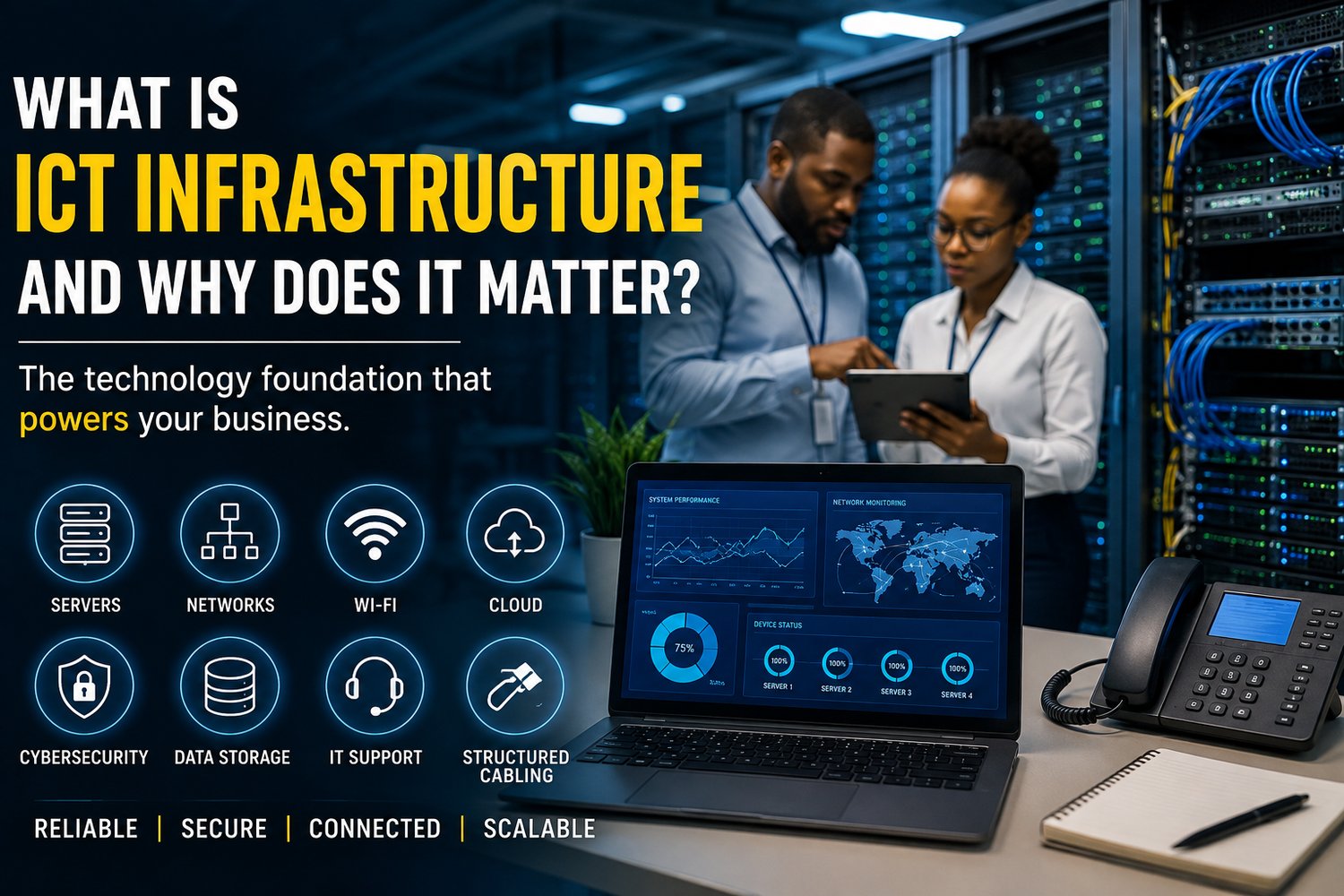
Imagine trying to run a modern business without reliable internet, computers, servers, networks, data storage, communication systems or secure access to business applications.
Even the best business strategy would struggle.
Today, technology sits underneath almost every major business function. Employees communicate through digital platforms, customers expect fast online services, businesses store information electronically, cloud applications require reliable connectivity, and cybersecurity depends heavily on the underlying technology environment.
All of these components form part of what is known as ICT infrastructure.
But what exactly is ICT infrastructure, and why should businesses care about it?
In this article, we'll explain ICT infrastructure in simple terms, explore its major components, discuss why it matters and look at how businesses can build a stronger technology foundation.
What Is ICT Infrastructure?
ICT stands for Information and Communication Technology.
ICT infrastructure refers to the collection of hardware, software, networks, communication systems, facilities and supporting technologies that allow an organization to create, process, store, transmit, access and protect information.
In simple terms:
ICT infrastructure is the technology foundation that allows a business to operate and communicate digitally.
It can include everything from computers and servers to network switches, Wi-Fi, data storage, structured cabling, internet connectivity, cloud services and security technologies.
A business may have excellent software, but if its underlying infrastructure is unreliable, employees may still experience slow systems, outages, connectivity problems and security risks.
What Are the Main Components of ICT Infrastructure?
ICT infrastructure isn't one piece of equipment. It is an ecosystem of technologies working together.
Let's look at some of the most important components.
1. Computers and End-User Devices
Employees need reliable devices to perform their daily responsibilities.
These can include:
- Desktop computers
- Laptops
- Tablets
- Smartphones
- Workstations
- Point-of-sale devices
- Specialized business equipment
The devices should be properly configured, maintained and secured.
For example, an employee working with large datasets may require a more powerful workstation than someone performing basic administrative tasks.
Choosing the right equipment therefore depends on the user's responsibilities and the organization's requirements.
2. Servers
Servers provide centralized computing and storage resources for organizations.
Depending on the business environment, servers may support:
- File storage
- Databases
- Business applications
- Authentication
- Email services
- Virtual machines
- Backup systems
- Internal applications
Some businesses operate physical servers on-site, while others use cloud-based infrastructure or a combination of on-premises and cloud technologies.
The right approach depends on factors such as cost, performance, security, availability and business requirements.
3. Network Infrastructure
A business network allows devices, applications and users to communicate.
Network infrastructure can include:
- Routers
- Switches
- Firewalls
- Network controllers
- Access points
- Network cables
- Wireless infrastructure
- Internet connectivity
Consider an office where employees cannot reliably access the internet or shared applications.
Even if the company's software is excellent, productivity can quickly collapse.
A well-designed network provides the connectivity required for modern business operations.
4. Structured Cabling
Structured cabling is often overlooked because most of it is hidden behind walls, ceilings and floors.
Yet it provides an important physical foundation for business connectivity.
Structured cabling can support:
- Computers
- Servers
- Wi-Fi access points
- CCTV systems
- Telephones
- Access control systems
- Other connected devices
Poorly designed or poorly installed cabling can create connectivity problems that are difficult to diagnose.
Professional cabling design therefore matters, particularly in larger offices, campuses, data centres and commercial buildings.
5. Wi-Fi and Wireless Connectivity
Modern employees expect reliable wireless connectivity.
Business Wi-Fi can support:
- Employees
- Visitors
- Mobile devices
- Voice communication
- IoT devices
- Meeting rooms
- Smart building technologies
However, business Wi-Fi is more than simply installing a few wireless routers.
Organizations need to consider:
- Coverage
- Capacity
- Interference
- Security
- User authentication
- Network segmentation
- Performance
A professional wireless design can provide a more reliable experience while helping protect the organization's network.
6. Data Storage
Businesses generate enormous amounts of information.
This can include:
- Customer records
- Financial documents
- Contracts
- Employee information
- Business reports
- Databases
- Multimedia
- Operational records
ICT infrastructure needs to provide appropriate storage capacity and protection.
Storage solutions can include:
- Network-attached storage
- Storage area networks
- Server storage
- Cloud storage
- Backup storage
The objective isn't simply to store information.
Businesses also need to ensure that important information is available, protected and recoverable when needed.
7. Backup and Disaster Recovery
What happens if a server fails?
What happens if ransomware encrypts important files?
What happens if a fire, flood, power problem or other incident affects your IT environment?
This is where backup and disaster recovery become critical.
A good backup strategy can help businesses recover important information and resume operations after an incident.
Businesses should consider:
- What information needs to be backed up?
- How frequently should backups occur?
- Where should backups be stored?
- Who can access them?
- How quickly must systems be restored?
- Have restoration procedures actually been tested?
A backup that has never been tested is a little like an emergency exit that nobody has ever opened.
8. Cybersecurity Infrastructure
ICT infrastructure and cybersecurity are closely connected.
Security technologies can include:
- Firewalls
- Endpoint protection
- Network security
- Intrusion detection
- Access controls
- Security monitoring
- Vulnerability management
- Encryption
- Identity management
For example, a firewall can help control traffic entering and leaving a network, while endpoint protection helps secure individual devices.
Cybersecurity should not be treated as an afterthought.
Security needs to be considered when designing the infrastructure itself.
9. Internet and Communication Systems
Businesses depend heavily on connectivity.
Internet connectivity enables organizations to access:
- Cloud applications
- Websites
- Online banking
- Collaboration platforms
- Customer platforms
- Digital services
Communication infrastructure may also include:
- VoIP
- Video conferencing
- Business messaging
- Unified communications
- Mobile connectivity
For many organizations, internet downtime is no longer merely an inconvenience. It can interrupt core business operations.
10. Cloud Infrastructure
Cloud computing has changed how businesses approach ICT infrastructure.
Organizations can use cloud services for:
- Computing
- Storage
- Backup
- Collaboration
- Business applications
- Virtual desktops
- Disaster recovery
Cloud infrastructure can provide scalability and flexibility without requiring every organization to purchase and maintain extensive physical hardware.
However, cloud adoption still requires appropriate planning around:
- Identity
- Access
- Security
- Connectivity
- Data protection
- Backup
- Costs
Moving something to the cloud doesn't automatically make it secure or efficient.
11. Data Centres and Rack Solutions
Larger organizations may require dedicated environments for their technology equipment.
Data centre and rack solutions can help organize:
- Servers
- Network switches
- Storage
- Power systems
- Cabling
- Security equipment
A well-designed environment can improve:
- Organization
- Cooling
- Equipment accessibility
- Security
- Maintenance
- Scalability
Proper infrastructure planning becomes increasingly important as an organization's technology environment grows.
Why Does ICT Infrastructure Matter?
Now that we've covered the major components, let's look at why ICT infrastructure is so important.
1. It Supports Business Productivity
Employees need reliable technology to perform their jobs.
When networks are slow, systems frequently fail or devices are unreliable, employees lose valuable time.
Reliable ICT infrastructure helps employees spend more time working and less time waiting for technology to cooperate.
2. It Improves Business Continuity
Businesses need to continue operating even when something goes wrong.
A combination of:
- Reliable infrastructure
- Redundancy
- Backups
- Monitoring
- Disaster recovery
can help organizations reduce the impact of unexpected disruptions.
3. It Strengthens Cybersecurity
Security begins with a solid foundation.
Poorly configured networks, unsupported devices, weak access controls and outdated infrastructure can create opportunities for attackers.
A properly designed infrastructure can provide stronger security controls and better visibility.
4. It Supports Digital Transformation
Digital transformation depends on infrastructure.
Businesses adopting:
- Cloud computing
- Artificial intelligence
- Business automation
- Digital customer platforms
- Data analytics
- Smart building technologies
need an infrastructure capable of supporting those technologies.
You cannot build a modern digital business on a technology foundation that is unable to support modern workloads.
5. It Enables Business Growth
As a company grows, its technology requirements change.
You may need:
- More employees
- More devices
- More storage
- Additional branches
- Better connectivity
- More powerful applications
- Stronger security
Scalable infrastructure allows businesses to expand without constantly rebuilding their entire technology environment.
6. It Improves Employee Collaboration
Modern businesses often operate across multiple locations.
Employees may need to collaborate with colleagues in:
- Different offices
- Different cities
- Different countries
- Remote locations
Reliable networks, cloud platforms and communication systems make collaboration easier.
7. It Can Reduce Long-Term Costs
It may seem counterintuitive, but investing in good infrastructure can reduce costs over time.
Poor infrastructure can result in:
- Frequent downtime
- Emergency repairs
- Productivity losses
- Security incidents
- Hardware failures
- Inefficient processes
A proactive infrastructure strategy can help organizations avoid some of these costs.
Signs Your ICT Infrastructure May Need an Upgrade
How do you know if your business infrastructure needs attention?
Look for warning signs such as:
Frequent network outages
Employees regularly lose connectivity.
Slow systems
Applications take too long to respond.
Outdated hardware
Equipment is no longer supported or struggles with modern workloads.
Increasing security incidents
Your organization is experiencing more suspicious activity or security alerts.
Storage problems
Your business regularly runs out of storage space.
Poor Wi-Fi coverage
Employees experience weak or inconsistent wireless connectivity.
Unorganized cabling
Network and power cables are difficult to manage or identify.
Poor cloud performance
Cloud applications perform badly because connectivity or configuration is inadequate.
Frequent downtime
Technology disruptions are becoming a normal part of business operations.
Business growth
Your current infrastructure simply cannot keep up with the organization's expansion.
If several of these problems sound familiar, it may be time for an ICT infrastructure assessment.
How to Build Better ICT Infrastructure
Businesses don't need to replace everything at once.
A practical approach can begin with an assessment.
Step 1: Assess your current environment
Document your:
- Hardware
- Network
- Servers
- Storage
- Cloud services
- Connectivity
- Security controls
Step 2: Identify weaknesses
Determine where your organization is experiencing:
- Performance problems
- Security gaps
- Capacity limitations
- Reliability issues
Step 3: Prioritize critical systems
Not every component requires immediate replacement.
Focus first on technologies that directly affect business continuity, security and productivity.
Step 4: Plan for growth
Consider where the organization expects to be in three to five years.
Step 5: Implement strategically
Upgrade infrastructure in stages where appropriate.
Step 6: Monitor and maintain
ICT infrastructure requires continuous maintenance.
Technology isn't a "build it once and forget it" environment.
ICT Infrastructure and Digital Transformation
There is an important connection between ICT infrastructure and digital transformation.
A business may decide to adopt:
Cloud computing + AI + automation + smart buildings + advanced cybersecurity
but all these technologies depend on a reliable foundation.
For example, smart building systems may require reliable networks.
Cloud applications require dependable connectivity.
Cybersecurity tools require appropriate infrastructure and monitoring.
Business applications depend on servers, storage or cloud environments.
In other words:
Digital transformation may be the visible building, but ICT infrastructure is part of the foundation underneath it.
How NTKays Innovations Can Help
At NTKays Innovations, ICT infrastructure is one of our core solution areas.
Our ICT Infrastructure services include:
Servers & Storage Solutions
Helping businesses establish reliable computing and storage environments.
Networking & Connectivity
Designing and supporting business connectivity for reliable communication and access to digital services.
Data Centre & Rack Solutions
Supporting organized and scalable technology environments.
Structured Cabling
Professional cabling solutions for business connectivity and connected technologies.
Wi-Fi & Wireless Solutions
Helping organizations establish secure and reliable wireless environments.
IT Support & Maintenance
Providing ongoing support to help keep technology environments operating effectively.
Hardware Supply & Management
Helping businesses manage the technology equipment required by their employees and operations.
Our broader technology portfolio also includes software solutions, cloud solutions, cybersecurity solutions, smart building solutions and strategic technology partnerships.
This means businesses can look at their technology environment more holistically rather than treating infrastructure, security, cloud and software as completely separate worlds.
Final Thoughts
ICT infrastructure may not always be the most visible part of a business, but it is one of the most important.
When it works well, employees can communicate, applications can operate, customers can be served, information can be accessed and business operations can continue smoothly.
When it fails, the effects can spread quickly across the organization.
That's why businesses should view ICT infrastructure as a strategic investment rather than simply an IT expense.
A strong infrastructure foundation can support productivity, cybersecurity, digital transformation, business continuity and future growth.
The question isn't simply whether your business has technology.
The more important question is:
Is your technology infrastructure ready for where your business is going?
If your organization is experiencing slow networks, unreliable connectivity, outdated equipment, security concerns or infrastructure that is struggling to keep up with growth, NTKays Innovations can help you assess your environment and identify practical technology solutions.
NTKays Innovations: Empowering Southern Africa Through Technology.