
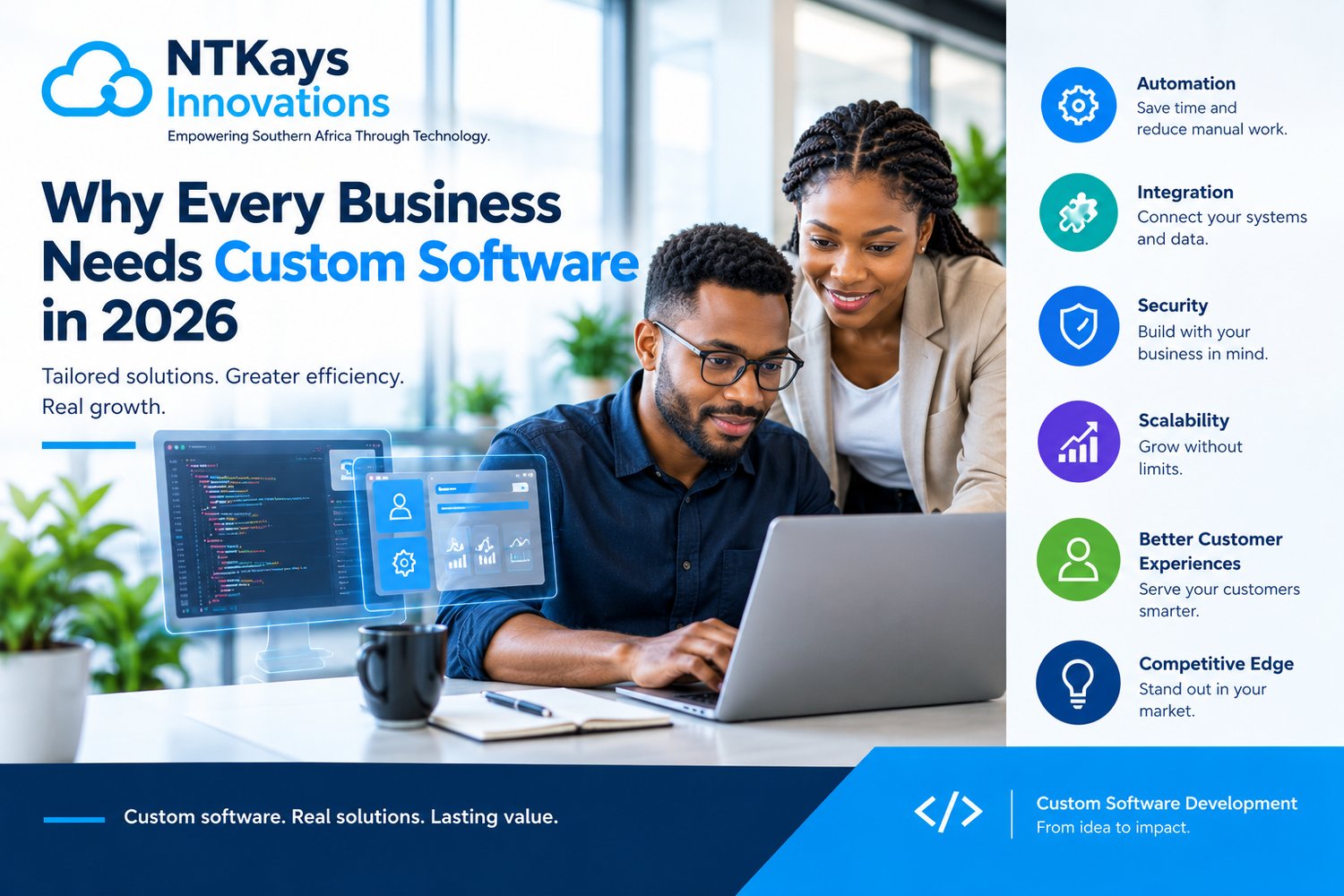
Businesses in 2026 operate in an environment where technology is no longer simply a support function.
It is part of how companies sell, communicate, serve customers, manage employees, protect information, analyse data and compete.
Off-the-shelf software can solve many common business problems. Accounting platforms, email applications, customer relationship management systems, collaboration tools and project management platforms have become essential for organizations of all sizes.
But there is another challenge.
What happens when your business doesn't operate like everyone else?
A company may have a unique workflow, specialized approval process, unusual reporting requirements or a customer experience that standard software cannot properly support.
This is where custom software development becomes valuable.
Custom software is designed and developed around the specific requirements of an organization rather than forcing the organization to completely change its processes to fit a pre-existing application.
In 2026, as businesses increasingly adopt cloud computing, artificial intelligence, automation and integrated digital systems, custom software can become an important part of a company's technology strategy.
What Is Custom Software?
Custom software is software specifically developed to meet the requirements of a particular business, organization or group of users.
Instead of purchasing a generic application and adapting business processes around it, the organization works from its own requirements.
For example, a business might need a system that combines:
- Customer management
- Inventory
- Sales
- Invoicing
- Reporting
- Staff management
- Notifications
- Approvals
Rather than operating six separate systems, a custom application could potentially bring several of these functions together.
Custom software can be developed as:
- Web applications
- Mobile applications
- Desktop applications
- Cloud platforms
- Enterprise systems
- Customer portals
- Internal management systems
- Business automation platforms
- Integration solutions
Your Business Has Unique Processes
Every business has its own way of operating.
Consider two companies selling similar products.
One may use a simple sales process:
Customer → Order → Payment → Delivery
Another might have:
Customer → Quote → Technical Assessment → Approval → Contract → Deposit → Production → Quality Check → Delivery → Installation → Final Invoice
A standard application may handle parts of this process but struggle with the complete workflow.
Custom software can be designed around the organization's actual operational requirements.
This can reduce the need for employees to constantly create workarounds.
Custom Software Can Automate Repetitive Tasks
Employees often spend significant amounts of time performing repetitive administrative tasks.
For example:
- Entering the same information into multiple systems
- Creating reports manually
- Sending routine notifications
- Updating spreadsheets
- Checking approval statuses
- Creating invoices
- Tracking customer requests
Custom software can automate appropriate parts of these workflows.
Imagine a customer submits an online request.
The system could automatically:
Capture the request → Create a record → Notify the responsible employee → Assign a task → Track progress → Notify the customer → Generate a report
Instead of employees moving information between multiple spreadsheets and emails, the software manages the workflow.
Better Integration With Existing Systems
One of the biggest problems businesses face is having too many disconnected applications.
You might have:
Accounting software
CRM
Inventory system
HR platform
Cloud storage
Website
Payment platform
The problem isn't necessarily having multiple applications.
The problem occurs when they don't communicate effectively.
Custom software can be developed to integrate appropriate systems through APIs and other integration methods.
For example:
Website → Customer Database → CRM → Accounting System
When information flows between systems correctly, employees may spend less time copying and pasting data.
Custom Software Can Improve Productivity
Productivity isn't always about making employees work faster.
It can also mean removing unnecessary work.
Consider an employee who spends 15 minutes every morning preparing a report manually.
If the business operates 250 working days per year:
15 minutes × 250 days = 3,750 minutes
That's approximately 62.5 hours per year spent on one repetitive task.
If software can automate that report, those hours could potentially be redirected toward more valuable work.
Now multiply that across several employees and several processes.
Small inefficiencies can become significant over time.
Better Customer Experiences
Customers increasingly expect businesses to provide convenient digital experiences.
They may expect:
- Online applications
- Customer portals
- Digital quotations
- Order tracking
- Automated notifications
- Online payments
- Self-service
- Mobile access
Custom software can help businesses design digital experiences around their customers.
For example, instead of asking customers to email the company every time they want an update, a customer portal could allow them to log in and view their request status.
Greater Control Over Your Data
Data is one of the most valuable resources in a modern business.
Custom software can help organizations determine:
- What information is collected
- Where information is stored
- Who can access it
- How it is processed
- How reports are generated
This can be particularly useful for organizations with specialized data requirements.
Businesses still need to implement appropriate security, privacy and governance controls, but custom development can give organizations greater control over how their systems handle information.
Custom Software Can Grow With Your Business
Businesses change.
A company that starts with five employees may eventually have 50, 500 or more.
Its processes may change along the way.
A custom system can be designed with future expansion in mind.
For example, a platform could initially support:
1 branch → 5 branches → 20 branches
or:
100 customers → 10,000 customers → 100,000 customers
Scalability still depends on good software architecture and infrastructure, but custom development allows the system to be designed around anticipated requirements.
More Flexibility Than Standard Software
Off-the-shelf applications usually provide features designed for a broad market.
That's their strength.
But it can also be their limitation.
A business may discover:
"We need this feature, but the software doesn't support it."
Then the organization may have to:
- Change its process
- Purchase another application
- Use spreadsheets
- Create manual workarounds
- Pay for expensive customization
With custom software, functionality can be designed around the organization's requirements from the beginning.
Custom Software Can Support Digital Transformation
Digital transformation is about more than purchasing new technology.
It involves changing how an organization operates using digital tools.
Custom software can support transformation by replacing processes such as:
Paper forms → Digital workflows
Manual approvals → Automated approvals
Spreadsheets → Centralized databases
Phone-based tracking → Customer portals
Manual reporting → Real-time dashboards
Repeated data entry → Automated integration
The technology becomes part of a broader operational transformation.
Custom Software Can Improve Business Intelligence
Businesses generate enormous amounts of information.
Sales.
Customers.
Orders.
Employees.
Inventory.
Projects.
Payments.
Operations.
Custom software can collect relevant information and present it through dashboards and reports.
For example, management could view:
- Sales performance
- Customer activity
- Outstanding orders
- Inventory levels
- Employee workloads
- Operational trends
Instead of waiting for someone to prepare a report manually, decision-makers can potentially access information more quickly.
Custom Software Can Support AI Integration
Artificial intelligence is increasingly becoming part of business technology.
Custom applications can potentially integrate AI capabilities into specific workflows.
For example:
Customer service
AI-assisted responses to common customer questions.
Document processing
Extracting information from documents.
Business analytics
Identifying patterns in business data.
Internal knowledge systems
Helping employees find relevant information.
Automation
Assisting with repetitive processes.
The important point is that AI doesn't have to exist as a separate application.
It can become part of a company's existing software ecosystem where appropriate.
Better Workflow Management
Many businesses rely heavily on email to manage internal processes.
Consider:
Employee sends email → Manager replies → Finance reviews → Another employee updates spreadsheet → Customer receives response
This can quickly become difficult to track.
Custom workflow software can turn the process into a structured system:
Request → Assignment → Review → Approval → Action → Completion
Each stage can be recorded.
This can improve visibility and accountability.
Improved Security Controls
Custom software can be designed with the organization's security requirements in mind.
Potential controls include:
- Role-based access
- Authentication
- Multi-factor authentication
- Audit logs
- Encryption
- Permission management
- Session controls
- Monitoring
Security still depends on how the application is designed, developed, deployed and maintained.
Custom software isn't automatically more secure than commercial software.
The security advantage comes from proper security engineering and ongoing maintenance.
Reduce Dependence on Spreadsheets
Spreadsheets are incredibly useful.
But they can become problematic when they become the backbone of a complex business process.
Imagine a company managing thousands of customers using:
Customer Spreadsheet + Sales Spreadsheet + Inventory Spreadsheet + Payment Spreadsheet + Reporting Spreadsheet
Eventually, someone will probably enter information incorrectly, overwrite a formula or work with an outdated version.
A properly designed business application can centralize information and reduce unnecessary duplication.
Custom Software Can Improve Reporting
Management needs accurate information to make decisions.
Custom systems can automatically generate reports based on the organization's specific requirements.
For example:
Daily reports
Operational activity.
Weekly reports
Sales and performance.
Monthly reports
Financial and management information.
Real-time dashboards
Current operational indicators.
Instead of producing reports manually, businesses can automate the collection and presentation of information.
Competitive Differentiation
Technology can sometimes become part of a company's competitive advantage.
Imagine two companies providing similar services.
Company A uses a standard process.
Company B provides customers with:
- Real-time tracking
- Online booking
- Automated notifications
- Customer dashboards
- Digital documentation
The technology becomes part of the customer experience.
Custom software can therefore support business processes that competitors may not easily replicate.
Long-Term Cost Considerations
Custom software often requires a significant initial investment.
That needs to be acknowledged.
Businesses should consider:
- Development costs
- Hosting
- Security
- Maintenance
- Updates
- Support
- Future enhancements
However, the financial analysis should not stop at the initial development cost.
Businesses should also consider the cost of:
- Manual processes
- Multiple software subscriptions
- Duplicate data entry
- Operational inefficiencies
- Limited integration
- Lost productivity
- Workarounds
The relevant question is:
What will this software cost compared with the business value it creates over time?
When Should a Business Consider Custom Software?
Custom development may be worth investigating if:
Your current software doesn't fit your processes
Employees constantly create workarounds.
You use many disconnected systems
Information must be manually transferred between applications.
Your business has unique workflows
Standard software doesn't properly support how you operate.
Manual processes consume significant time
Employees spend hours performing repetitive administrative work.
You need specialized reporting
Existing systems cannot provide the information management requires.
Your customer experience needs improvement
Customers need a more convenient digital platform.
You are growing rapidly
Your existing systems may not support future requirements.
You want to automate processes
Your business has repetitive workflows that could potentially be digitized.
Questions to Ask Before Developing Custom Software
Custom development should begin with business requirements, not programming.
Ask:
What problem are we solving?
Who will use the system?
What process needs improvement?
What information does the business need?
Which existing systems must it integrate with?
What security controls are required?
How many users will need access?
Will the system need mobile access?
How will it scale?
Who will maintain it after launch?
These questions can prevent businesses from spending money building software that solves the wrong problem.
How NTKays Innovations Can Help
At NTKays Innovations, custom software development forms part of our Software Solutions offering.
Our approach can include:
Custom Software Development
Developing applications around specific business requirements.
Integration & Automation
Connecting systems and automating appropriate workflows.
Enterprise Applications
Supporting larger organizations with business applications designed around operational requirements.
Business Management Systems
Helping organizations digitize processes such as management, customer operations and internal workflows.
Licensing & Support
Supporting businesses beyond the initial implementation of their technology.
Custom software can also work alongside our other solutions:
Cloud Solutions
Cybersecurity Solutions
ICT Infrastructure
Smart Building Solutions
Strategic Technology Partnerships
This creates an opportunity to develop software as part of a broader technology environment rather than treating the application as an isolated system.
Final Thoughts
In 2026, businesses have more software choices than ever before.
But having more software doesn't necessarily mean having better technology.
Sometimes the problem isn't that your business needs another application.
It needs one system that actually understands how the business works.
Custom software can help organizations automate processes, integrate systems, improve customer experiences, manage data and build digital capabilities around their specific requirements.
The smartest approach is not necessarily to replace every existing application with custom software.
Instead, businesses should examine their processes and ask:
Where does standard software work well, and where does our business need something built specifically for us?
That distinction can help organizations make more practical technology investments.