
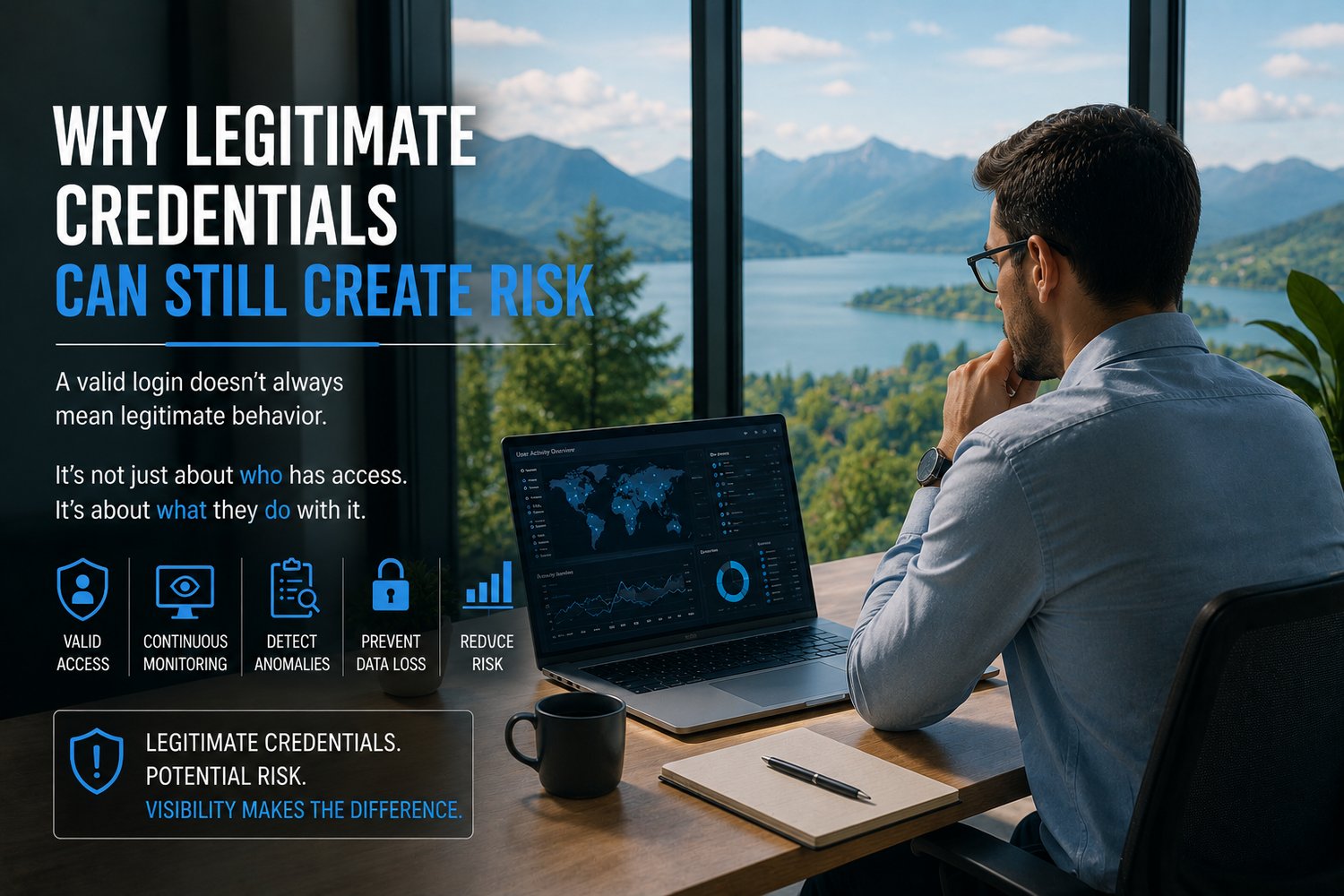
For many years, organizations have viewed strong authentication as the cornerstone of cybersecurity.
Complex passwords, multi-factor authentication (MFA), identity management, and strict access controls have become standard security practices. These technologies are highly effective at preventing unauthorized users from gaining access to corporate systems.
However, there is an important reality that every organization must recognize:
A legitimate login does not always mean legitimate behavior.
Some of the most damaging cybersecurity incidents today involve users who have valid credentials and authorized access. Whether through malicious intent, negligence, or compromised accounts, legitimate credentials can become one of the greatest security risks an organization faces.
The challenge is no longer just identifying who logged in. It is understanding what happens after authentication.
What Are Legitimate Credentials?
Legitimate credentials refer to valid authentication information used to access systems and applications.
This includes:
- usernames and passwords
- multi-factor authentication credentials
- biometric authentication
- security tokens
- privileged administrator accounts
When these credentials are used correctly, they enable employees to perform their daily responsibilities securely.
Unfortunately, the same credentials can also be exploited.
Why Credentials Alone Do Not Guarantee Security
Authentication verifies identity.
It does not verify intent.
An employee may successfully log into a system using valid credentials while engaging in activities that expose the organization to significant risk.
Examples include:
- downloading confidential files unnecessarily
- copying sensitive information to personal devices
- transferring business data to unauthorized cloud services
- accessing systems unrelated to their responsibilities
- sharing confidential information through unauthorized channels
From a technical perspective, the login appears completely normal.
The risk lies in the user's actions.
Insider Threats Often Begin with Legitimate Access
One of the biggest misconceptions in cybersecurity is that threats always come from external hackers.
In reality, many incidents originate from trusted users such as:
- employees
- contractors
- consultants
- third-party vendors
- privileged administrators
These individuals often have legitimate credentials that allow them to access sensitive systems.
Because the login itself is authorized, traditional security controls may not immediately detect unusual behavior.
Compromised Accounts Create the Same Problem
Not every misuse of legitimate credentials comes from the account owner.
Cybercriminals frequently steal credentials through:
- phishing attacks
- malware
- credential stuffing
- password reuse
- social engineering
Once attackers gain access to a legitimate account, they appear to be trusted users.
Without behavioral monitoring, organizations may struggle to distinguish attackers from legitimate employees.
The Importance of Behavioral Monitoring
Modern cybersecurity focuses not only on authentication but also on user behavior.
Organizations should monitor:
- unusual login times
- abnormal file access
- excessive downloads
- clipboard activity
- application usage
- website activity
- USB device usage
- privileged account behavior
Behavior provides context that credentials alone cannot.
High-Risk Indicators Security Teams Should Watch
Legitimate credentials become concerning when accompanied by unusual activity such as:
Large File Downloads
Employees suddenly downloading hundreds or thousands of files may indicate data collection or unauthorized extraction.
Access Outside Normal Working Hours
Late-night or weekend access may warrant additional investigation, particularly for sensitive systems.
Access to Unrelated Departments
A finance employee accessing engineering documentation or HR records may indicate abnormal behavior.
Excessive Copy-and-Paste Activity
Repeated copying of confidential information can signal attempts to move sensitive data outside organizational controls.
Unexpected Use of External Storage
Connecting USB devices shortly after accessing confidential information may indicate potential data exfiltration.
Why Access Control Alone Is Not Enough
Access control determines:
- who may enter
- what permissions they receive
It does not determine:
- how permissions are used
- whether activity is appropriate
- whether data is handled responsibly
This is why access control must be complemented by continuous monitoring.
Building a Stronger Security Strategy
Organizations can significantly reduce insider risk by combining identity management with:
- User Activity Monitoring
- Session Recording
- Screenshot Monitoring
- File Activity Monitoring
- Clipboard Monitoring
- Website Monitoring
- Insider Threat Detection
- Data Loss Prevention (DLP)
- Behavioral Analytics
Together, these technologies provide the visibility needed to identify suspicious activity before it becomes a security incident.
The Business Value of Behavioral Visibility
Monitoring user behavior helps organizations:
- detect insider threats earlier
- investigate incidents faster
- strengthen compliance
- reduce data loss
- improve operational accountability
- protect critical business assets
It shifts cybersecurity from reactive response to proactive risk management.
Final Thought
Legitimate credentials are essential for business operations.
But they should never be mistaken for proof of safe behavior.
Modern cybersecurity requires organizations to verify not only who is accessing systems, but also how those systems are being used.
At NTKays Innovations, we help organizations strengthen their security posture through intelligent user activity monitoring, insider threat detection, and workforce visibility solutions that go beyond authentication to provide complete operational insight.
Because in today's threat landscape, the greatest risk is not always an unauthorized login.
Sometimes, it is a trusted login performing unexpected actions.