

Introduction
Motivation is often the feeling that gets us excited about pursuing a goal. It is the sudden desire to start exercising, study for an examination, launch a business, read more books, improve our finances or make a positive change in our lives.
However, motivation has one major weakness: it does not always last.
There are days when you wake up feeling energetic, confident and ready to achieve everything on your list. Then there are other days when you feel tired, distracted, discouraged or simply unwilling to do anything.
If your progress depends entirely on how motivated you feel, you may find yourself starting many things but struggling to finish them.
This is where discipline becomes important.
Discipline is the ability to take responsibility for your actions and remain committed to what needs to be done, even when you do not feel like doing it. It helps you follow through on your plans, maintain healthy habits and work towards long-term goals despite temporary discomfort.
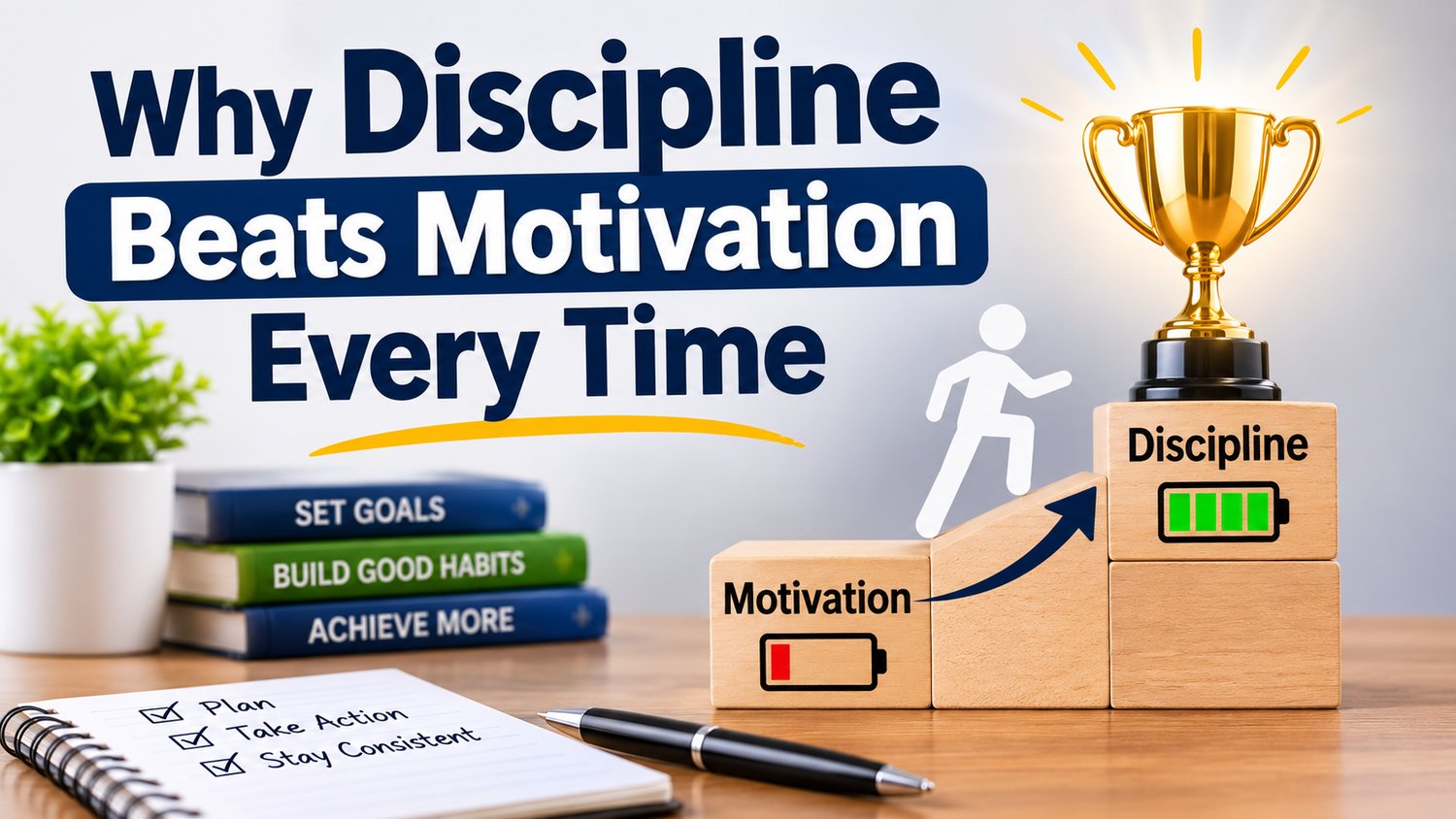
Motivation can help you get started, but discipline helps you keep going.
Let's explore why discipline is often more powerful than motivation and how you can develop it in your everyday life.
1. Motivation Is Temporary, but Discipline Builds Consistency
Motivation is influenced by many things, including your mood, environment, energy levels, circumstances and personal experiences. It can be strong today and almost nonexistent tomorrow.
For example, imagine someone who decides to start exercising because they want to improve their fitness. During the first week, they are excited. They buy workout clothes, prepare a schedule and wake up early to exercise.
By the third week, however, the excitement begins to disappear. The weather is cold, work is demanding and getting out of bed becomes difficult.
A person who relies only on motivation may stop exercising. Someone who has developed discipline is more likely to continue because exercise has become part of their routine.
The lesson: Consistency does not require you to feel excited every day. It requires you to keep showing up.
2. Discipline Helps You Work Towards Long-Term Goals
Many meaningful achievements take time. Completing a qualification, building a successful business, developing professional skills, improving your health or becoming financially stable rarely happens overnight.
Motivation often focuses on the excitement of the result. Discipline focuses on the actions required to reach that result.
Consider a student preparing for a professional certification examination. Passing the examination may be the student's dream, but success requires more than wanting the qualification.
The student must:
- Set aside time to study regularly.
- Understand difficult topics instead of avoiding them.
- Practise examination questions.
- Review incorrect answers.
- Identify knowledge gaps.
- Continue preparing even when progress feels slow.
These activities may not always be exciting, but they gradually build the knowledge and confidence needed for the examination.
Discipline keeps your attention on the process rather than allowing you to become distracted by how far away the final result seems.
3. Discipline Helps You Take Action Even When You Do Not Feel Ready
One of the biggest obstacles to success is waiting for the perfect moment.
People often say:
- I will start studying when I feel motivated.
- I will exercise when my schedule becomes less busy.
- I will start my business when I have more confidence.
- I will read when I have more free time.
- I will work on my goals when life becomes easier.
Unfortunately, the perfect moment may never arrive.
Discipline teaches you that you do not need to feel completely ready before taking action.
For example, if you want to write a book, you do not have to wait until you feel inspired. You can begin by writing one paragraph every day. If you want to improve your professional knowledge, you can start with 20 minutes of learning.
Small actions create movement. Once you begin, motivation may follow.
4. Discipline Reduces Dependence on Your Mood
Your mood can change throughout the day. You may feel positive in the morning but discouraged after receiving difficult news, experiencing a stressful situation or encountering a setback.
If your responsibilities depend on your mood, your productivity can become unpredictable.
Imagine an employee who wants to improve their computer skills to qualify for better career opportunities. On days when they feel enthusiastic, they complete online lessons. On difficult days, they postpone learning entirely.
After several months, their progress is inconsistent.
A disciplined person creates a learning schedule and makes a reasonable effort to follow it, even when the day has not gone as planned.
This does not mean ignoring exhaustion or personal circumstances. It means avoiding the habit of allowing every temporary feeling to determine your actions.
5. Discipline Builds Self-Confidence
Confidence is not developed only by thinking positively about yourself. It also grows when you repeatedly demonstrate that you can rely on yourself.
Every time you complete something you committed to doing, you strengthen your belief in your own ability.
For example:
- You promise yourself to read ten pages daily and follow through.
- You decide to save a small amount each month and remain consistent.
- You commit to studying for an hour and complete the session.
- You set a goal to improve your communication skills and practise regularly.
These small achievements send an important message: you can trust yourself to take action.
Over time, this creates a stronger sense of self-confidence because your belief is supported by evidence from your own behaviour.
6. Discipline Helps You Overcome Procrastination
Procrastination is the habit of delaying tasks even when you understand that completing them is important.
It often happens because a task feels difficult, boring, overwhelming or uncomfortable.
For instance, a student may know that an examination is approaching but spend hours watching videos, scrolling through social media or doing less important activities.
The problem is not necessarily a lack of ambition. The student may genuinely want to pass. However, the immediate comfort of avoiding the work becomes more attractive than the future benefit of preparation.
Discipline helps you act before procrastination takes control.
Practical ways to do this include:
- Break large tasks into smaller activities.
- Start with the easiest part if the task feels overwhelming.
- Set a specific time to begin.
- Remove unnecessary distractions.
- Use a timer to create focused work sessions.
- Complete important tasks before spending time on entertainment.
You do not need to finish everything immediately. You need to stop allowing unnecessary delays to become a regular habit.
7. Discipline Creates Better Habits
A successful life is not built only through occasional big decisions. It is also shaped by the small activities you repeat every day.
When you consistently perform a positive action, it becomes easier to incorporate into your routine.
For example, someone who wants to develop a reading habit can begin with ten minutes each evening. Initially, they may need to remind themselves to read. After practising regularly, reading can become a natural part of their daily schedule.
The same principle applies to:
- Exercising.
- Studying.
- Planning your day.
- Managing your finances.
- Developing professional skills.
- Maintaining a clean working environment.
- Spending quality time with family.
- Reflecting on personal progress.
Discipline helps turn good intentions into repeatable behaviours.
8. Discipline Helps You Make Better Decisions
Not every decision that feels good in the moment is beneficial in the long term.
You may want to spend money on something unnecessary, postpone an important responsibility, avoid a difficult conversation or spend hours on entertainment instead of completing an important task.
Discipline encourages you to consider the consequences of your choices.
For example, imagine receiving your salary and immediately wanting to spend a large portion of it on things you do not need. Financial discipline encourages you to consider your essential expenses, savings goals and future responsibilities before spending.
The same applies to time management. Choosing to study for an important examination instead of spending the entire evening on social media may not provide immediate entertainment, but it supports a more important objective.
Discipline helps you choose what contributes to your future rather than focusing only on what provides immediate satisfaction.
9. Discipline Makes You More Productive
Being busy does not necessarily mean being productive.
You can spend an entire day moving between activities without completing the tasks that matter most.
Discipline helps you identify priorities, organise your time and concentrate on meaningful work.
For example, a business owner may have many responsibilities, including responding to customers, managing finances, marketing products, improving services and planning future activities.
Without discipline, the day can easily become dominated by interruptions and less important tasks.
A disciplined approach involves:
- Identifying the three most important tasks for the day.
- Allocating time to complete them.
- Limiting unnecessary interruptions.
- Reviewing what has been achieved.
- Preparing priorities for the following day.
This approach creates structure and makes it easier to measure progress.
10. Discipline Helps You Recover After Failure
Failure is part of learning and personal development. You may fail an examination, lose a business opportunity, make a financial mistake, miss a deadline or experience a setback in your career.
Motivation may decrease after such experiences. You might begin questioning your abilities or wondering whether continuing is worthwhile.
Discipline helps you respond constructively.
Instead of abandoning your goal, you can examine what went wrong, identify what needs to change and take the next practical step.
For example, a student who fails an examination can review their preparation strategy, identify weak topics, increase practice time and prepare differently for the next attempt.
Discipline does not mean pretending that failure does not hurt. It means refusing to allow one disappointing experience to determine your entire future.
11. Discipline Teaches You to Be Patient
We live in a world where people often expect immediate results. Social media can make success appear effortless, creating the impression that everyone else is progressing faster.
However, many achievements require months or years of consistent effort.
A person learning a new language may practise for several months before becoming comfortable with conversations. Someone building a business may work consistently before attracting a reliable customer base. A student may need repeated practice before mastering a difficult subject.
Discipline helps you remain committed during the period when your efforts are not yet producing visible results.
Remember that progress is not always immediately noticeable. Sometimes you are developing knowledge, experience, confidence and habits that will become valuable later.
12. Discipline Does Not Mean Being Perfect
One common misunderstanding is that disciplined people never make mistakes, miss deadlines or experience unproductive days.
That is not realistic.
Discipline is not about living a perfect life. It is about developing the ability to return to your commitments after interruptions and setbacks.
Suppose you planned to exercise five days a week but missed two sessions because of unexpected responsibilities. You do not need to abandon your fitness goal or wait for the beginning of another month.
You can simply return to your schedule.
The same applies to reading, studying, saving money and professional development.
A missed day should not automatically become a missed week. A temporary setback should not become a permanent excuse.
Progress is more important than perfection.
13. Discipline Creates Opportunities for Personal and Professional Growth
Discipline can influence almost every area of your life.
In the workplace, it can help you meet deadlines, improve your technical knowledge, communicate professionally and take responsibility for your duties.
In business, it can help you maintain customer relationships, market your products consistently, manage resources and improve service delivery.
In education, it supports regular study, examination preparation and continuous learning.
In personal development, it helps you build healthy routines, improve relationships and pursue meaningful goals.
People who consistently develop their skills and fulfil their responsibilities are often better prepared to recognise and take advantage of opportunities.
You cannot control every opportunity that comes your way, but you can control how prepared you are to make use of it.
How to Develop Discipline in Your Everyday Life
Discipline is a skill that can be developed through practice. You do not need to transform your entire life in one day.
Start with manageable changes and gradually build on them.
A. Set Clear and Realistic Goals
Avoid vague goals such as "I want to become successful" or "I want to improve my life."
Be specific about what you want to achieve.
For example:
- Read for 20 minutes every day.
- Study for one hour from Monday to Friday.
- Exercise three times a week.
- Save a fixed amount every month.
- Complete one professional development course within three months.
Clear goals make it easier to understand what action is required.
B. Create a Daily Routine
A routine reduces the need to make repeated decisions about when to complete important activities.
You can establish a simple morning, afternoon or evening routine depending on your responsibilities.
For example, a working professional might dedicate 30 minutes after work to studying, followed by time for personal responsibilities and relaxation.
Your routine should be realistic enough to maintain.
C. Start Small
Do not overwhelm yourself by introducing ten new habits at once.
If you want to become a regular reader, begin with five or ten pages daily. If you want to improve your fitness, start with a manageable walk.
Small actions are easier to repeat, and repetition helps establish consistency.
D. Remove Distractions
Identify the things that regularly interrupt your progress.
These may include excessive social media use, unnecessary notifications, television, disorganised workspaces or frequent interruptions.
Create an environment that supports your priorities.
For example, when studying, keep your phone away unless you need it for learning. Prepare your materials before beginning and work in a space where you can concentrate.
E. Track Your Progress
Keep a simple record of your activities.
You can use a notebook, calendar, spreadsheet or habit-tracking application.
Record whether you completed your planned activities and review your progress weekly.
Tracking helps you identify patterns, recognise improvements and understand where you need to make adjustments.
F. Learn to Say No
Discipline sometimes requires you to decline activities that compete with your priorities.
You may need to reduce unnecessary commitments, avoid distractions or postpone entertainment until important responsibilities are completed.
Saying no to something that does not support your current priorities can mean saying yes to a more meaningful goal.
G. Allow Time for Rest
Discipline should not be confused with working continuously without breaks.
Rest is important for concentration, health and sustainable performance.
Create a routine that includes sleep, relaxation and time for responsibilities outside work or study.
The objective is not to exhaust yourself. It is to develop a consistent approach that you can maintain over time.
A Simple 7-Day Challenge to Build Discipline
If you want to begin developing discipline, try the following seven-day challenge.
Day 1: Choose one important goal. Identify one area of your life that needs improvement.
Day 2: Create a realistic schedule. Decide when you will work on your goal and how much time you can commit.
Day 3: Remove one distraction. Identify something that regularly wastes your time and reduce its influence.
Day 4: Complete a task you have been postponing. Stop waiting for the perfect mood and take action.
Day 5: Track your progress. Review what you have completed and identify areas that need improvement.
Day 6: Repeat your routine. Focus on consistency rather than increasing the workload unnecessarily.
Day 7: Reflect and plan. Evaluate what worked, what was difficult and what you will continue doing during the following week.
The purpose of this challenge is not to become a completely different person in seven days. It is to prove to yourself that you can take consistent action.
Let Discipline Carry You When Motivation Disappears
Motivation is valuable because it can inspire you to begin something meaningful. However, it is not always reliable enough to sustain long-term progress.
Discipline provides the structure, consistency and commitment needed to continue working towards your goals, even when the excitement disappears.
Whether you are preparing for an examination, developing your career, building a business, improving your health or working towards personal growth, remember that success is often the result of small actions repeated over time.
You do not have to feel motivated every morning. You need to understand what matters, make a realistic plan and take responsibility for following through.
Start small. Stay consistent. Learn from setbacks. Keep improving.
Do not build your future around how you feel today. Build it around the actions you are willing to repeat.
How NTKayz E-Learning Centre Can Support Your Growth
Personal development begins with a willingness to learn. Books can introduce you to new ideas, practical strategies and different perspectives that support your educational and personal goals.
At NTKayz E-Learning Centre, readers can explore ebooks covering education, motivation and self-development. Whether you want to strengthen your knowledge, improve your habits or develop a more productive mindset, the right reading material can support your journey.
Make learning part of your routine. Invest in your growth, one page at a time.
NTKayz E-Learning Centre: Read. Learn. Grow. Become More.
Comments ()