
Education is an investment, but that does not mean students should have to spend a fortune to access quality learning resources.
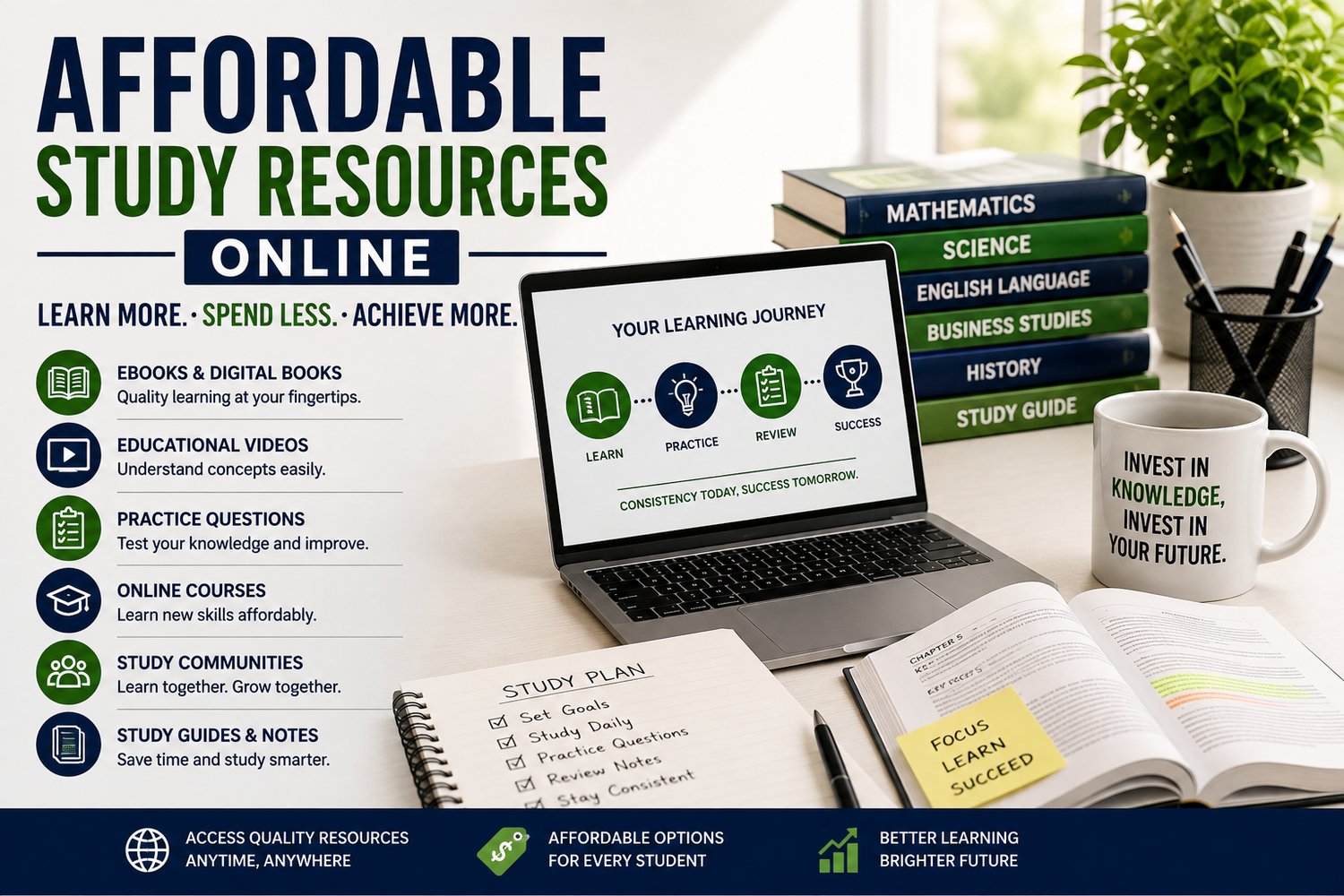
Today, students have access to an enormous range of educational materials online. From ebooks and digital textbooks to practice questions, online courses, study guides, educational videos, revision notes, and learning communities, the internet has made it possible to supplement classroom learning from almost anywhere.
However, having access to thousands of resources does not automatically make studying easier.
The challenge is knowing which resources are useful, which are trustworthy, and which provide genuine value for money.
For students working with limited budgets, choosing affordable study resources can make a significant difference. The right resources can help you understand difficult subjects, prepare for examinations, develop better study habits, and continue learning without placing unnecessary financial pressure on you or your family.
This guide explores affordable online study resources, how to choose them, and how to get the most value from the resources you already have.
Why Online Study Resources Matter
Traditional education remains extremely important, but learning does not stop when a student leaves the classroom.
A teacher may explain a topic during a lesson, but a student may still need additional examples or practice before fully understanding it.
Online resources can provide that additional support.
For example, a student struggling with mathematics might use:
- An ebook explaining the concept
- A video demonstrating the solution
- Practice questions
- Digital flashcards
- An online discussion forum
- A study guide
This gives the student multiple ways to approach the same topic.
Sometimes the explanation that finally makes sense is not the first one you encounter.
1. Educational Ebooks
Ebooks are among the most convenient study resources available online.
Instead of purchasing several expensive physical textbooks, students can often find digital books covering specific subjects or areas of interest.
Ebooks can be useful for:
- Revision
- Additional explanations
- Personal development
- Exam preparation
- Research
- General knowledge
- Professional development
Another advantage is portability.
A student can carry an entire digital library on a smartphone, tablet, or computer.
For students looking for affordable educational and self-development reading material, NTKayzbookworld provides ebooks designed to support learning, personal development, motivation, and lifelong reading.
2. Free Educational Websites
There are many websites offering educational information at no cost.
Students can use free online resources to supplement their formal education and explore subjects beyond their curriculum.
However, students should evaluate free resources carefully.
Ask:
- Who created the content?
- Is the information current?
- Are sources provided?
- Does the material explain concepts clearly?
- Does it match your curriculum or learning objectives?
"Free" does not always mean "good."
The objective should be to find reliable and useful resources rather than simply collecting as many resources as possible.
3. Online Courses
Online courses can provide structured learning without the cost associated with traditional classroom-based programs.
Depending on the platform and subject, students may find:
- Free courses
- Low-cost courses
- Discounted courses
- Short skills-based courses
- Professional development programs
Online courses can be particularly useful when you want to learn something outside your normal school or university curriculum.
For example, a student studying business might also learn:
- Microsoft Excel
- Digital marketing
- Communication
- Project management
- Data analysis
These additional skills can become valuable later in academic and professional life.
4. Practice Questions and Past Papers
One of the most valuable study resources may be completely free: practice.
Students often spend too much time reading and not enough time answering questions.
Practice questions can help you determine whether you actually understand the material.
They can also help you identify:
- Weak areas
- Frequently misunderstood concepts
- Exam question patterns
- Time-management problems
When preparing for an examination, try to combine reading with active practice.
A useful approach is:
Learn → Practise → Check → Correct → Repeat
This is often more effective than simply reading the same notes repeatedly.
5. Digital Flashcards
Flashcards can be particularly useful for memorising:
- Definitions
- Vocabulary
- Formulas
- Dates
- Terminology
- Key concepts
You can create physical flashcards or use digital tools.
The important thing is how you use them.
Instead of looking at the answer immediately, try to recall it first.
That process strengthens your ability to retrieve information.
6. Educational Videos
Some concepts are easier to understand when you can see them demonstrated.
Educational videos can help explain:
- Mathematical calculations
- Scientific processes
- Historical events
- Technical concepts
- Language skills
- Practical procedures
However, watching videos should not become passive entertainment disguised as studying.
After watching a lesson, ask yourself:
"Can I explain what I just learned without watching the video again?"
If not, take notes and test yourself.
7. Online Libraries
Digital libraries can provide access to thousands of books and academic materials.
Depending on your institution or local library system, you may have access to:
- Digital textbooks
- Academic journals
- Research papers
- Reference books
- Newspapers
- Educational databases
Students should check whether their school, college, university, or public library provides free digital access.
You may already have access to valuable resources without realizing it.
8. Online Study Communities
Learning does not have to happen alone.
Online study communities can allow students to:
- Ask questions
- Share study strategies
- Discuss difficult topics
- Form virtual study groups
- Exchange revision ideas
However, students should be careful when using community-generated information.
Always verify important academic information using reliable sources.
A confident answer from another student is not necessarily a correct answer.
9. Study Guides and Revision Materials
Study guides can help students organise large amounts of information into manageable sections.
They may include:
- Key concepts
- Summaries
- Definitions
- Practice questions
- Revision checklists
- Topic outlines
They are especially useful before examinations because they can help students quickly identify areas requiring further attention.
However, study guides should supplement learning rather than replace proper understanding.
10. Note-Taking Resources
Effective notes can save students enormous amounts of time during revision.
You can create digital or handwritten notes using:
- Notebooks
- Word processors
- Note-taking applications
- Mind maps
- Structured summaries
Try to avoid copying entire textbooks or lectures.
Instead, focus on:
What is the main idea?
What do I need to remember?
Can I explain it in my own words?
Good notes should make revision easier, not create another textbook that you have to read.
11. Free Productivity Tools
Sometimes the biggest problem is not a lack of educational resources.
It is poor organization.
Students can use free or low-cost digital tools to manage:
- Study schedules
- Assignments
- Deadlines
- Reading lists
- Revision plans
- Daily tasks
A simple calendar and task list can make a significant difference.
You do not necessarily need an expensive productivity system.
You need a system you will actually use.
12. Affordable Resources for Different Budgets
Not every student has the same financial circumstances.
Fortunately, study resources can be organised according to different budgets.
Zero-budget approach
Start with:
- School or university resources
- Public libraries
- Free educational websites
- Free online courses
- Free educational videos
- Free practice questions
- Your own notes
Low-budget approach
Consider adding:
- Affordable ebooks
- Discounted courses
- Digital study guides
- Practice materials
- Subject-specific resources
Larger study budget
Students who have more resources available may consider:
- Comprehensive online courses
- Professional exam preparation programs
- Premium learning platforms
- Private tutoring
- Specialized academic databases
The important lesson is that you do not need the most expensive resources to become a successful learner.
How to Choose Affordable Study Resources
Before purchasing an ebook, course, study guide, or other resource, ask yourself several questions.
1. Does it match my learning objective?
Do not buy a resource simply because the title sounds impressive.
Make sure it addresses what you actually need to learn.
2. Is it trustworthy?
Look at the author, publisher, qualifications, reputation, and available information about the resource.
3. Is it current?
Some subjects change rapidly.
Technology, business practices, regulations, and professional certifications may require updated information.
4. Is it practical?
A resource should help you do something, not merely provide pages of information.
5. Will I actually use it?
An inexpensive book that sits unread on your device is still money wasted.
Don't Buy Too Many Resources
One of the biggest mistakes students make is collecting resources instead of studying.
You might have:
📚 Five ebooks
🎥 Twenty videos
📝 Hundreds of practice questions
📱 Several study applications
But if you never use them properly, they have little value.
Too many resources can actually create confusion.
Choose a small number of reliable resources and use them consistently.
Quality + consistency beats quantity.
Use the Resources You Already Have
Before spending money, take inventory of what is already available to you.
You may have access to:
- School textbooks
- Lecture notes
- Teacher-provided materials
- Library books
- Online databases
- Free educational websites
- Previous assignments
- Past examinations
Sometimes students purchase new resources before fully using the ones already available.
Start with what you have.
Then identify the gaps.
Only purchase additional resources when they genuinely solve a problem.
Combine Different Learning Methods
Different resources work better for different learning situations.
For example:
Step 1: Read
Use an ebook or textbook to understand the concept.
Step 2: Watch
Find an educational explanation if the concept remains unclear.
Step 3: Practise
Answer questions without looking at the solution.
Step 4: Review
Identify mistakes.
Step 5: Explain
Teach the concept to someone else or explain it aloud.
This combination creates a much stronger learning process than relying on one resource alone.
Affordable Resources Can Support Lifelong Learning
Online study resources are not only useful for students preparing for examinations.
They can also support adults who want to continue learning.
You might use affordable resources to learn:
- A new language
- Computer skills
- Business
- Leadership
- Communication
- Personal finance
- Entrepreneurship
- Personal development
Learning does not have an expiry date.
You can continue developing your knowledge at any stage of life.
Be Careful With "Too Good to Be True" Study Resources
Students should also be cautious when purchasing online educational materials.
Avoid resources that make unrealistic promises such as:
- Guaranteed exam results
- Guaranteed qualifications
- Instant mastery
- Guaranteed employment
- "No studying required"
Academic success still requires effort.
A resource can support your learning, but it cannot do the learning for you.
Be particularly careful with materials that claim to provide unauthorized exam answers or compromise examination integrity.
The best resource is one that helps you understand and prepare, not one that encourages shortcuts that could put your academic future at risk.
Make Your Study Resources Work Harder
Once you have selected your resources, create a simple system.
For every resource, determine:
Purpose: Why am I using it?
Schedule: When will I use it?
Action: What will I do with what I learn?
Review: When will I revisit the material?
For example:
Ebook: Read one chapter every Tuesday and Thursday.
Practice questions: Complete 20 questions every Saturday.
Notes: Review difficult concepts every Sunday.
This transforms resources from things you own into tools you actively use.
Why Affordable Does Not Mean Low Quality
There is sometimes a misconception that quality education must be expensive.
That is not necessarily true.
The digital world has dramatically expanded access to knowledge. Students can now learn from books, educators, institutions, experts, libraries, and educational platforms from around the world.
The key is being selective.
A low-cost resource that clearly explains an important concept may be more valuable than an expensive resource you never use.
Ultimately, the value of a study resource depends on how effectively it helps you learn.
Final Thoughts
Studying successfully is not about having the largest collection of books, the most expensive courses, or the newest learning application.
It is about having the right resources and using them effectively.
Affordable online study resources can help students supplement classroom learning, prepare for examinations, develop new skills, and pursue personal growth without unnecessary financial pressure.
Start with the resources already available to you.
Identify what you are struggling with.
Find a reliable resource that addresses that specific need.
Study consistently.
Practise what you learn.
Review your mistakes.
And keep improving.
Your education is an investment in your future, but investing in yourself does not always require spending a fortune.
Sometimes, the most valuable resource is simply a good book, a focused mind, a clear goal, and the discipline to keep learning.
Key Takeaways
✔ Affordable online resources can supplement formal education.
✔ Ebooks, study guides, practice questions, videos, and online courses can all support learning.
✔ Always check the quality and reliability of educational materials.
✔ Use the resources you already have before spending more money.
✔ Avoid collecting resources without actually using them.
✔ Combine reading, practice, self-testing, and review.
✔ Choose resources according to your specific learning needs.
✔ Be cautious of unrealistic promises and academic shortcuts.
✔ Remember that consistency matters more than the price of a resource.
✔ Keep investing in your knowledge and personal development.
Keep Learning With NTKayzbookworld
Looking for affordable digital reading resources?
NTKayz Educational E-Book Centre is focused on providing educational, motivational, and self-development ebooks for readers who want to learn, grow, develop new perspectives, and build a stronger reading habit.
Your next useful lesson could be just one book away.
Read. Learn. Grow. Become More.
Comments ()