

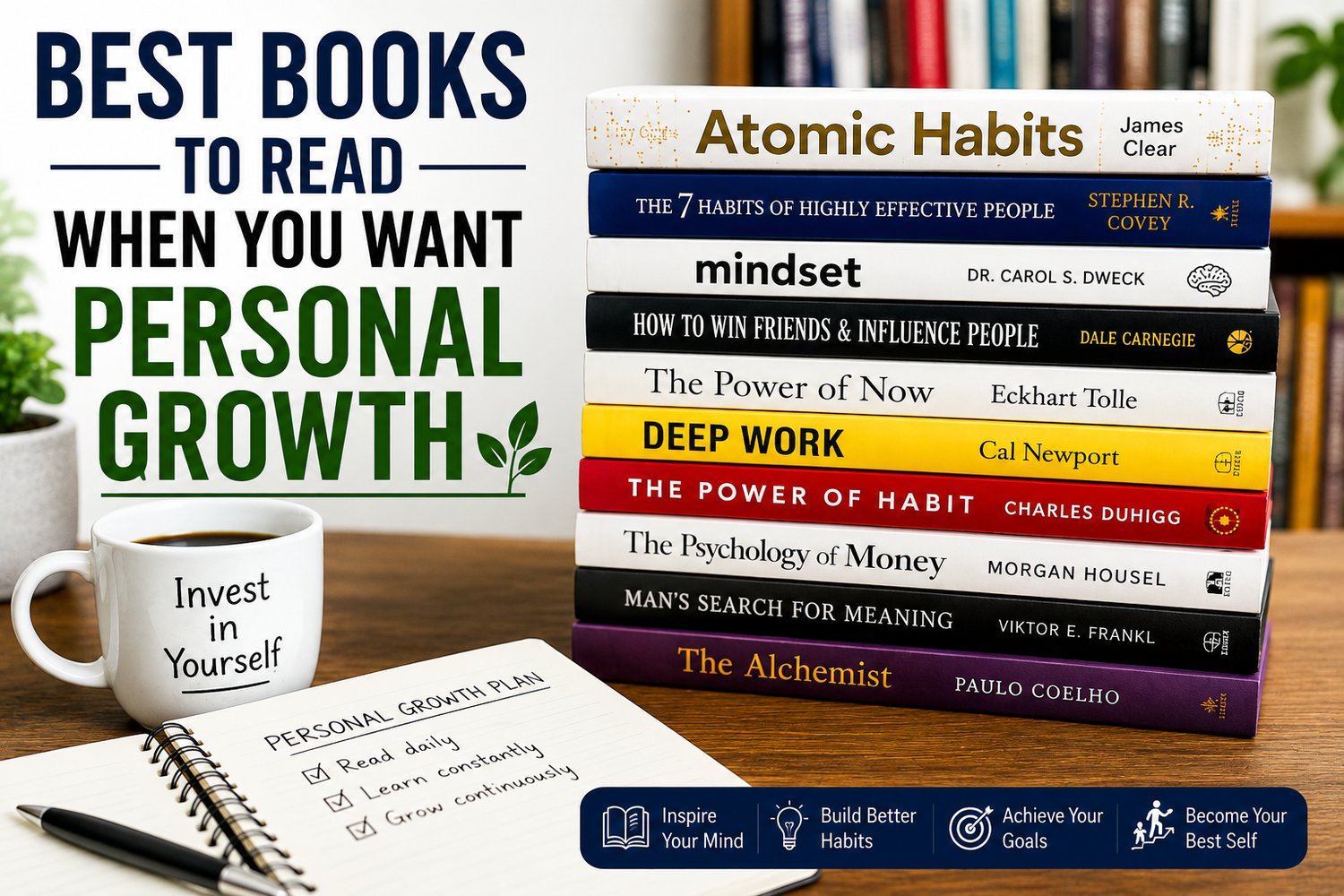
Personal growth does not happen by accident. It develops through the ideas we encounter, the lessons we learn, the habits we build, and the decisions we make every day.
One of the most powerful ways to invest in yourself is through reading. A good book can introduce you to a new way of thinking, challenge beliefs you have carried for years, teach practical skills, or inspire you to take action.
You do not need to read hundreds of books to transform your life. Sometimes, the right book at the right stage of your journey can provide exactly the perspective you need.
Whether you want to become more disciplined, improve your mindset, manage your time, understand people better, develop better financial habits, or simply become more intentional about your life, there are books that can help.
Below is a carefully selected collection of books that are widely regarded as valuable starting points for different areas of personal development.
1. Atomic Habits by James Clear
If your biggest challenge is consistency, this is an excellent place to start.
Atomic Habits focuses on the idea that meaningful change can come from small improvements repeated consistently. Instead of trying to completely transform your life overnight, the book encourages readers to focus on building systems and habits that support the person they want to become.
What you can learn:
- How small habits compound over time
- How to make good habits easier to maintain
- How to reduce unwanted habits
- Why environment influences behavior
- How identity can shape your habits
The central lesson is particularly useful for anyone who repeatedly sets goals but struggles to follow through.
2. The 7 Habits of Highly Effective People by Stephen R. Covey
This is a classic personal-development book focused on effectiveness, responsibility, relationships, and personal leadership.
Rather than simply offering productivity tricks, Covey explores principles that can help readers become more intentional about how they live and interact with others.
What you can learn:
- Taking responsibility for your choices
- Setting meaningful priorities
- Developing a clear personal vision
- Improving relationships
- Creating better collaboration
- Balancing personal achievement with important relationships
It is particularly useful for students, professionals, leaders, and anyone trying to become more organized and purposeful.
3. Mindset by Carol S. Dweck
How you think about your abilities can influence how you respond to challenges.
In Mindset, psychologist Carol Dweck explores the distinction between a fixed mindset and a growth mindset.
A fixed mindset can lead someone to believe that abilities are largely unchangeable. A growth mindset emphasizes learning, effort, development, and the possibility of improvement.
What you can learn:
- How beliefs influence behavior
- Why challenges can become learning opportunities
- How to respond to failure
- Why effort matters
- How to develop a learning-oriented attitude
This book is particularly relevant for students and professionals who want to become more resilient when facing setbacks.
4. How to Win Friends and Influence People by Dale Carnegie
Personal growth is not only about individual achievement.
Your ability to communicate, listen, cooperate, and build relationships can have a major impact on your personal and professional life.
Dale Carnegie's classic book explores principles of human interaction and communication.
What you can learn:
- How to communicate more effectively
- How to listen to people
- How to handle disagreements
- How to build stronger relationships
- How to show genuine interest in others
The lessons can be applied in classrooms, workplaces, businesses, friendships, and family relationships.
5. The Power of Now by Eckhart Tolle
Many people spend significant amounts of time worrying about the future or replaying the past.
The Power of Now encourages readers to pay greater attention to the present moment and become more aware of their thoughts.
What you can explore:
- Present-moment awareness
- Overthinking
- Emotional awareness
- Detachment from unhelpful thought patterns
- Mindfulness
This book can appeal to readers interested in self-awareness and developing a calmer relationship with their thoughts.
6. Deep Work by Cal Newport
In a world filled with notifications, social media, emails, and constant interruptions, the ability to concentrate has become increasingly valuable.
Deep Work explores the importance of focused, distraction-free work.
What you can learn:
- How to improve concentration
- Why distractions reduce productivity
- How to create focused work periods
- How to structure your environment
- Why valuable skills often require sustained attention
This is particularly useful for students, writers, entrepreneurs, researchers, and professionals.
7. The Power of Habit by Charles Duhigg
If you want to understand why you repeatedly behave in certain ways, this book provides an interesting introduction to the science and psychology of habits.
It explores how habits develop and how changing habitual patterns can influence behavior.
What you can learn:
- How habits are formed
- How routines influence behavior
- How habits affect organizations and individuals
- How changing patterns can support personal improvement
It pairs well with practical habit-building books because it focuses more heavily on understanding the mechanisms behind habits.
8. The Psychology of Money by Morgan Housel
Personal growth also includes developing a healthier relationship with money.
The Psychology of Money explores how emotions, experiences, behavior, and personal beliefs influence financial decisions.
What you can learn:
- Why financial behavior is often emotional
- The importance of patience
- Why saving matters
- How expectations influence financial decisions
- Why wealth and income are not the same thing
The book is useful even for readers who are just beginning to develop financial awareness.
9. Man's Search for Meaning by Viktor E. Frankl
This book takes personal growth into deeper territory.
Written by psychiatrist Viktor Frankl, it combines his experiences during the Holocaust with his psychological ideas about meaning and human resilience.
It explores how people can search for meaning even during extremely difficult circumstances.
What you can reflect on:
- Purpose
- Resilience
- Meaning
- Human dignity
- Responsibility
- Finding direction during difficult periods
This is a more serious and emotionally demanding book, but it can profoundly influence how readers think about purpose and adversity.
10. The Alchemist by Paulo Coelho
Personal growth does not always have to come from a traditional self-help book.
The Alchemist is a novel about a young shepherd who travels in pursuit of his dreams.
Through storytelling, it explores themes such as:
- Dreams
- Courage
- Purpose
- Persistence
- Self-discovery
- Following one's aspirations
For readers who prefer learning through stories rather than instructional books, this can be an accessible introduction to personal-development themes.
How to Choose the Right Personal-Growth Book
With thousands of books available, choosing what to read can feel overwhelming.
Instead of simply asking:
"What is the best personal-development book?"
Ask:
"What area of my life do I want to improve right now?"
Your answer can guide your choice.
If you want better habits
Start with:
- Atomic Habits
- The Power of Habit
If you want better productivity
Consider:
- Deep Work
- The 7 Habits of Highly Effective People
If you want a stronger mindset
Consider:
- Mindset
- Man's Search for Meaning
If you want better relationships
Consider:
- How to Win Friends and Influence People
If you want better financial thinking
Consider:
- The Psychology of Money
If you want greater self-awareness
Consider:
- The Power of Now
If you want inspiration through storytelling
Consider:
- The Alchemist
Don't Read Just to Finish Books
One common mistake is turning reading into a competition.
Some people focus on how many books they can finish each year rather than what they actually learn from them.
Reading 50 books without applying anything may be less valuable than reading five books carefully and implementing their lessons.
After completing a chapter, ask:
- What did I learn?
- What surprised me?
- What can I apply to my life?
- Which idea challenged my thinking?
- What action can I take this week?
Reading becomes more powerful when knowledge turns into action.
Take Notes While You Read
You do not have to annotate every page.
However, recording important ideas can help you remember and apply them.
Consider keeping a reading journal where you write:
Book:
Main idea:
Three lessons:
One idea I disagree with:
One action I will take:
This simple approach turns reading into an active learning experience.
Build a Reading Habit
You do not need to read for hours every day.
Start with something manageable.
For example:
- 10 pages a day
- 15 minutes before bed
- One chapter every morning
- 20 minutes during your lunch break
The objective is to create consistency.
Once reading becomes part of your routine, increasing the amount you read becomes much easier.
Don't Believe Everything You Read
Personal-development books can provide valuable ideas, but they should not be treated as unquestionable truth.
Different authors have different:
- Experiences
- Philosophies
- Research backgrounds
- Cultural perspectives
- Opinions
Think critically.
Compare ideas.
Ask questions.
Keep what is useful and examine what does not fit your circumstances.
A good reader does not simply collect ideas. A good reader learns how to evaluate them.
Turn Reading Into Personal Growth
The real value of a book begins after you close it.
If you read about discipline, practise discipline.
If you read about communication, improve how you communicate.
If you read about financial responsibility, review your spending.
If you read about habits, build one.
If you read about purpose, reflect on your own direction.
Knowledge becomes powerful when it changes behavior.
Create Your Personal Growth Reading List
You can create a reading list based on the areas you want to develop.
For example:
Month 1: Habits
Read about habit formation and consistency.
Month 2: Mindset
Explore resilience, learning, and personal beliefs.
Month 3: Productivity
Learn about focus, planning, and time management.
Month 4: Communication
Develop interpersonal and professional communication skills.
Month 5: Finance
Improve your understanding of money and financial behavior.
Month 6: Purpose
Explore meaning, values, and long-term direction.
This creates a structured learning journey rather than randomly jumping from one book to another.
Reading Is an Investment in Yourself
Books give us access to ideas that may have taken other people decades to develop.
A book can introduce you to:
- A new skill
- A new perspective
- A new opportunity
- A new philosophy
- A new way of solving problems
The financial cost of a book can be small compared with the value of a useful idea that changes how you approach your life.
That is why reading remains one of the most valuable personal-development habits.
Final Thoughts
Personal growth is not about becoming perfect.
It is about becoming more aware, more capable, more disciplined, and more intentional over time.
The books you choose can become companions on that journey.
You do not have to read every popular self-development book. You do not have to finish dozens of books each year.
Start with one.
Read it carefully.
Think about it.
Apply what you learn.
Then pick up the next one.
Over time, those pages can become knowledge, knowledge can become action, and action can become a completely different way of living.
Key Takeaways
- ✔ Choose books according to the area you want to improve.
- ✔ Read consistently rather than trying to finish books quickly.
- ✔ Take notes and reflect on important ideas.
- ✔ Question and evaluate what you read.
- ✔ Apply lessons instead of simply collecting information.
- ✔ Build a personal reading list around your long-term goals.
- ✔ Remember that personal growth is a continuous journey.
For readers who want to make reading part of their personal-development journey, NTKayz Educational E-Book Centre offers educational, motivational, and self-development ebooks designed to encourage continuous learning, personal growth, and a stronger reading culture.
Comments ()