

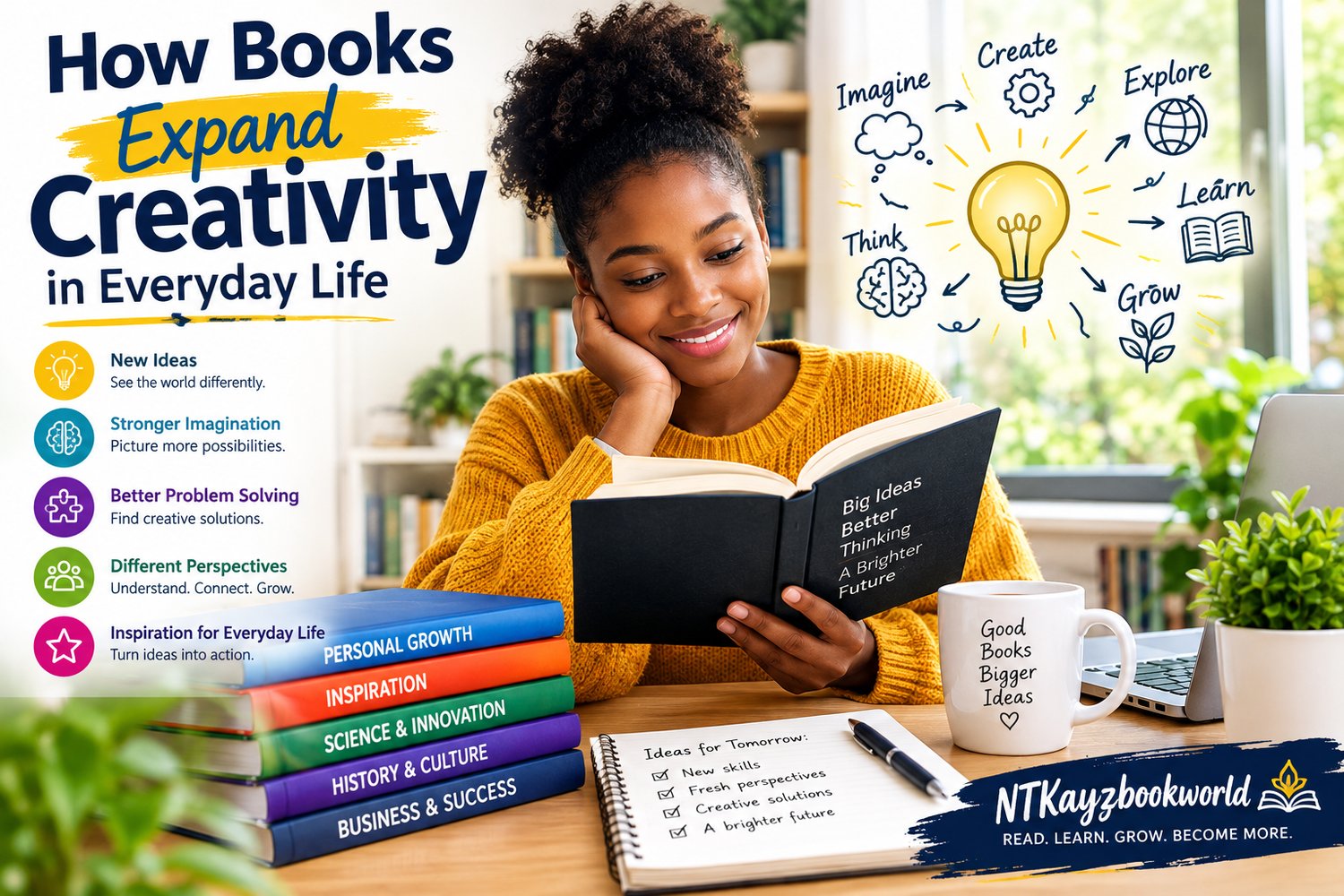
Creativity is often associated with artists, writers, musicians, designers, and inventors. But creativity is not limited to people working in creative professions.
Every person uses creativity every day.
You use creativity when solving a problem at work, finding a different way to study, preparing a meal from limited ingredients, decorating your home, developing a business idea, resolving a disagreement, or deciding how to overcome an unexpected challenge.
At its heart, creativity is the ability to connect ideas, imagine possibilities, approach problems differently, and create something new or meaningful from what you already know.
One of the simplest ways to strengthen this ability is through reading.
Books introduce us to unfamiliar worlds, perspectives, experiences, ideas, characters, problems, solutions, and possibilities. They give the mind new material to work with.
The more ideas you encounter, the more connections your brain has available to make.
Reading therefore does more than fill your mind with information. It can give your imagination more ingredients to work with.
1. Books Introduce You to New Ideas
Creativity needs ideas.
When you repeatedly encounter the same information, environments, and experiences, your thinking can become predictable.
Books can break that pattern.
A book about entrepreneurship may introduce you to a business model you had never considered.
A science book may explain a phenomenon that inspires a new question.
A biography may show you how another person approached a difficult situation.
A novel may introduce you to a completely different world.
Each new idea becomes another piece of information that your mind can connect with something you already know.
For example, someone reading about agriculture, technology, and business might eventually begin thinking about ways technology could improve agricultural services.
The idea may not have appeared from a single source.
It may have emerged from connecting ideas encountered in different books.
That is one of the fascinating ways creativity works.
2. Reading Strengthens Your Imagination
When you watch a movie, many visual details are already provided for you.
Reading is different.
When a book describes a person, location, conversation, or event, your mind has to construct part of the experience.
You imagine:
- What the environment looks like
- What the characters sound like
- What they might be feeling
- What could happen next
- What a particular place might look like
Your imagination becomes an active participant.
This repeated mental activity can help you become more comfortable imagining possibilities beyond what is immediately visible.
That ability is useful far beyond reading.
3. Fiction Can Make You Think Differently
Fiction is sometimes dismissed as entertainment, but stories can expose readers to complex ideas about people, relationships, decisions, morality, society, and human behavior.
A fictional character might make a decision you would never make.
You may disagree with them.
You may understand them.
You may wonder what you would have done in the same situation.
This creates mental exploration.
Stories allow you to experiment with possibilities without having to experience every situation personally.
That can encourage flexible thinking and imaginative problem-solving.
4. Books Help You Make Unexpected Connections
Creativity often appears when two seemingly unrelated ideas are connected.
Consider someone who reads about:
- Artificial intelligence
- Education
- Psychology
- Business
At first, these may appear to be separate subjects.
But eventually the reader might begin asking:
"How could artificial intelligence be used to personalize learning based on how people think and learn?"
That question combines ideas from different fields.
This is why reading broadly can be valuable.
You do not always know which piece of information will become useful later.
5. Reading Gives You Different Perspectives
Creativity requires flexibility.
If you believe there is only one correct way to look at a problem, your possible solutions become limited.
Books expose you to different viewpoints.
You can read about:
- Different cultures
- Different generations
- Different professions
- Different philosophies
- Different historical periods
- Different approaches to solving problems
You may encounter ideas you strongly agree with.
You may also encounter ideas you completely disagree with.
Both experiences can be valuable.
Agreement can strengthen your understanding.
Disagreement can force you to think more carefully about why you believe what you believe.
6. Reading Can Improve Problem-Solving
Many books contain problems and challenges.
A mystery novel presents a puzzle.
A business book examines challenges faced by organizations.
A biography describes obstacles encountered by an individual.
A scientific book explores questions about how the world works.
As you read, you naturally encounter different approaches to solving problems.
You begin asking:
What would I do?
Would I have made the same decision?
Is there another solution?
These questions encourage analytical and creative thinking.
7. Books Encourage Curiosity
Curiosity is one of creativity's best companions.
A curious person does not simply accept information.
They ask questions.
One answer can lead to another question.
For example:
You read about space.
You become curious about planets.
That leads you to astronomy.
Astronomy makes you interested in physics.
Physics makes you curious about energy.
Before long, one book has opened the door to an entirely new area of learning.
This is how reading can turn learning into exploration.
8. Reading Helps You See Possibilities
Sometimes creativity begins with a simple question:
"What if?"
What if this could be done differently?
What if this problem had another solution?
What if these two ideas were combined?
What if something that works in one industry could work in another?
Books provide examples of people imagining possibilities that did not previously exist.
Entrepreneurs read about businesses.
Inventors study science.
Writers study stories.
Leaders study history.
Researchers study previous discoveries.
Reading gives people access to possibilities that can influence what they imagine for themselves.
9. Reading Can Improve Communication of Creative Ideas
Having a creative idea is only part of the process.
You also need to communicate it.
Whether you are pitching a business idea, writing a proposal, creating a presentation, explaining a project, or discussing a solution with your team, you need language to communicate your thinking.
Reading can help develop:
- Vocabulary
- Sentence structure
- Storytelling
- Explanation skills
- Writing ability
- Understanding of tone
The better you can communicate an idea, the easier it becomes for others to understand and support it.
10. Books Can Inspire New Hobbies
Sometimes creativity begins with discovering something you did not know you enjoyed.
A book about photography might inspire you to pick up a camera.
A gardening book might inspire you to grow vegetables.
A cooking book might lead you into the kitchen.
A history book might encourage you to explore your local heritage.
A design book might encourage you to experiment with drawing.
A business book might inspire you to develop an entrepreneurial idea.
Reading can therefore act as a doorway.
You start with curiosity and discover a new activity on the other side.
11. Reading Can Help You Escape Creative Blocks
Everyone experiences moments when ideas stop flowing.
A writer may not know what to write.
A student may struggle with a project.
An entrepreneur may not know how to approach a business challenge.
A designer may feel stuck.
When this happens, consuming more of the same information is not always the answer.
Sometimes you need a completely different perspective.
Reading something outside your normal subject can provide that mental change.
A person struggling with a business problem might find inspiration in psychology.
A writer might discover an interesting idea in history.
A teacher might find a new approach in technology.
Creativity sometimes returns when you give your mind new material.
12. Reading Makes Everyday Experiences More Interesting
Books can change the way you observe the world.
After reading about architecture, you might start noticing buildings differently.
After reading about psychology, you may become more aware of human behavior.
After reading about nature, you might pay greater attention to plants, weather, and wildlife.
After reading about history, ordinary locations may suddenly seem connected to important events.
Knowledge changes what you notice.
And what you notice can influence what you imagine.
13. Reading Encourages Daydreaming and Mental Exploration
There is value in allowing your mind to wander occasionally.
A story, idea, or interesting concept can continue developing in your mind long after you close the book.
You might suddenly think:
"What if..."
That thought can lead somewhere unexpected.
Perhaps you imagine a story.
Perhaps you develop a business idea.
Perhaps you find a solution to a problem.
Perhaps you simply see your surroundings differently.
Not every creative thought becomes something significant.
That is perfectly fine.
Creativity is often about generating possibilities before deciding which ones are worth pursuing.
14. Reading Helps You Become a Lifelong Learner
Creative people tend to remain curious.
They continue learning because they understand that knowledge does not have a final destination.
There is always another subject to explore.
Another perspective to consider.
Another skill to develop.
Another question to investigate.
Reading makes lifelong learning accessible.
You do not need to enrol in a formal course every time you want to learn something new.
Sometimes you simply need a good book and the willingness to explore.
How to Use Reading to Become More Creative
You do not need to completely change your reading routine.
A few intentional habits can make your reading more creatively stimulating.
Read Outside Your Comfort Zone
If you normally read business books, try fiction.
If you usually read fiction, try history.
If you read self-development books, explore science.
Different subjects provide different mental ingredients.
Keep an Idea Notebook
Whenever a book gives you an interesting idea, write it down.
You could record:
Idea:
What caught my attention?
Connection:
What does this remind me of?
Possibility:
How could I use this idea?
Question:
What else do I want to learn?
You may eventually discover connections between ideas from completely different books.
Ask "What If?"
While reading, challenge yourself with questions such as:
- What if this situation happened today?
- What would I do differently?
- Could this idea work in another industry?
- How could this concept solve a problem I have?
- What would happen if these two ideas were combined?
Questions stimulate imagination.
Discuss What You Read
Talk about books with other people.
Two people can read the same book and take away completely different lessons.
That difference can generate interesting conversations.
One person may notice the business lesson.
Another may notice the psychological lesson.
Someone else may focus on the storytelling.
Sharing these perspectives can create even more ideas.
Apply One Idea
The ultimate test of creative reading is application.
After finishing a book, choose one idea and ask:
"How can I use this in my everyday life?"
Perhaps you change your study routine.
Perhaps you redesign your workspace.
Perhaps you start a new hobby.
Perhaps you approach a workplace problem differently.
Perhaps you develop a new business idea.
The purpose of reading is not merely to collect information.
It is to transform information into understanding and, when appropriate, action.
A Simple Creative Reading Routine
If you want to use reading intentionally to develop creativity, try this 20-minute routine.
10 minutes: Read
Read a few pages without distractions.
5 minutes: Reflect
Ask yourself what surprised or interested you.
3 minutes: Connect
Think about how the idea relates to something else you know.
2 minutes: Create
Write down one possibility, question, solution, or idea inspired by your reading.
Repeat this regularly.
Over time, you will build not only a reading habit but also a habit of thinking beyond the obvious.
Reading Different Types of Books for Creativity
A diverse reading collection can provide different creative benefits.
Fiction
Can stimulate imagination, storytelling, and emotional understanding.
Biographies
Can expose you to real-life decisions, challenges, failures, and achievements.
Science
Can introduce you to discoveries and explanations about the natural world.
History
Can reveal patterns, events, cultures, and human experiences from the past.
Business
Can introduce strategies, opportunities, challenges, and entrepreneurial thinking.
Self-development
Can encourage reflection, goal-setting, discipline, and personal improvement.
Philosophy
Can challenge assumptions and encourage deeper questions.
Art and design
Can influence visual thinking and creative expression.
You do not need to read all of these categories at once.
Simply allow yourself to explore.
Creativity Is Not About Having Endless Ideas
It is important to remember that creativity is not about constantly producing brilliant ideas.
Sometimes creativity means finding a simpler solution.
Sometimes it means asking a better question.
Sometimes it means combining two existing ideas.
Sometimes it means seeing an old problem from a new perspective.
And sometimes it simply means having the courage to experiment.
Reading can support all of these forms of creativity because it continually exposes your mind to new information and possibilities.
Final Thoughts
Books are more than collections of words.
They are collections of ideas, experiences, questions, perspectives, possibilities, and stories.
Every book you read gives your mind something new to consider.
A story can inspire an idea.
An idea can lead to a question.
A question can lead to exploration.
Exploration can lead to discovery.
And discovery can lead to creation.
That is why reading can play such an important role in creativity.
You do not need to become a professional writer, artist, inventor, or designer to benefit.
Creativity belongs in everyday life.
It can help you solve problems, make decisions, communicate ideas, discover interests, approach challenges, and imagine a better future.
So the next time you open a book, don't only ask:
"What can I learn from this?"
Also ask:
"What can I imagine because of this?"
That question can turn reading from a passive activity into an engine for curiosity, imagination, and personal growth.
Key Takeaways
✔ Reading introduces your mind to new ideas.
✔ Books can strengthen imagination and curiosity.
✔ Different perspectives encourage flexible thinking.
✔ Reading can improve problem-solving and critical thinking.
✔ Fiction can stimulate imagination and emotional understanding.
✔ Reading across different subjects can create unexpected connections.
✔ Books can inspire new hobbies, projects, and business ideas.
✔ Keeping an idea notebook can help capture creative thoughts.
✔ Applying what you read makes the experience more meaningful.
✔ A diverse reading habit can continuously give your creativity new material.
Keep Exploring With NTKayzbookworld
At NTKayz Educational E-Book Centre, we believe books are not simply something to read. They are tools for learning, imagination, personal development, and discovering new possibilities.
Explore educational, motivational, and self-development ebooks that can give you new ideas, new perspectives, and new reasons to keep learning.
Read. Learn. Imagine. Create. Grow.
Comments ()