
NYLE Civil Procedure: Why It Matters (and How to Actually Master It)
If you're preparing for the New York Law Exam (NYLE), Civil Procedure is one of the highest-impact sections on the exam.
It is also the longest section in the NYLE course materials (around 20%), and often accounts for a similar—or even larger—portion of the actual exam. That makes it one of the most important areas to master.
Why Civil Procedure Is So Important on the NYLE
Civil Procedure is not just another subject—it’s one of the most frequently tested areas on the NYLE (not an exact science, but consistently observed).
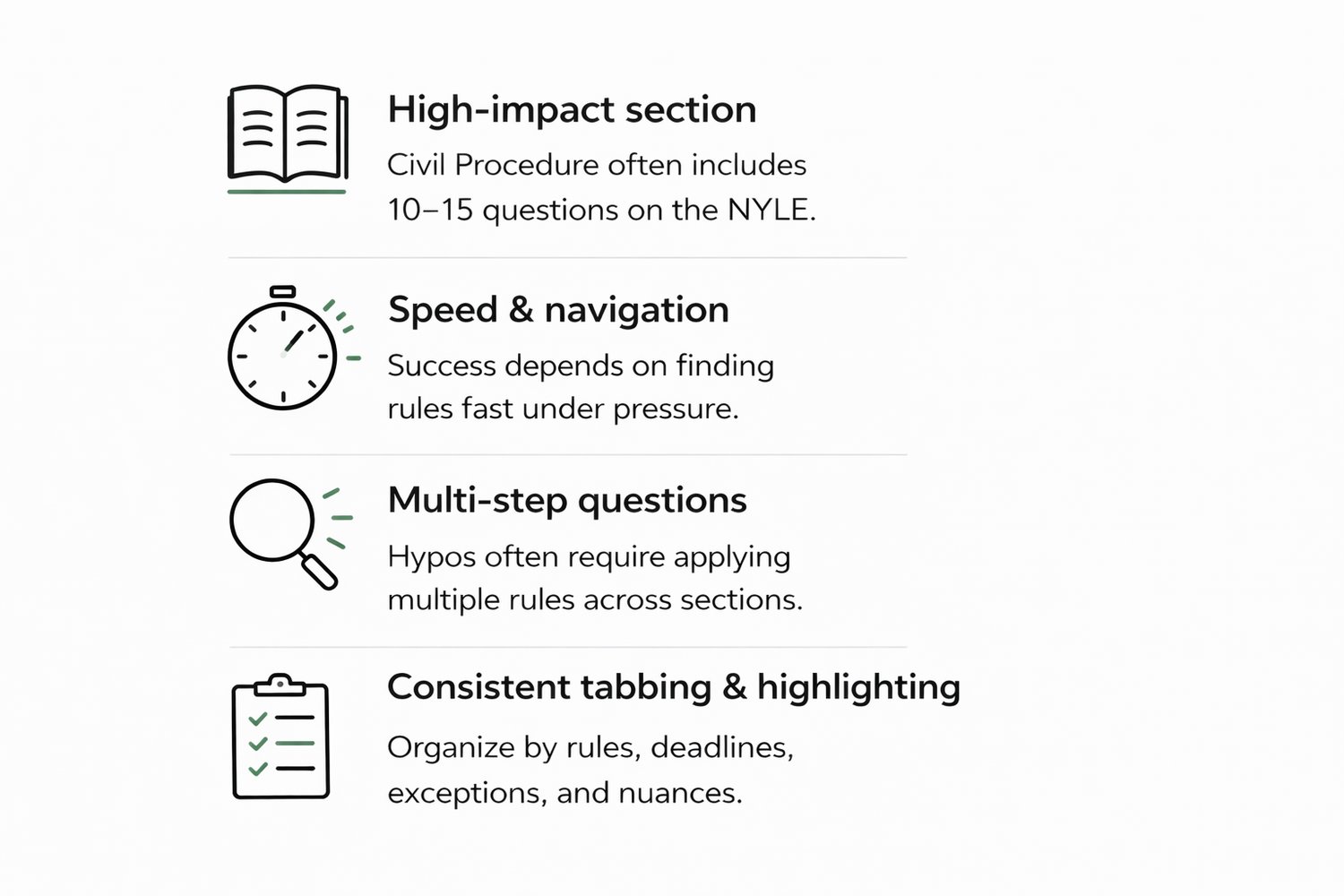
Test-taker reports suggest that Civ Pro can account for 10–15 questions on the exam (and you only need 30 correct to pass).
More importantly, the questions tend to be:
- Rule-specific (deadlines, jurisdiction, service requirements)
- Detail-sensitive (small distinctions change outcomes)
- Time-intensive (hard to locate quickly under pressure)
The Real Challenge: Navigation, Not Knowledge
Most people who struggle with Civil Procedure don’t fail because they don’t understand the material. They struggle because they can’t execute under time pressure.
The NYLE is designed to test whether you can:
- Find the right rule quickly
- Apply it to a fact pattern
- Move on without losing time
Civil Procedure makes this harder because:
- Questions often require multiple steps
- You may need to jump between sections of the outline
- Answer choices hinge on subtle procedural distinctions
This is why relying purely on “lookup during the exam” is risky.
Why the “Open-Book” Strategy Often Fails
A common assumption is that you can simply search the outline during the exam and still perform well.
While that is sometimes true, in practice:
- Questions are not always word-for-word from the outline
- You often need to synthesize rules across sections
- Time pressure makes excessive lookup impractical
How to Nail the Civil Procedure Section:
1. Read the Outline at Least Once
Even for an open-book exam, familiarity is essential.
Reading the Civil Procedure outline at least once helps you:
- Understand where rules are located
- Recognize patterns in questions
- Avoid wasting time searching blindly
2. Use a Functional Tabbing System
Basic tabbing is not enough.
The goal is not just organization—it’s speed under pressure.
We recommend tabbing based on how you’ll actually use the outline during the exam. A practical approach is to follow the main NYLE outline structure:
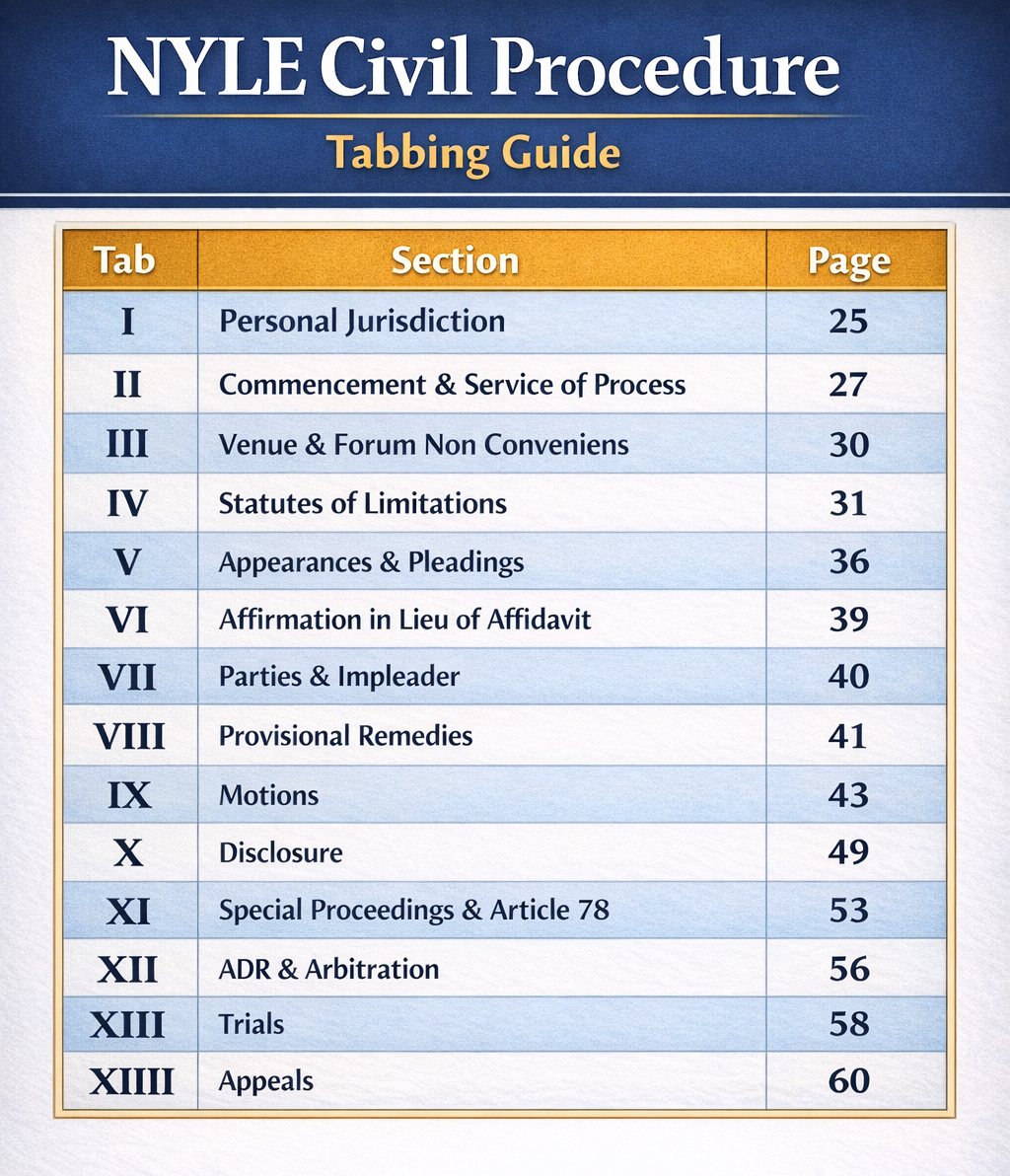
This reduces search time and improves accuracy.
We also recommend highlighting using a consistent system:
- One color for rules
- One for deadlines
- One for exceptions
- One for differences between New York and federal law
3. Practice with NYLE-Style Questions
This is the most important step.
Civil Procedure questions on the NYLE often:
- Combine multiple rules in a single hypo
- Include answer choices that are all plausible
- Test exceptions and edge cases
Practicing helps you build:
- Speed
- Pattern recognition
- Confidence under time pressure
👉 If you want to train specifically for this, you can try our NYLE Civil Procedure practice questions.
4. Expect More Complex Questions Than You Think
Many test-takers underestimate the level of difficulty.
Civil Procedure questions often:
- Include distracting facts
- Require multiple steps of reasoning
- Test small but decisive distinctions
Preparing for this upfront gives you a significant advantage.
Final Takeaway
Civil Procedure is one of the most testable—and most controllable—sections on the NYLE.
Success comes down to:
- Efficient navigation of the outline (through a strong tabbing system)
- Familiarity with structure and rules
- Most importantly: practice with realistic question formats
If you prepare strategically, Civil Procedure can become a reliable source of points rather than a liability.
Comments ()