

An AI agent just completed 104 real-world penetration testing scenarios in 28 minutes. A seasoned human pentester took 40 hours to do the same work.
That's not a typo. That's an 85x speed advantage — and it's happening right now, in production, against hardened targets belonging to companies like Amazon, Disney, and PayPal.
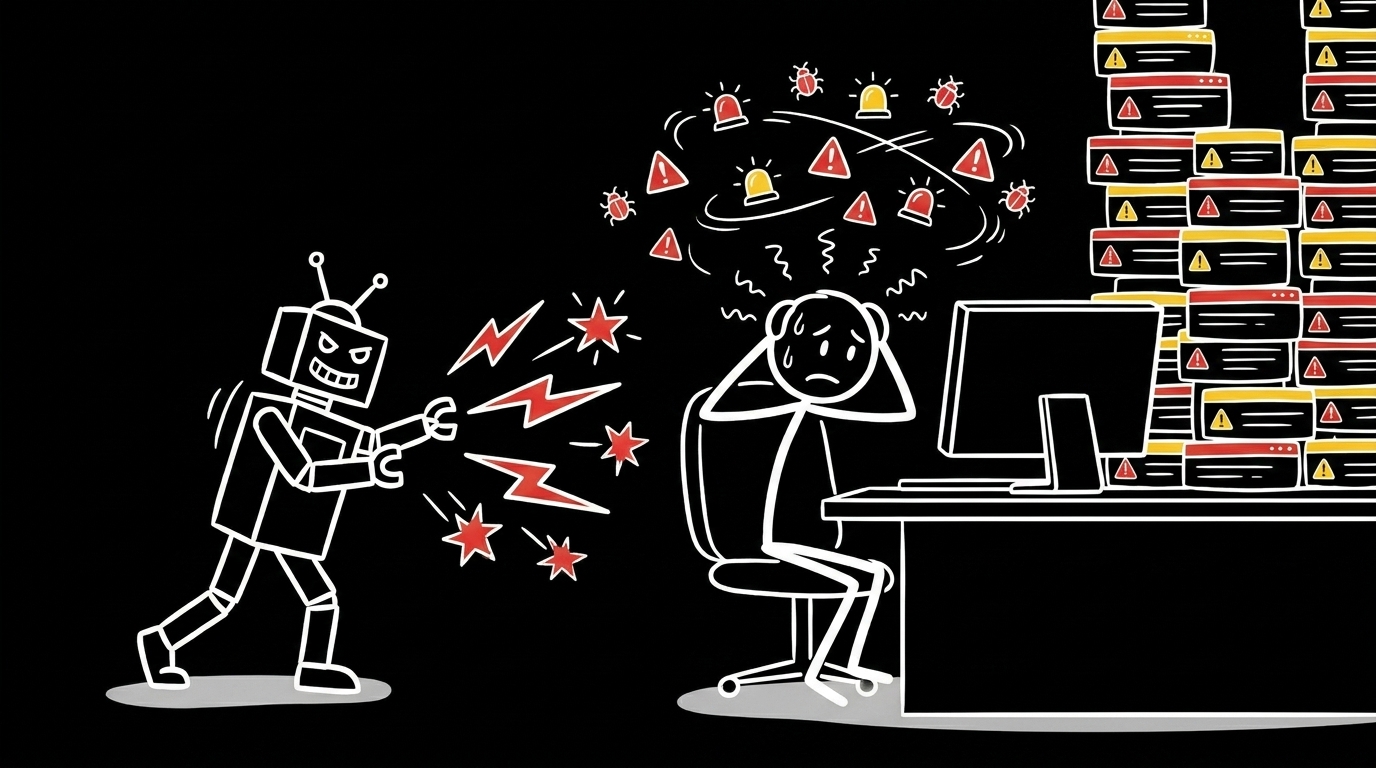
Meanwhile, on the defensive side, your SOC L1 analyst is staring at dashboard alert #3,832 for the day, clicking "dismiss" on the same false positive they've already seen a hundred times this week. Somewhere in that avalanche of noise, a real threat is hiding. And the analyst — exhausted, desensitized, and overwhelmed, is about to miss it.
This is the reality of cybersecurity in 2026: offense has been automated at machine speed, but defense is still running on human stamina. The gap between these two is no longer a staffing problem. It's a structural impossibility.
In this post, I'll break down exactly why SOC L1 analysts can no longer handle alerts manually, what AI-powered offensive tools have changed about the threat landscape, and what the path forward looks like for security teams that want to survive.
The Offense Has Gone Autonomous And It Doesn't Sleep
Let's start with what's actually happening on the attacker's side, because this is what makes the SOC L1 crisis existential rather than incremental.
In June 2025, XBOW — an autonomous AI-powered penetration testing platform — reached the #1 spot on HackerOne's global leaderboard. For the first time in bug bounty history, an AI outperformed every human hacker on the platform. Not in a controlled lab. Not in a CTF challenge. In live, production environments, against real targets.
And XBOW isn't alone. As of April 2026, there are over 39 open-source AI pentesting agent projects spanning six different architecture patterns. Tools like NodeZero can achieve full Domain Admin access in under 77 seconds. ARTEMIS — an autonomous pentesting system tested in December 2025 — outperformed 9 out of 10 human pentesters on a live 8,000-host enterprise network, at a cost of $18 per hour.
Here's where it gets worse for defenders: these tools don't just find known vulnerabilities. They reason about application behavior, identify logical flaws, and chain low-severity findings into high-impact exploit paths that simulate exactly how a real attacker would operate. They do this 24 hours a day, 7 days a week, across hundreds or thousands of targets simultaneously.
The offensive playbook has fundamentally changed. Attackers — whether they're nation-states, criminal groups, or automated agents — now operate at a speed and scale that no human analyst can match by staring at a SIEM dashboard.
The Math That Breaks Every SOC L1 Team
Now flip to the defensive side. Here's the arithmetic that makes the current model unsustainable.
Organizations face an average of 960 security alerts per day. Enterprises with more than 20,000 employees see north of 3,000 daily. A mid-size enterprise with 12 analysts receiving 3,000–5,000 alerts daily would need those analysts to collectively put in 500 hours per day just to spend 10 minutes on each alert.
That's physically impossible. There are only 288 analyst-hours available per day in a 24/7 shift rotation with 12 people.
But the volume problem compounds with a quality problem. False positive rates in enterprise SOCs frequently exceed 50%, with some organizations reporting rates as high as 80%. Analysts spend roughly 27% of their time chasing alerts that lead absolutely nowhere. When 4 out of 5 alerts are noise, the human brain does what human brains do — it starts tuning them out.
This isn't laziness. It's neuroscience. Alert fatigue is a documented cognitive phenomenon where prolonged exposure to high-volume, low-signal stimuli desensitizes the operator. The same mechanism that makes you stop hearing a ticking clock eventually makes a SOC analyst stop truly seeing the 3,000th alert of their shift.
The result? According to multiple industry reports, 44% of all alerts go uninvestigated. Not triaged incorrectly — literally never looked at. Nearly half of the signals your security infrastructure generates are hitting a void.
71% Burnout Rate: The Human Cost Nobody's Solving With Hiring
The toll on the people behind the dashboards is staggering.
A study by Tines found that 71% of SOC analysts report feeling burned out on the job. Two-thirds of cybersecurity professionals reported experiencing burnout broadly, and more than 60% said it directly contributed to staff turnover.
And that turnover is accelerating. 70% of SOC analysts with five or fewer years of experience leave within three years. Average analyst tenure at some SOCs has shrunk to less than 18 months. One-third of cybersecurity professionals are actively considering leaving their jobs entirely due to stress.
Think about what that means operationally. Every time a seasoned L1 analyst walks out the door, they take institutional knowledge with them — the contextual understanding of what's normal in your environment, which alerts are business-justified, which log patterns matter, which escalation paths actually work. That knowledge takes months to rebuild. And during that rebuilding period, your SOC is running with a blind spot that attackers are quick to exploit.
Here's the cruel irony: organizations try to solve this problem by hiring more analysts. But you can't hire your way out of a structural mismatch. If each analyst can realistically process 50-80 meaningful alerts per shift, and you're generating 3,000+, you'd need a team of 40+ L1 analysts working around the clock just to achieve basic coverage. At $70K-90K per analyst fully loaded, that's over $3 million annually — for an L1 team that's still drowning.
The problem isn't the number of people. The problem is asking humans to do machine work.
Why AI-Powered Attacks Make the L1 Model Structurally Obsolete
Traditional SOC design assumed a world where attacks were largely manual, happened at human speed, and followed recognizable patterns. In that world, an L1 analyst could reasonably scan alerts, match them against known signatures, and escalate anything suspicious.
That world no longer exists.
AI pentesting agents don't follow playbooks. They adapt in real time. They chain multiple low-severity vulnerabilities into critical exploit paths that no single alert would flag. They operate across email, endpoint, cloud, and identity simultaneously — pivoting between attack surfaces faster than any human can context-switch between the SIEM, the EDR console, the firewall logs, and the ticketing system.
Consider a concrete scenario. An AI-powered offensive agent identifies a misconfigured API endpoint. On its own, this might generate a low-priority alert. The agent then discovers a weak credential on an adjacent service — another low-priority alert. It chains these together with a privilege escalation path through an unpatched internal system. The final compromise happens in under four minutes.
Your L1 analyst sees three separate low-severity alerts, potentially spread across three different tools. Each one, in isolation, looks like noise. The analyst dismisses two of them, flags one for review tomorrow, and moves on to the next screen. By tomorrow, the attacker — or the AI agent simulating one — has already exfiltrated data.
The L1 model breaks because it assumes threats arrive as discrete, classifiable events. Modern AI-powered attacks arrive as coordinated sequences of individually benign-looking activities that only reveal their malicious intent when correlated across time, tools, and context. No human can do that correlation at the speed and scale required.
The Tool Fragmentation Problem That Multiplies Everything
The alert volume problem doesn't exist in isolation. It's amplified by a fragmentation problem that most SOCs have created unintentionally.
Modern organizations deploy an average of 28 security monitoring tools, each producing its own alert stream. Without proper correlation and deduplication, analysts receive duplicate alerts for the same event across multiple platforms. Every investigation requires constant context-switching between the SIEM, endpoint tools, firewalls, threat intelligence feeds, and ticketing systems.
A European SOC practitioner survey from early 2026 found that when analysts ranked their top operational challenges, high alert volume actually came in fourth. What ranked above it? Tool fragmentation and context switching came first. Too many false positives came second. Insufficient automation came third.
The problem, in other words, isn't just the number of alerts. It's the workflow required to deal with them. An L1 analyst spending 10 minutes on an alert isn't spending 10 minutes investigating a threat. They're spending 3 minutes switching between tools, 4 minutes looking up context that should have been automatically enriched, 2 minutes documenting in the ticketing system, and 1 minute actually assessing the alert.
Now multiply that workflow by 250+ alerts per shift, and you understand why analysts describe the experience as "drowning."
What AI-Augmented Defense Actually Looks Like
The solution isn't to replace L1 analysts with AI. It's to stop asking them to do the work that AI should be handling so they can focus on what humans actually excel at.
Here's what an AI-augmented SOC workflow looks like in practice:
Automated triage and enrichment. Every alert gets automatically correlated with threat intelligence, asset context, user behavior baselines, and historical patterns — before a human ever sees it. Related events get clustered into unified incidents. A sequence of failed authentication attempts followed by a successful login and privilege escalation doesn't arrive as three separate alerts. It arrives as one enriched case with full context.
- Intelligent prioritization. Instead of a flat queue of thousands of alerts, the analyst sees a ranked list of 5-15 high-confidence incidents that the AI has pre-investigated. Each one comes with a recommendation, supporting evidence, and a confidence score. The analyst's job shifts from "scan everything" to "validate the AI's judgment on the cases that matter."
- Automated response for known patterns. For well-understood alert types with established response procedures — the same false positives that eat 27% of analyst time — the AI executes the initial triage automatically. Blocked IP, quarantined file, disabled account. No human needed for the 80% of alerts that have a known, repeatable resolution.
- Human focus on complex investigation. The analyst now spends their time on what humans are genuinely better at: understanding business context, making nuanced judgment calls about ambiguous situations, communicating with stakeholders, and investigating novel attack patterns that the AI hasn't seen before.
Organizations implementing this model report going from investigating 40-60% of alerts to investigating 100% — while simultaneously reducing the workload on individual analysts.
The Before-and-After That Tells the Whole Story
Picture the L1 analyst's day under the old model. It's 9:00 AM. They log in and face hundreds of unfiltered alerts across SIEM and EDR dashboards. They spend 15 minutes validating a single suspicious login, flipping between firewall logs, Active Directory, and the ticketing system. After three hours, they've closed 12 false positives. Zero real threat investigation done. By hour six, alert fatigue has set in. They're making faster decisions — but less accurate ones. A genuine phishing-to-lateral-movement chain gets classified as low priority because it looks similar to a pattern they've been dismissing all morning.
Now picture the same analyst with AI-powered automation. It's 9:00 AM. They see 6 enriched cases, pre-prioritized by severity and confidence. Each case includes correlated events, asset context, threat intelligence matches, and a recommended action. By 10:30 AM, they've completed two deep investigations and escalated one confirmed incident to L2 with a full evidence package. The remaining three cases were resolved with one-click approval of the AI's recommended response. They spend the afternoon on a proactive threat hunt, something they haven't had time for in months.
Same analyst. Same skills. Same salary. Radically different output — because the workflow was redesigned to play to human strengths instead of grinding against human limitations.
What SOC Leaders Need to Do Right Now
If you're running a SOC that still depends on L1 analysts manually triaging an ocean of alerts, your defensive posture is structurally mismatched against the offensive tools that are already in production. Here's how to start closing the gap:
- Audit your alert-to-analyst ratio. Calculate the actual number of alerts per analyst per shift. If it exceeds 100 meaningful alerts per analyst, you have a structural problem that hiring won't solve.
- Deploy AI-powered triage as the first line, not the last. The AI handles volume. The human handles judgment. Don't implement AI as an optional add-on to existing workflows — redesign the workflow around the AI. Let the automation handle correlation, enrichment, and known-pattern response. Let your analysts investigate.
- Consolidate your tooling. Every additional tool adds to the context-switching tax. Reduce the number of independent alert streams by investing in platforms that correlate across sources natively. Your analysts shouldn't need to check five dashboards to understand one event.
- Redefine the L1 role. The traditional L1 job description — "monitor alerts and escalate" — describes a machine's job, not a human's. Redefine L1 analysts as AI-assisted investigators who validate automated findings, handle edge cases, and contribute to continuous improvement of detection logic. Give them career growth that doesn't require them to survive two years of monotonous triage first.
- Measure what matters. Stop tracking "alerts closed per shift" as a productivity metric. Start tracking mean time to detect, mean time to respond, and percentage of alerts receiving meaningful investigation. Those are the numbers that tell you whether your SOC is actually securing anything.
The Window Is Closing
AI-powered offensive tools aren't a future threat. They're a current reality. XBOW has published over 1,060 valid vulnerability submissions. NodeZero has discovered 50,000+ vulnerabilities across 1,000 defense contractors. Autonomous pentesting systems are completing comprehensive assessments in hours instead of weeks, at a fraction of the cost.
Every one of those vulnerabilities, if exploited, generates alerts that land in your SOC. The volume is only going up. The speed of attack is only going up. The complexity of exploit chains is only going up.
Your L1 analysts, no matter how talented, cannot manually process this wave. Not because they're not good enough — but because the task has exceeded human cognitive capacity. Asking them to keep trying isn't just ineffective. It's burning out the people your security depends on, creating turnover that weakens your defenses, and leaving critical threats uninvestigated.
The SOC of 2026 needs to be built around a different architecture: AI handles the volume, speed, and pattern recognition. Humans handle the judgment, context, and creative thinking. Neither works alone. Both are essential.
The question isn't whether your SOC will adopt this model. It's whether you'll do it before the next AI-generated exploit chain finds the gap your exhausted L1 analyst just missed.