


Fixed vs Floating Mortgage Rates: Quick Answer
A fixed mortgage rate remains unchanged for a predetermined period, providing payment certainty and protection against rising interest rates. A floating mortgage rate fluctuates based on market conditions and benchmark rates, potentially resulting in lower costs when rates fall but higher repayments when rates rise.
In 2026, the better option depends on your financial stability, risk tolerance, and expectations for future interest rate movements rather than simply choosing the lowest advertised rate.
What Is a Fixed Mortgage Rate?
A fixed mortgage rate locks in your interest rate for a specific period, typically ranging from 1 - 5 years.
During the fixed-rate period:
- Monthly repayments remain predictable
- Interest costs do not change
- Budgeting becomes easier
- You are protected from rate hikes
For example, if your mortgage rate is fixed at 2.50% for 3 years, your interest rate remains unchanged even if market rates increase during that period.
Advantages of Fixed Rates
- Stable monthly repayments
- Easier household budgeting
- Protection against rising interest rates
- Reduced financial uncertainty
Disadvantages of Fixed Rates
- Usually higher starting rates
- Limited benefit if market rates fall
- Early repayment penalties may apply
- Less flexibility for refinancing
What Is a Floating Mortgage Rate?
A floating mortgage rate changes according to market benchmarks and the lender's pricing structure.
As interest rates move, your mortgage repayments may increase or decrease.
Floating-rate mortgages often track:
- Internal board rates
- Deposit rates
- Reference rates
- Other market-linked benchmarks
Advantages of Floating Rates
- Potentially lower initial rates
- Benefit from falling interest rates
- Greater refinancing flexibility
- Often lower lock-in restrictions
Disadvantages of Floating Rates
- Repayment amounts can increase unexpectedly
- Harder to budget long term
- Higher exposure to economic changes
- Greater financial uncertainty
Fixed vs Floating Mortgage Rates: Key Differences
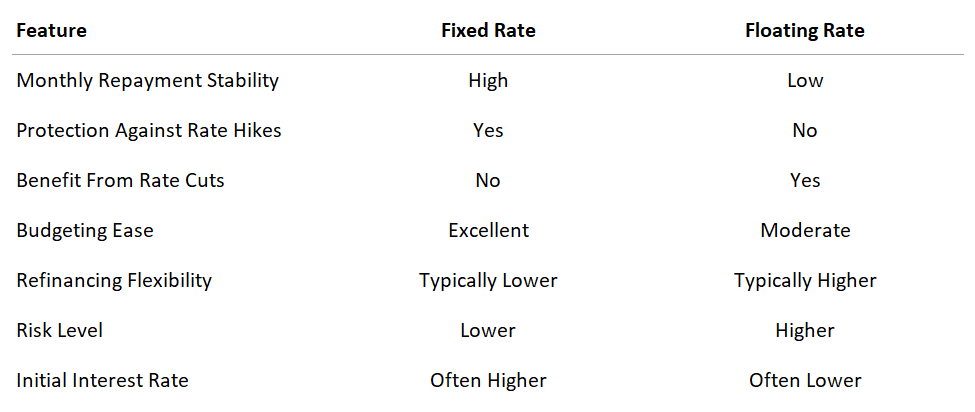
Key takeaway:
Fixed-rate mortgages provide repayment certainty and protection against rising interest rates. Floating-rate mortgages offer greater flexibility and may be cheaper when rates fall, but expose borrowers to repayment fluctuations.
Why Most Home Buyers Choose the Wrong Mortgage Package
Many borrowers focus only on the advertised interest rate.
This is one of the most expensive mistakes in mortgage planning.
A mortgage package should be evaluated using:
- Monthly repayment affordability
- Total interest cost
- Lock-in periods
- Refinancing flexibility
- Future interest rate risks
- Cash flow resilience
The package with the lowest rate today is not always the cheapest option over the next 2 - 5 years.
When a Fixed Mortgage Rate Makes Sense
A fixed-rate mortgage may be suitable if:
You Prefer Predictability
If knowing your exact monthly repayment helps you manage household finances, fixed rates offer certainty.
You Have Tight Cash Flow
Families with limited financial buffers may benefit from protection against sudden repayment increases.
You Expect Rates to Rise
Locking in a fixed rate can provide peace of mind if market interest rates increase.
You Are a First-Time Home Buyer
Many first-time buyers value payment stability over potential savings from rate fluctuations.
When a Floating Mortgage Rate Makes Sense
A floating-rate mortgage may be suitable if:
You Expect Rates to Fall
Floating packages benefit directly from lower interest rates.
You Have Strong Cash Reserves
Borrowers with healthy emergency funds can better absorb temporary increases in repayments.
You Plan to Refinance Soon
Floating packages often provide greater flexibility and fewer penalties.
You Are Comfortable With Risk
If short-term fluctuations do not affect your financial goals, floating rates may offer cost advantages.
Example: Fixed vs Floating Mortgage Comparison
Assume:
- Loan Amount: $800,000
- Loan Tenure: 25 Years
Fixed Package
- Interest Rate: 2.60%
- Fixed for 3 Years
Floating Package
- Initial Interest Rate: 2.30%
At first glance, the floating package appears cheaper.
However, if market rates increase by 1% within the next 2 years, the floating package could ultimately cost significantly more than the fixed-rate alternative.
This demonstrates why comparing only today's interest rates can be misleading.
The Mortgage Decision Framework Used by Experienced Borrowers
Instead of asking:
"Which package has the lowest interest rate?"
Ask:
"Which package offers the best balance of cost, flexibility, and risk?"
Use this 5-step framework.
Step 1: Calculate Monthly Repayments
Understand your affordability under different rate scenarios.
Step 2: Compare Total Interest Costs
Look beyond promotional rates.
Step 3: Assess Lock-In Restrictions
Review penalties for refinancing or selling your property.
Step 4: Stress-Test Future Rates
Determine whether you can comfortably afford repayments if rates rise.
Step 5: Compare Flexibility
Evaluate future refinancing opportunities and exit options.
This approach provides a more accurate assessment than comparing interest rates alone.
Fixed vs Floating Mortgage Rates: Which Is Better in 2026?
There is no universal winner.
Fixed Rates May Be Better If:
- You prioritize certainty
- You have a strict monthly budget
- You expect interest rates to rise
- You want predictable repayments
Floating Rates May Be Better If:
- You expect rates to decline
- You value flexibility
- You can tolerate repayment fluctuations
- You plan to refinance in the near future
The best mortgage package is the one that aligns with your financial situation, risk tolerance, and future plans.
Frequently Asked Questions
Is a fixed mortgage rate safer?
Generally, yes. Fixed rates provide protection against rising interest rates and make monthly repayments predictable.
Are floating rates always cheaper?
No. While floating rates may start lower, future rate increases can result in higher overall borrowing costs.
Can I switch from fixed to floating later?
In many cases, yes. However, switching during a lock-in period may trigger penalties.
What is the biggest mistake when comparing mortgages?
Focusing solely on the advertised interest rate without considering total costs, flexibility, and future rate risks.
Should first-time home buyers choose fixed rates?
Many first-time buyers prefer fixed rates due to repayment stability, though the best option depends on individual circumstances.
Final Verdict
Choosing between a fixed and floating mortgage rate is ultimately a risk-management decision rather than an interest-rate decision.
Fixed rates provide certainty and protection. Floating rates offer flexibility and potential savings.
Before committing to any mortgage package, compare not only the interest rate but also the total interest cost, repayment affordability, lock-in conditions, and refinancing opportunities.
A structured mortgage comparison process can potentially save thousands of dollars over the life of a home loan.
Mortgage Comparison Model
Want to compare mortgage packages like a professional?
Use our Mortgage Comparison Model to evaluate:
- Monthly repayments
- Total interest costs
- Lock-in periods
- Refinancing opportunities
- Side-by-side package comparisons
Make your mortgage decision based on data rather than marketing rates.