
Your First Digital Product Idea May Already Be Sitting Between Your Ears
Ask someone what they know well enough to teach and you'll often hear:
"Nothing anyone would pay for."
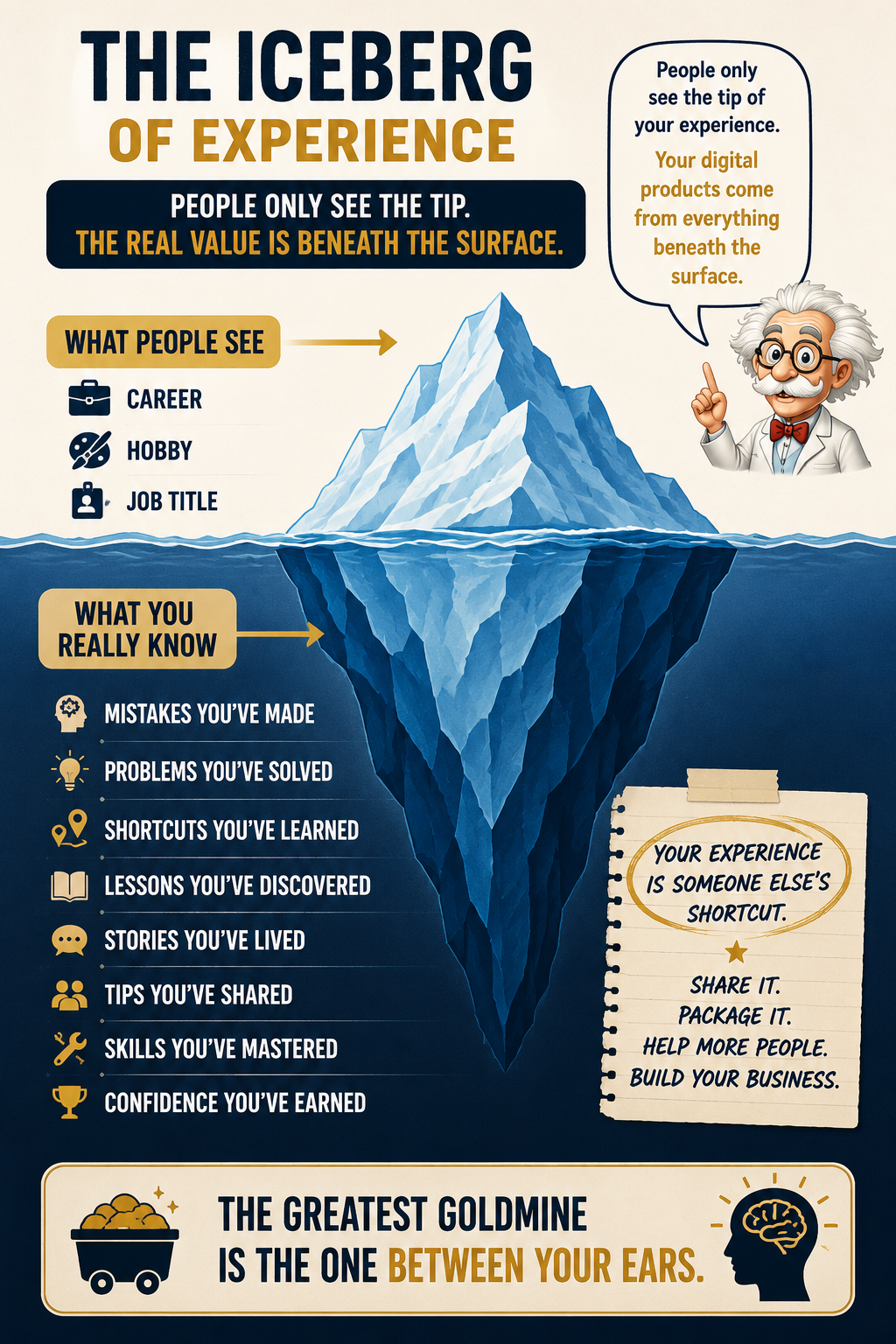
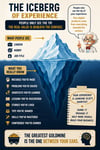
I'm willing to bet that's probably wrong because as you already know, by the time you've reached your 50s, 60s or beyond, you've accumulated decades of knowledge.
Some came from your career.
Some came from hobbies.
Some came from raising a family, managing a household, travelling, volunteering or running a business.
And plenty came from doing things the wrong way the first time and that gave you eperience and knowledge.
The problem is that the knowledge you've had for years doesn't feel particularly valuable to you anymore.
It's just something you know.
But to someone encountering that problem for the first time?
It could be exactly the shortcut they've been searching for... and it could be your goldmine!
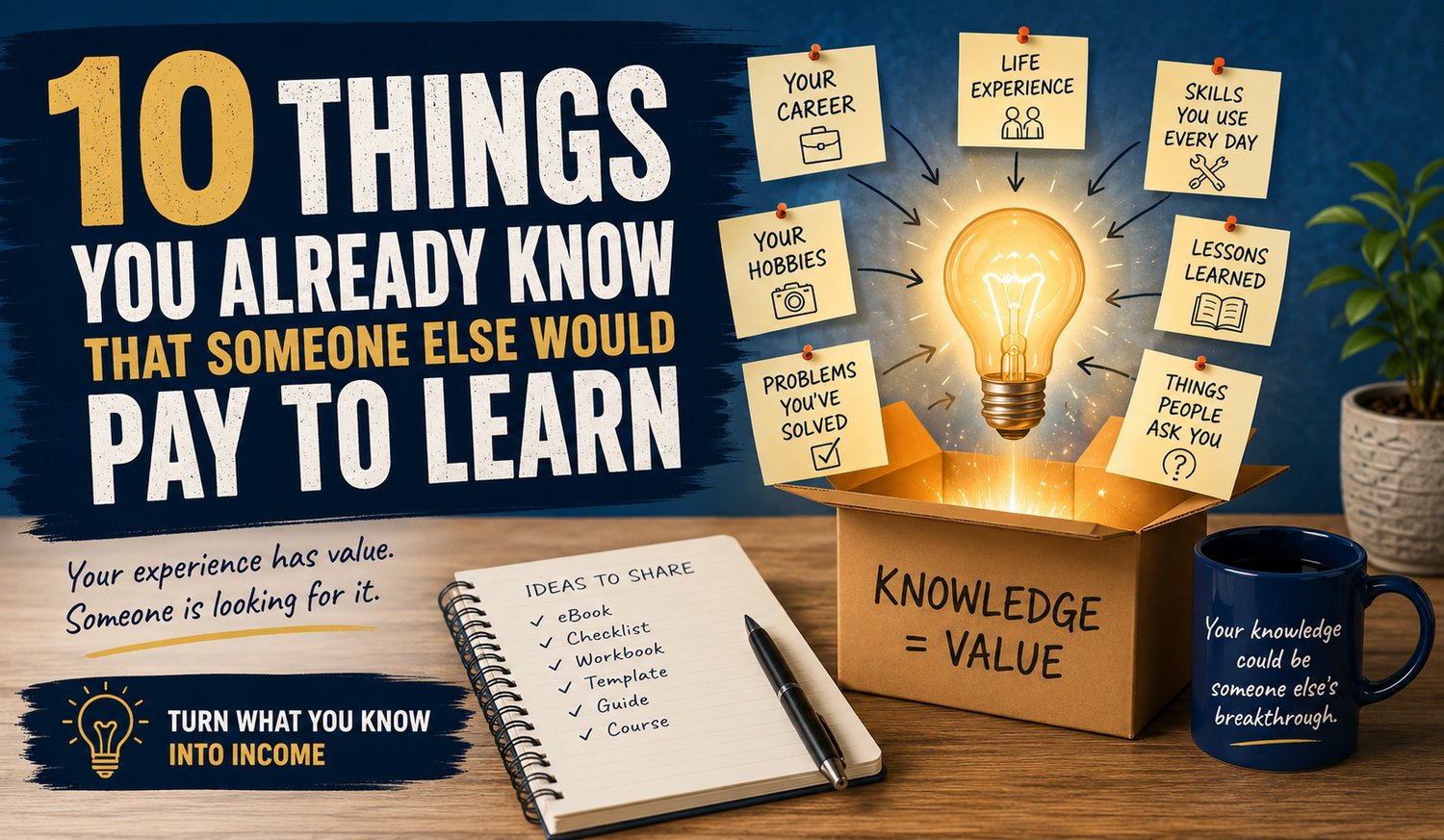
Here are ten places your first digital product idea might already be hiding.
1. What You Did for a Living
Think about your career.
What could you teach someone who started your old job tomorrow?
You don't need to write the definitive textbook on your profession.
Perhaps you could teach one useful part of it:
- A retired salesperson might create a guide to handling difficult customers.
- A bookkeeper might create a simple small-business record-keeping checklist.
- A tradesperson might create a beginner's buying guide for tools.
Your old job may be behind you.
Your knowledge isn't.
2. Your Favourite Hobby
This is one of my favourites because we routinely underestimate how much we know about things we enjoy.
- Fishing.
- Gardening.
- Photography.
- Woodworking.
- Knitting.
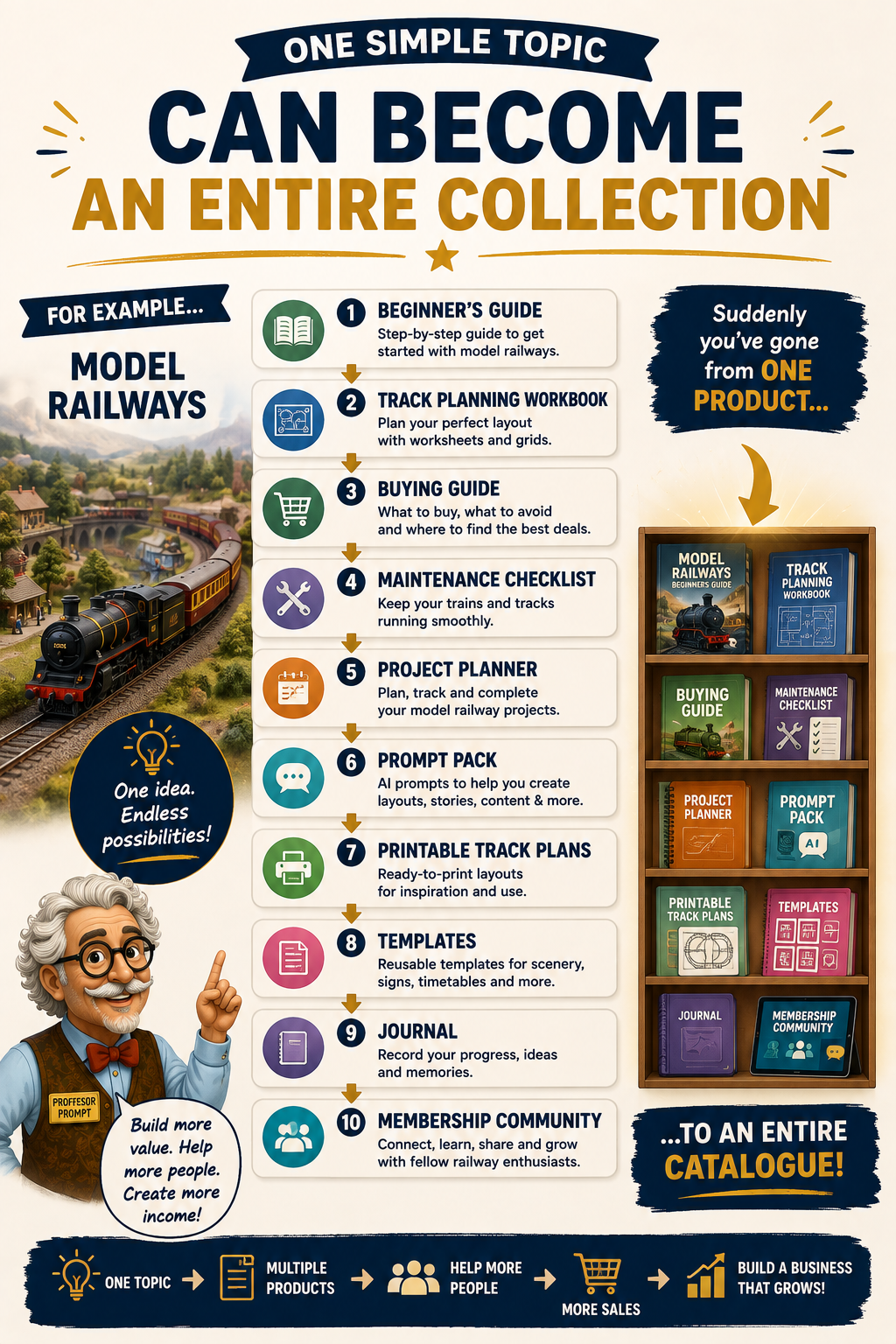
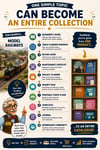
- Model railways.
- Family history.
- Cooking.
You've probably spent years learning little tricks that a beginner hasn't discovered yet.
You can turn the hobby you'd happily talk about for hours into an eBook, checklist, workbook or beginner's guide.
"You don't have to be the world's greatest gardener.
You just need to know more than the person planting their first tomato."
3. A Problem You've Already Solved
Think about something that once frustrated you.
Maybe you learned how to organise thousands of family photographs.
Perhaps you figured out how to travel cheaply.
Maybe you restored an old caravan, downsized your home or finally worked out a simple way to organise household paperwork.
Other people are struggling with those same problems right now.
Whatever your experience you can package the solution that took you months to discover into a simple guide someone else can follow in an afternoon.
That's valuable.
You're not selling information.
You're helping someone avoid the frustration you went through.
4. Something People Always Ask You About
What do friends or family regularly ask you to help with?
- "How did you do that?"
- "Which one should I buy?"
- "Can you show me how?"
Pay attention to those questions.
They're clues.
If people repeatedly ask for your advice about vegetable gardens, photography, computers, travel, budgeting or anything else, there's probably demand for that knowledge beyond your immediate circle.
5. Something You Learned the Hard Way
Mistakes are surprisingly valuable... Why?
Because beginners desperately want to avoid them and we are repeatedly told that making mistakes are a bad thing, when in reality a mistake can be an opportunity to learn and teach others how to avoid that mistake.
Imagine you've owned caravans for 25 years and know the expensive mistakes first-time buyers make.
There's a product!!
17 Mistakes to Avoid When Buying Your First Caravan.
Or perhaps you've renovated several houses:
The First-Time Renovator's Checklist: What I Wish I'd Known Before We Started.
Turn your expensive mistakes into inexpensive lessons for someone else.
Sometimes the things that went wrong teach us far more than the things that went right.
6. Something You Can Do Faster Than Most People
We all have tasks that seem obvious because we've done them hundreds of times.
Maybe you can prepare a professional quote in ten minutes.
Perhaps you can plan a week's meals without thinking about it.
Maybe you can organise a holiday itinerary, sharpen woodworking tools or set up a campsite while everyone else is still arguing with the tent poles.
That's experience at work.
Take something that now takes you 20 minutes and teach a beginner how to avoid spending three hours figuring it out.
7. Something You've Researched for Years
You don't necessarily need professional qualifications to develop deep knowledge.
Some people spend decades researching family history.
Others know everything about vintage cars, orchids, local history, military memorabilia, fishing spots or restoring old furniture.
If you've been enthusiastically researching something for years, you've already done work a beginner hasn't.
Turn years of scattered research into one organised resource that gives a beginner somewhere sensible to start...AI can be particularly useful here because it can help you organise your notes and knowledge into a logical structure.
8. Something You Created for Yourself
Have you ever made your own:
- Checklist?
- Spreadsheet?
- Planner?
- Worksheet?
- Template?
- Reference sheet?
If you created something because you couldn't find exactly what you needed, other people may have the same problem.
That homemade travel checklist you've been using for ten years could become a downloadable travel planner.
Your garden planting spreadsheet could become a seasonal garden planner.
Turn the little tool you created to make your own life easier into something that saves somebody else time too.
9. Something You've Successfully Taught Someone Else
Think back over the years.
Have you taught someone to:
- Cook?
- Drive?
- Use a camera?
- Build something?
- Start a garden?
- Use software?
- Manage money?
- Research their family tree?
If you've successfully helped one beginner understand something, you already have evidence that your knowledge can be taught.
Take the explanation that worked for one person and turn it into a step-by-step guide that can help hundreds.
That's one of the wonderful things about digital products.
You create them once.
The same product can then help people you've never met!
10. What You Wish Someone Had Taught You
This might be the most powerful question of all.
Think back to when you were starting something new.
- What guide do you wish you'd had?
- What would have saved you time?
- What would have saved you money?
- What would have stopped you making those embarrassing beginner mistakes?
There's your clue.
Create the guide you wish somebody had handed you when you were starting out.
You already understand the beginner's frustration because you were once that beginner yourself.
And that makes you particularly well qualified to help the next person.
You Don't Need to Be an Expert
This is where many people get stuck.
They think:
"Who am I to teach this?"... but in reality...
- You don't need to know everything.
- You don't need a television show.
- You don't need 100,000 followers.
And you don't need to call yourself a guru.
You simply need useful knowledge that can help someone a few steps behind you.
AI has made the next part easier than ever.
It can help you organise your knowledge, develop an outline, create a first draft, improve your writing, generate ideas and turn one subject into multiple potential products.
But the valuable ingredient still comes from you:
Your experience.
Try This Simple Challenge
Grab a piece of paper and write:
50 Things I Know
Then start listing them.
- Don't judge the ideas.
- Don't worry whether anyone would buy them.
- Just write.
Include jobs you've done, hobbies you've enjoyed, problems you've solved, things you've built, places you've travelled and skills people ask you about.
You may be surprised by what appears on that page.
Somewhere among those 50 things could be your first eBook, checklist, workbook, template, planner or digital guide.
Ready to Turn What You Know Into Something You Can Sell?
Recognising that your experience has value is the first step.
The next is learning how to package that knowledge into something another person can actually use.
How to Turn What You Already Know Into Ca$H takes you through that process step-by-step—from discovering what you could create and choosing a niche to using AI, creating your product, selling through Payhip and turning one good idea into an entire range of possibilities.
You've already spent decades collecting the raw material.
Now it's time to do something with it.