
Somewhere in Your Lifetime of Experience Could Be a Product Someone Needs
Here's a question:
What do you know?
It sounds simple.
But ask most people to write down everything they know well enough to teach someone else and something strange happens.
Their mind goes blank.
- "I don't know anything special."
- "Nobody would pay for what I know."
- "I'm certainly not an expert."
I hear variations of these all the time.
The problem isn't that you don't know enough.
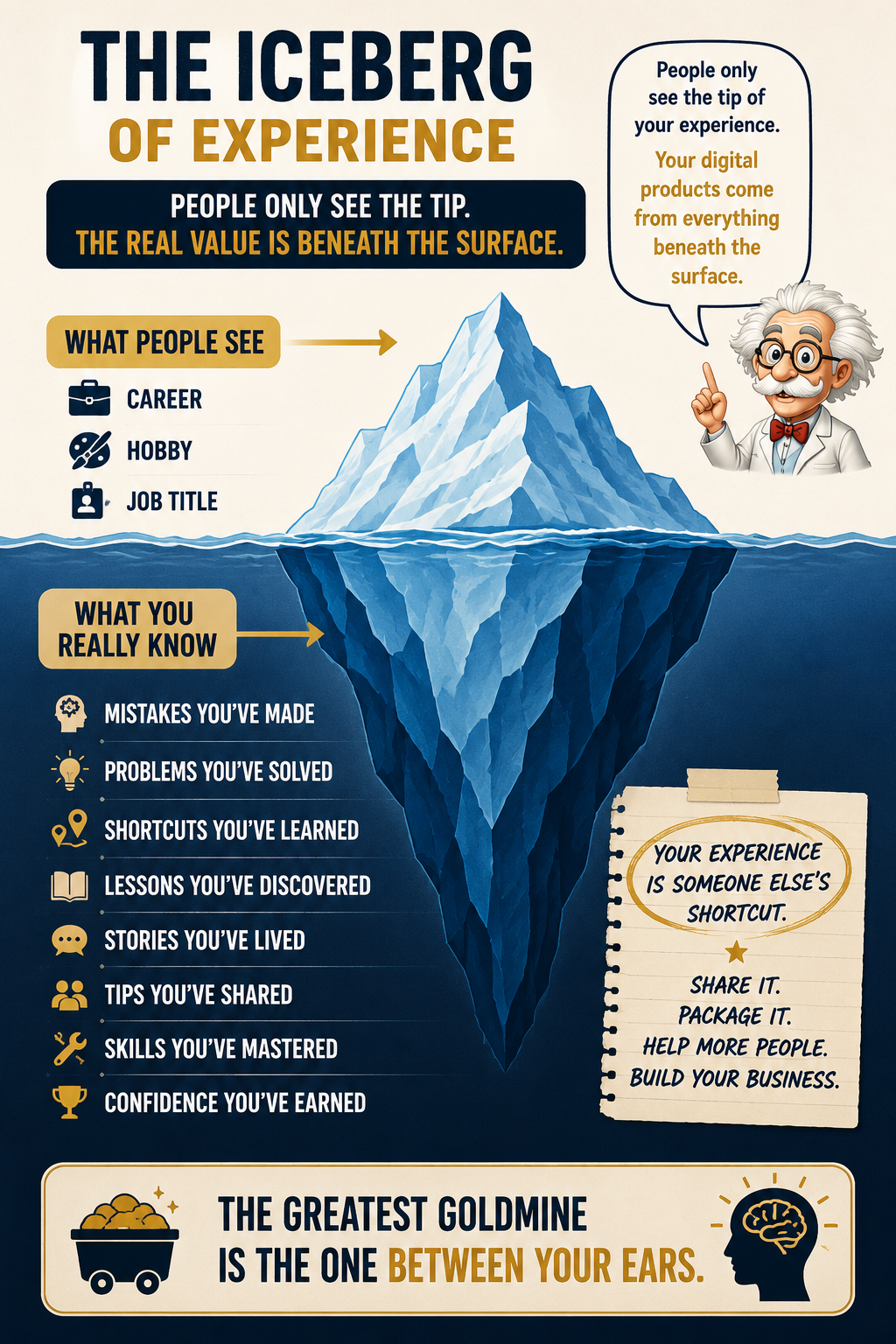
The problem is that you've known many of these things for so long that you've forgotten what it was like not to know them.
That's what today's challenge is designed to uncover.
Grab a piece of paper, open a Word document or start a fresh note on your computer.
At the top write:
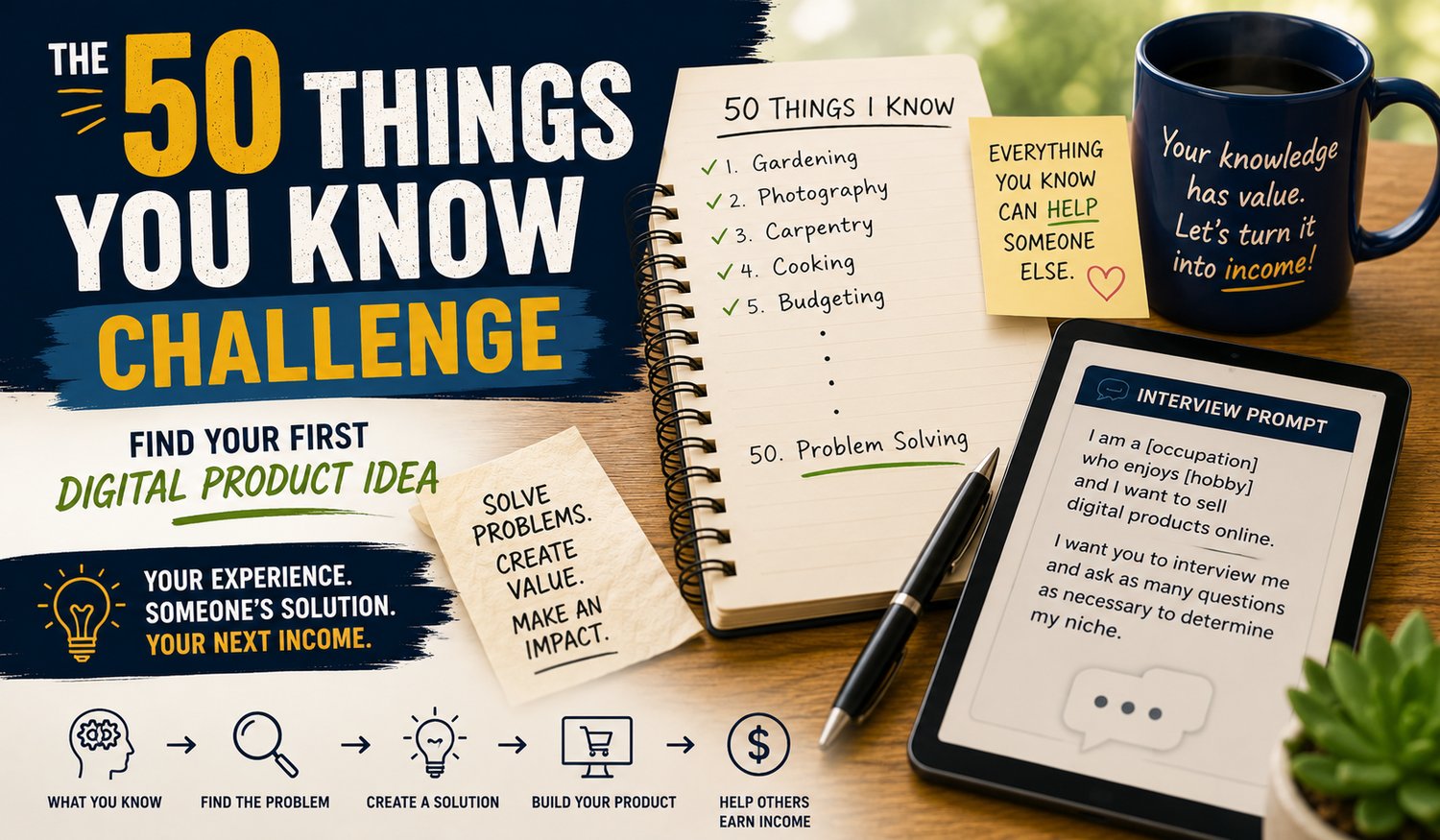
50 THINGS I KNOW
Now we're going digging.
Don't Look for Business Ideas Just Yet
This is important.
Don't start by asking:
"What digital product could I sell?" That's putting the cart before the horse.
- For now, forget products.
- Forget prices.
- Forget Payhip.
- Forget whether anybody would buy anything.
Your only job is to uncover the knowledge, experience and skills you've accumulated over your lifetime.
Think about:
- Jobs you've had
- Trades you've learned
- Hobbies you've enjoyed
- Things you've built
- Places you've travelled
- Problems you've solved
- Things you've repaired
- Subjects you've researched
- Skills you've taught other people
- Mistakes you've learned from
- Things friends ask your advice about
- Everyday tasks you've become good at
Write everything down.
Nothing is too ordinary at this stage.
Start With Your Career
If you've worked for 30 or 40 years, there's an enormous amount of knowledge hiding here.
Don't just write:
"I was a printer."
Break it down.
Perhaps you know about typography, colour, page layout, estimating jobs, dealing with customers, preparing artwork, checking proofs, operating equipment or spotting mistakes before something goes to print.
One occupation could easily give you ten or twenty entries.
Do the same with every job you've had.
Ask yourself:
What did I know at the end of that job that I didn't know on my first day? There's your knowledgebase.
Now Look at Your Hobbies
What have you willingly spent hundreds—or perhaps thousands—of hours learning simply because you enjoy it?
- Gardening?
- Fishing?
- Photography?
- Woodworking?
- Knitting?
- Cooking?
- Family history?
- Car restoration?
- Model railways?
- Travelling?
Don't dismiss hobbies because they aren't your profession.
Someone buying their first fishing rod doesn't necessarily want advice from the world champion. They want to know how to bait a hook and how to tie knots.
They might prefer straightforward help from someone who's been fishing every weekend for 25 years and remembers what beginners actually struggle with.
The hobby you've enjoyed for decades could contain the shortcut a beginner is searching for today so put it on the list.
Your Problems May Be More Valuable Than Your Skills
Digital products work particularly well when they solve problems.
People rarely wake up thinking:
"I desperately need another 37-page PDF."
They think:
- "How do I fix this?"
- "Which one should I buy?"
- "Where do I start?"
- "How can I do this faster?"
- "How do I avoid making an expensive mistake?"
That's what they're really buying.
A solution.
So think about problems you've already solved.
Perhaps you've:
- Organised decades of family photographs.
- Learned how to grow vegetables in terrible soil.
- Restored an old caravan.
- Changed careers after 50.
- Researched your family tree.
- Learned how to use Canva.
- Planned an overseas holiday on a tight budget.
- Built your own garden shed.
- Mastered sourdough bread.
- Worked out how to use AI without wanting to throw the computer through a window. 😂😂
Each solved problem potentially represents someone else's current problem.
Turn a problem that took you months to solve into a shortcut someone else can follow in an afternoon.
That's where knowledge starts becoming valuable.
Look for Expensive Mistakes
Here's another category for your list.
What have you learned the hard way?
Maybe you bought the wrong equipment.
Chose the wrong materials.
Booked the wrong accommodation.
Planted something at the wrong time.
Made mistakes starting a business.
Bought a caravan that looked wonderful until you discovered what was hiding underneath it.
Those lessons have value because somebody else would quite happily avoid paying the same tuition fee to the University of Hard Knocks which is why it's important to write them down.
Your expensive mistake could become somebody else's inexpensive lesson.
What Do People Ask You?
Think about the questions you've heard repeatedly over the years.
"Can you show me how you did that?"
"Which camera should I buy?"
"How do you get your tomatoes like that?"
"Can you help me set this up?"
"What would you recommend?"
These questions are particularly valuable because somebody else has already identified you as a source of useful information. You didn't have to convince them... They came to you... Add those subjects to your list.
Keep Going Until You Reach 50
The first ten will probably be easy.
Then it gets harder.
Good.
Keep going.
The interesting ideas often appear after you've exhausted the obvious ones.
- Think about your career again.
- Your hobbies.
- Your family life.
- Volunteer work.
- Things you've taught.
- Things you've repaired.
- Things you've researched.
- Places you've visited.
- Problems you've overcome.
You are not looking for 50 brilliant business ideas.
You're creating an inventory of your experience.
And when you finally reach 50, we're going to give that inventory to AI.
Meet the Interview Prompt
Most people use AI by asking it questions.
We're going to turn that around.
We're going to ask AI to interview you.
Instead of saying:
"Give me 20 digital product ideas." give AI some background and tell it to keep asking questions until it understands what you know, what you enjoy and which problems you might be particularly well equipped to solve.
Copy this prompt into your favourite AI assistant:
The Interview Prompt
"I am a [YOUR OCCUPATION OR CAREER BACKGROUND] who enjoys [YOUR HOBBIES AND INTERESTS], and I want to explore creating and selling useful digital products online.
I want you to interview me to help identify a suitable niche and potential digital product ideas.
Ask me one question at a time and continue asking as many questions as necessary. Explore my career experience, hobbies, practical skills, interests, problems I've solved, mistakes I've learned from, subjects people ask me about and anything I've successfully taught other people.
Pay particular attention to problems I know how to solve for beginners, because I want to create products that provide practical solutions and solve problems rather than simply providing information.
When you believe you understand my experience well enough, identify 5–10 potential niches that combine my knowledge, interests and useful problems I can solve.
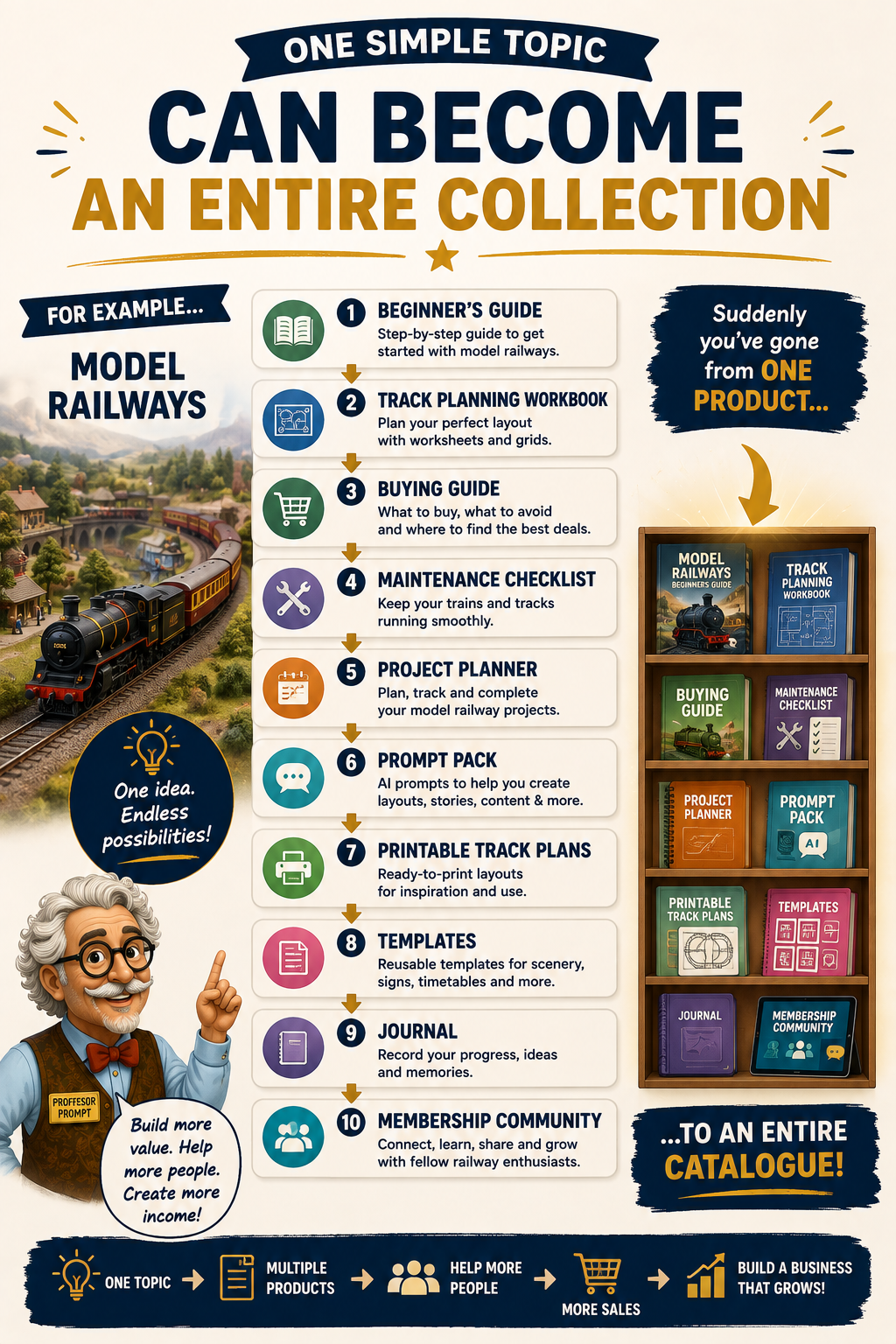
For each niche, suggest several simple digital products I could create, such as eBooks, checklists, workbooks, planners, templates, prompt packs or quick-reference guides.
Explain why each idea could be useful, who the likely customer would be and what specific problem the product would help them solve.
Don't rush to give me product ideas. Interview me thoroughly first."
Then start answering its questions.
Don't try to sound clever or use computer jargon. Just have a conversation.
You might be surprised where it leads.
Give AI Your 50 Things Too
Once the interview is underway, tell AI you've completed the 50 Things I Know Challenge and paste your list into the conversation.
Now AI has considerably more to work with and it can start spotting connections you may have overlooked. Perhaps your career taught you project management while your hobby is restoring classic cars. Maybe you've spent 30 years in hospitality and love travelling. Perhaps you're retired from bookkeeping and you're passionate about community organisations.
The best niche isn't always obvious. Sometimes it's hiding between two things you know.
Don't Ask "What Can I Sell?"
Ask a better question:
"Whose problem can I solve?"
That small change in thinking makes a tremendous difference.
- A gardening eBook is a product.
- A beginner's guide to growing vegetables successfully in a small backyard solves a problem.
- A photography checklist is a product.
- A simple checklist that helps grandparents take better photos of their grandchildren with a phone solves a problem.
- A travel planner is a product.
- A first-time overseas travel planner for people over 60 solves a problem.
The more clearly you can identify the person and the problem, the easier it becomes to create something useful... and useful products are much easier to sell.
Your Experience Is the Raw Material
AI has made creating digital products faster than it has ever been.
- It can help research.
- Organise ideas.
- Create outlines.
- Draft content.
- Suggest titles.
- Generate images.
- Proofread.
- Repurpose your work.
But AI still needs something to work with.
That's where you come in.
- Your career.
- Your hobbies.
- Your successes.
- Your disasters.
- Your shortcuts.
- Your stories.
- Your experience solving real-world problems.
The purpose of the 50 Things You Know Challenge isn't to prove you're an expert. It's to help you recognise something you've probably been overlooking:
You already know more than you think.
Found Something Interesting on Your List?
Excellent.
Now comes the fun part.
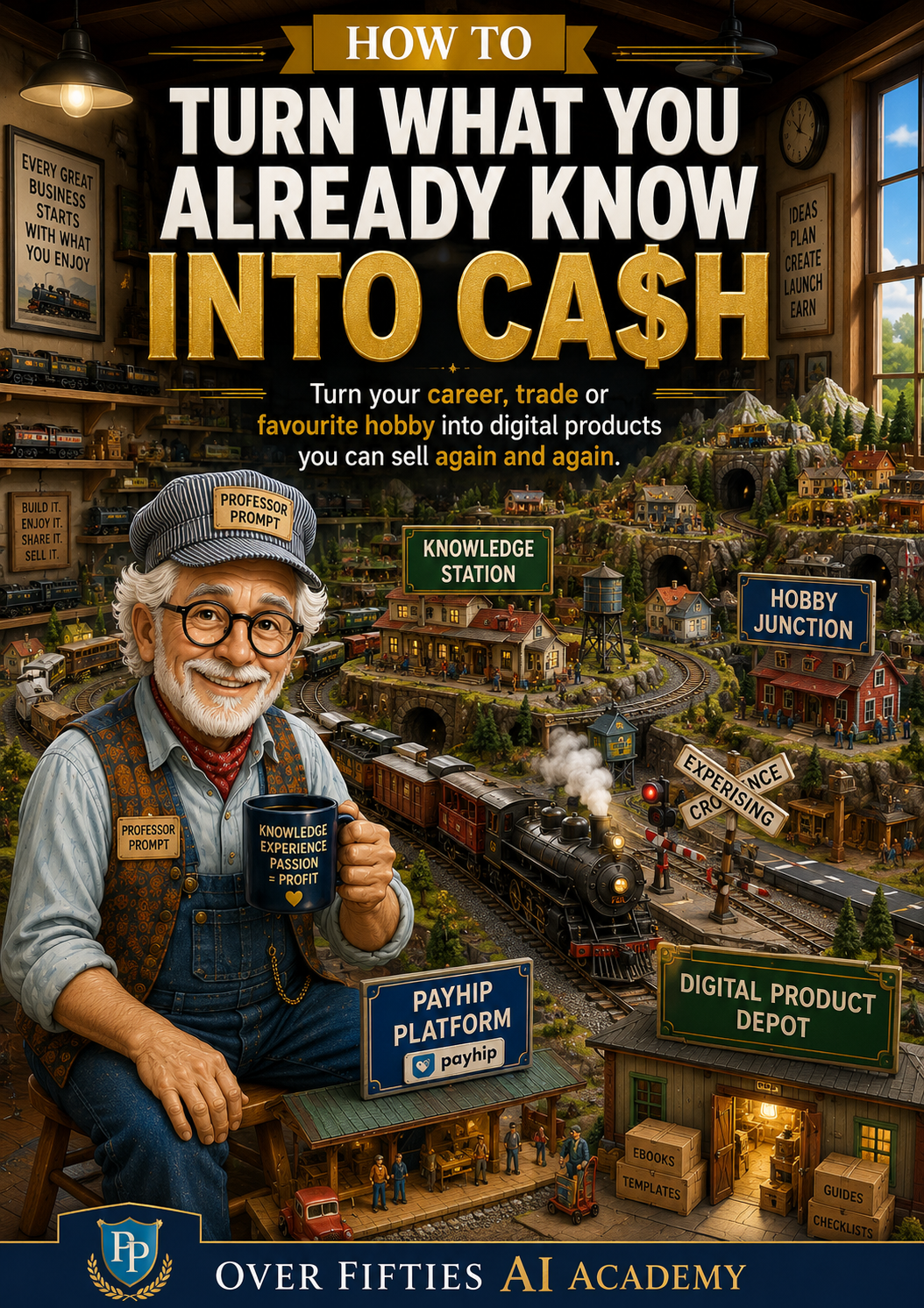
How to Turn What You Already Know Into Ca$H shows you how to take that experience, identify a useful niche, turn one subject into potential digital products and use AI to help you create them faster.
- You don't need to invent a revolutionary new business.
- You don't need to become an internet guru.
And you certainly don't need to know everything.
- Start with something you know.
- Find someone with a problem.
- Create something that helps solve it.
That's where your first digital product begins.