

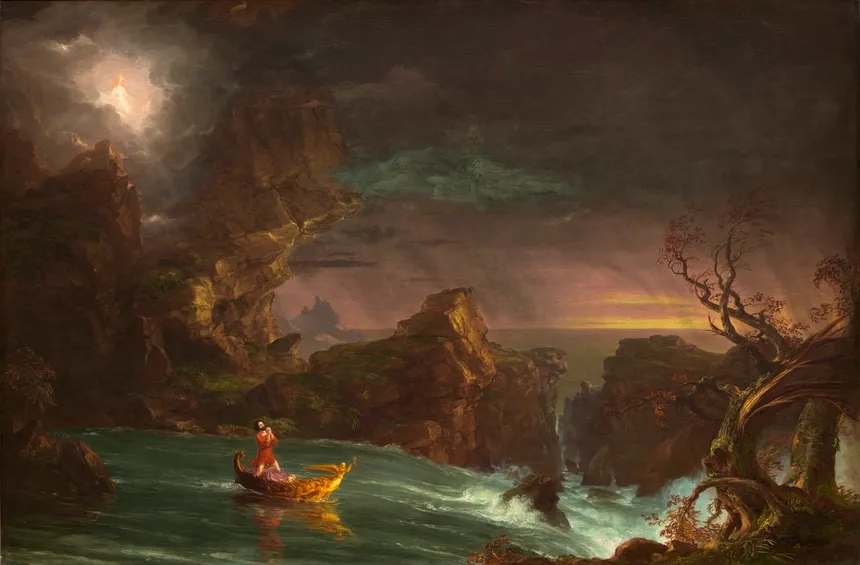
During the 19th Century, The United States of America experienced a fundamental shift from Colonial struggles to Arcadian prosperity. America had established itself as a leader in the Western world, had recently acquired over 800,000 square miles of land in the historic Louisiana Purchase, and was experiencing a rapidly booming economy and population. This swift growth in the 1800s brought many benefits, namely a rise of Western culture and art highlighted through popular depictions of Colonial territory and life. One name stands out whose artistic impact played a key role in the prolific art communities whose works are still deeply admired by modern critics and viewers. This man was Thomas Cole. He was an English migrant best known for his Romantic-style artwork driven by sweeping landscapes that incorporate realistic elements yet still highlight raw emotion and the beauty of nature. Cole also emphasized drawing the viewer to religious and spiritual meaning, in either an allegorical fashion or through the grandeur displayed on his canvases. This essay will explore how Thomas Cole used his artwork to display allegorical parallels between religion and secularism, specifically through the series A Voyage of Life and The Course of Empire.
Though Thomas Cole established himself as one of the greatest and most influential American artists in the 19th Century, he emerged from unlikely beginnings. Born in England, Cole migrated at the age of seventeen with his father to the United States. He initially worked as an engraver but took lessons from an itinerary artist and found a passion for sketching the wild American scenery surrounding him. Several of his works were sold to John Trumbull, a prominent artist of the American Revolution. Colonel Trumbull immediately recognized the raw talent imbued in Cole’s canvases and leveraged his influence to kickstart the young artist’s career. What made Cole’s landscapes so unique to the American art scene was that he captured both the inherent physical and spiritual beauty of nature alongside the wild, dangerous elements often ignored by contemporary landscape artists. As Cole grew in fame, he continued to communicate spiritual and religious truth based on his profound Christian convictions. He used a series format, in which allegories would bring the viewer to existential implications through four or five paintings. Two of his greatest series still admired today are The Voyage of Life and The Course of Empire, which serve as both an encouragement and warning to viewers of the results of choosing a God-fearing lifestyle or one marked by godless and humanistic depravity.
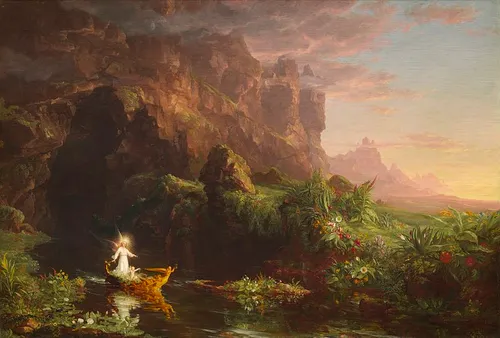
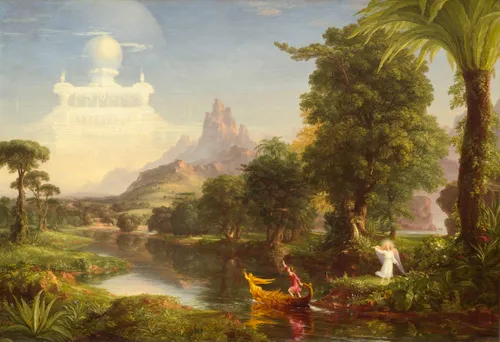
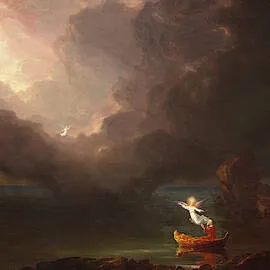
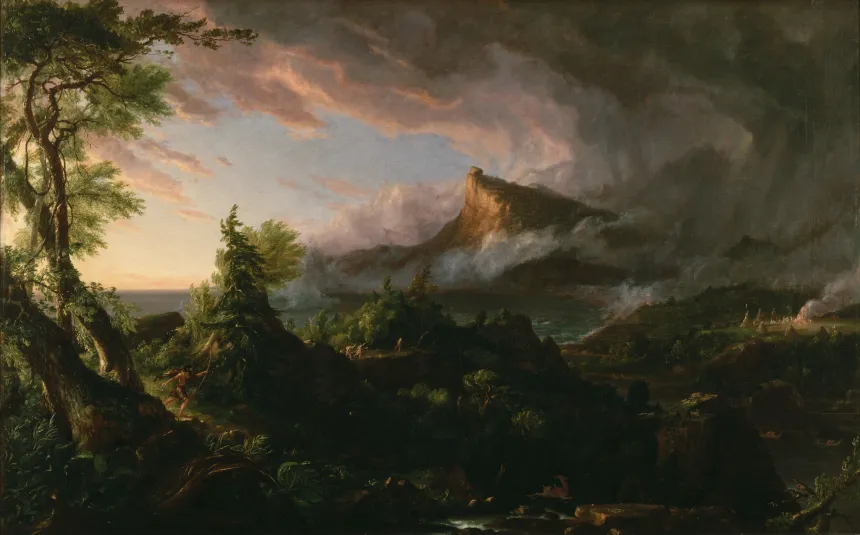
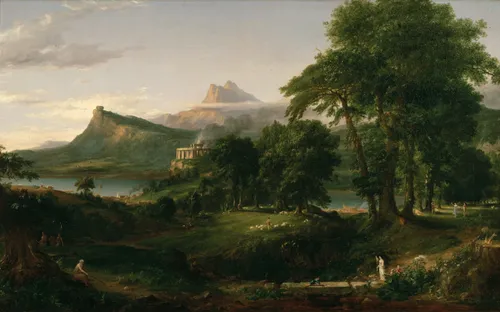
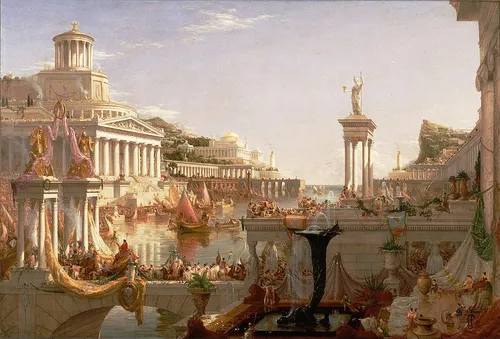
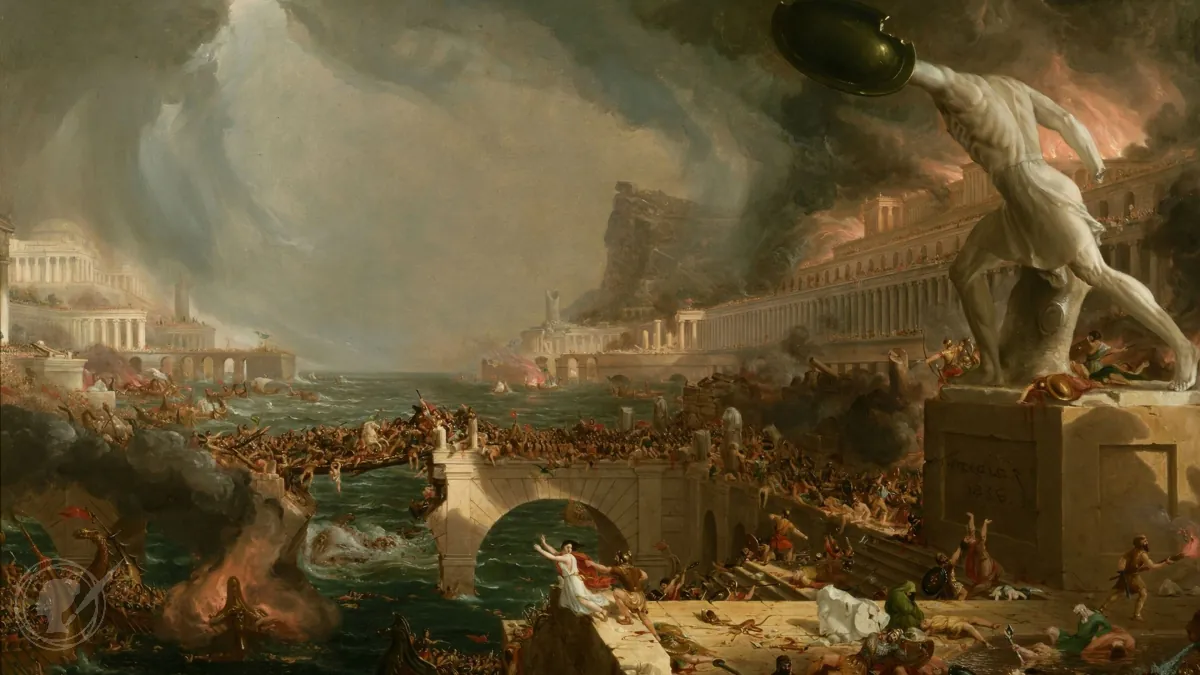
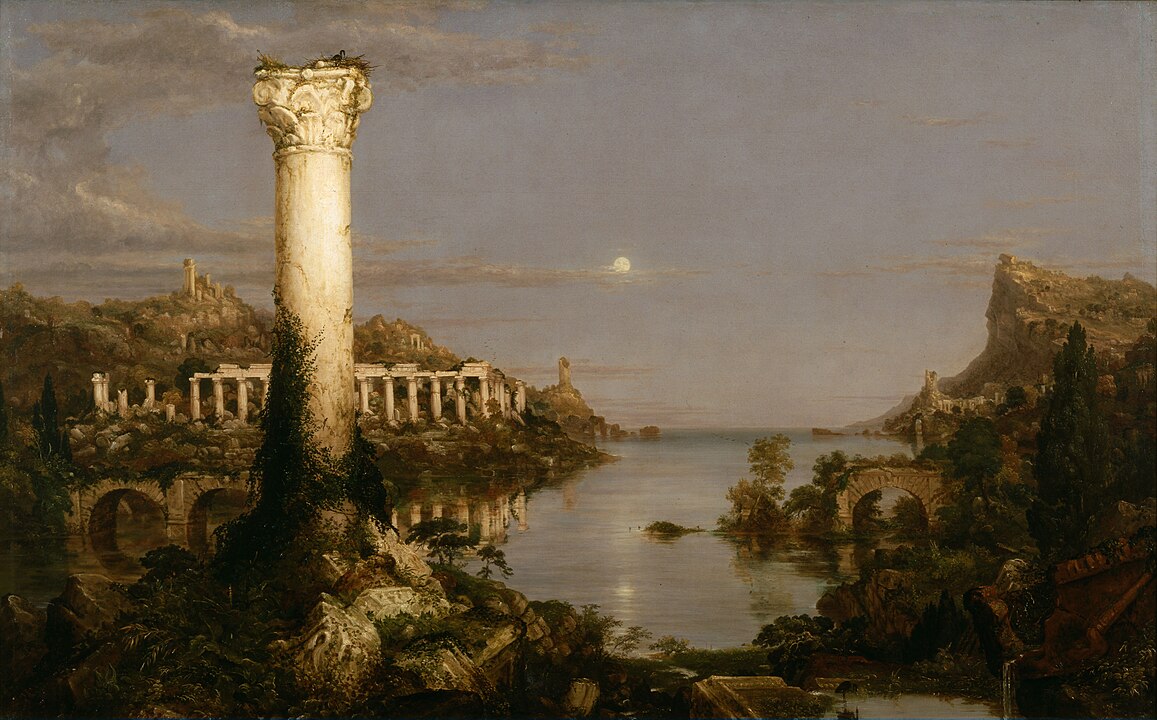
The Voyage of Life and The Course of Empire both strive to draw the viewer to religious meaning, in juxtaposed but parallel means. The Voyage of Life consists of four different paintings, telling the progressive story of the four stages of man’s life. The protagonist is depicted traveling in a small boat through a beautiful but treacherous wilderness reminiscent of territory Cole likely explored throughout his career. The unnamed man is accompanied in all four canvases by a mysterious guardian angel; even in the stormy seas and desperate struggle depicted in Manhood, the angel still presides over the man, silent yet still safeguarding his charge. After the climax reached in Manhood, the protagonist is shown in his old age. He is weathered but still steadfast in strength and is lifted to eternal peace accompanied by a host of celestial beings. The theological implications of this series are unmistakable: Thomas Cole illustrates that Christian life is no easy endeavor, but is rewarded with redemption and fulfillment of man’s intrinsic purpose. But with the hopeful heeding delivered by Cole through The Voyage of Life, he also delivers a foreboding warning through The Course of Empire. This series consists of five different canvases depicting the evolution of a godless and humanistic civilization. Beginning with The Savage State, Cole illustrates how a small Arcadian settlement, similar to developing American colonies, progresses into a wealthy but degenerate city shown in The Consummation. The grand, self-centered civilization is confronted in Destruction by superior adversaries and falls into the ruins depicted by the final canvas, Desolation. The spiritual conclusions implied by The Course of Empire are striking and blatant; a life or nation spent pursuing self-interest without the direction of a divine moral compass will eventually fall through their hubris.
Thomas Cole displayed striking contrasts as well as similarities in these two series. The chief difference displayed in the two collections is how the decisions of one’s lifetime influence their conclusion. The Voyage of Life and The Course of Empire both have protagonists; one is a physical man, and the other is a civilization that represents the central character. The man embarks on a treacherous voyage in which he risks his life to stay in the narrow river and realize his purpose, representative of a Christian man overcoming trials and striving to fulfill his God-given mission on Earth. His industry is rewarded with eternal life. On the other hand, the Empire decides to veer into debauchery and degeneracy, symbolic of the natural consequences of temporal atheism. The necessary result is the downfall of the prideful city depicted in Destruction. Thomas Cole communicates this idea perfectly through simultaneously inspiring but cautioning allegories that one must choose between long-term heavenly peace and short-term worldly pleasures.
In conclusion, Thomas Cole's artwork in the series A Voyage of Life and The Course of Empire portrays allegorical parallels between religion and secularism. With both series, the artist entices the viewer with stunning Romantic-stye landscapes coupled with the significant symbolism signature to the majority of his works. Thomas Cole accomplishes his goal of bringing hope to the atypical American settler striving to live a pious life, as well as gravely warning the nation of the dangers and inevitable downfall of secularism.
Thanks for reading my college essay ;)
Check out the full Voyage of Life and Course of Empires paintings here:
Voyage of Life:
The Course of Empires:
Comments ()