

South Africa’s township economy has always been resilient. It has survived exclusion, underinvestment, and structural inequality. But Covid-19 introduced a structural shock—one that erased jobs, destabilised household incomes, and damaged credit profiles at scale, pushing aspiring homeowners further outside the formal banking system.
At RB Property Group, we engage daily with township households who want to own homes, invest in stability, and build generational wealth—yet are labelled “unbankable” by traditional measures.
The data tells a powerful story.
Demand Is Not the Problem — Conversion Is
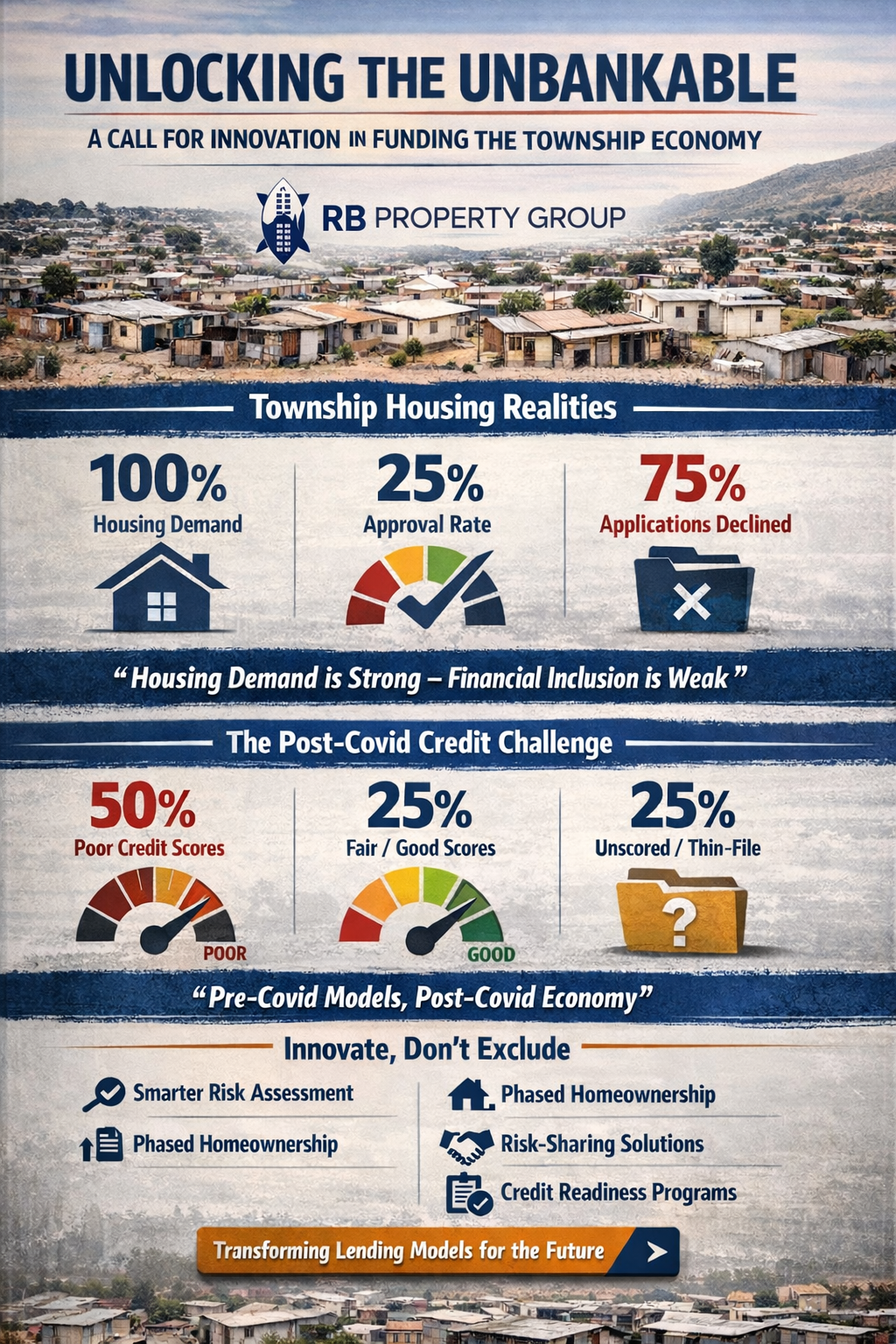
Recent township housing application data analysed by RB Property Group reveals:
- 100% of applicants expressed clear housing demand
- Yet only 25% converted from application to approved funding
- 75% of applicants were excluded, not due to lack of willingness, but due to affordability and credit constraints
This conversion gap highlights a critical truth:
Housing demand in township economies is strong — financial inclusion is weak.
The Credit Reality Post-Covid
Covid-19 job losses disproportionately affected township households employed in:
- Retail and services
- Construction and logistics
- Informal and hybrid income sectors
As incomes collapsed, households turned to short-term credit to survive. The result is visible today in credit data:
- 50% of applicants fall within a “Poor” credit score band
- Only 25% fall within Fair to Good bands, typically considered the minimum for bond eligibility
- The average applicant credit profile skews between Poor and Fair
- A further 25% are unscored or thin-file, often due to informal earnings
These are not reckless borrowers — they are economically active households whose credit profiles absorbed a systemic shock.
Why Traditional Lending Models Are Struggling
Banks are correct to prioritise:
- Capital protection
- Regulatory compliance
- Sound risk management
But the challenge is increasingly clear:
Pre-Covid credit models are being applied to a post-Covid township economy.
This mismatch produces:
- High rejection rates
- Low housing delivery conversion
- Underutilised housing demand
- Growing dependence on subsidies alone
In short, risk is being avoided — not managed differently.
A Bold, Responsible Challenge to the Banking Sector
RB Property Group is not calling for relaxed governance or reckless lending.
We are calling for measured, data-driven innovation that expands access without compromising risk discipline.
The question is no longer:
“Can banks fund the township market?”
The real question is:
“How can banks evolve their models to fund this market responsibly?”
Innovation Without Compromising Governance
Responsible innovation already exists within current regulatory frameworks — it simply needs to be activated.
1. Smarter Risk Assessment, Not Lower Standards
- Use rental payment history, municipal services, stokvel participation, and long-term location stability
- Combine traditional credit scoring with behavioural data
2. Phased or Stepped Homeownership
- Entry-level loan exposure
- Gradual credit scaling based on repayment performance
- Reduced default risk through controlled exposure growth
3. Risk-Sharing Structures
- Partial guarantees or first-loss participation by:
- Developers
- DFIs
- Insurers
- Government programmes
This preserves bank balance sheets while expanding access.
4. Credit Readiness Embedded in Housing Delivery
- Financial literacy and credit rehabilitation before bond application
- This directly improves:
- Conversion rates
- Portfolio performance
- Long-term sustainability
Why This Matters Beyond Banking
Homeownership is not just a loan product.
It is:
- Household stability
- Community investment
- Economic participation
- Reduced long-term state dependency
When 75% of willing buyers are excluded, the cost is absorbed elsewhere — socially, economically, and fiscally.
RB Property Group’s Position
The so-called unbankable market is not marginal.
It is:
- Large
- Growing
- Economically active
- And critical to South Africa’s future housing demand
The data is clear:
- Demand exists
- Payment behaviour can be built
- Risk can be managed — if models evolve
A Call to Leadership
The post-Covid economy requires:
- Shared risk
- Shared data
- Shared responsibility
RB Property Group stands ready to partner with financial institutions willing to:
- Pilot new funding models
- Test alternative data responsibly
- Improve conversion without increasing default risk
The future of inclusive housing finance will not be defined by avoidance —
it will be defined by innovation with discipline.